
 E-Paper



Sensex crashes 770 pts on slowing GDP growth
Investors lost around ₹2.55 lakh crore (in terms of market value) on Tuesday, the first day of trading after Friday; Monday was a holiday for the markets.

 Prefer HTon Google


India’s capital and currency markets reacted strongly to Gross Domestic Product (GDP) data released on Friday that put economic growth at a six-year low, and poor car sales data released over the weekend, with the benchmark BSE Sensex falling 2.06%, although some of the drop can also be attributed to faltering trade talks between the US and China and US factory output declining for the first time in three years.
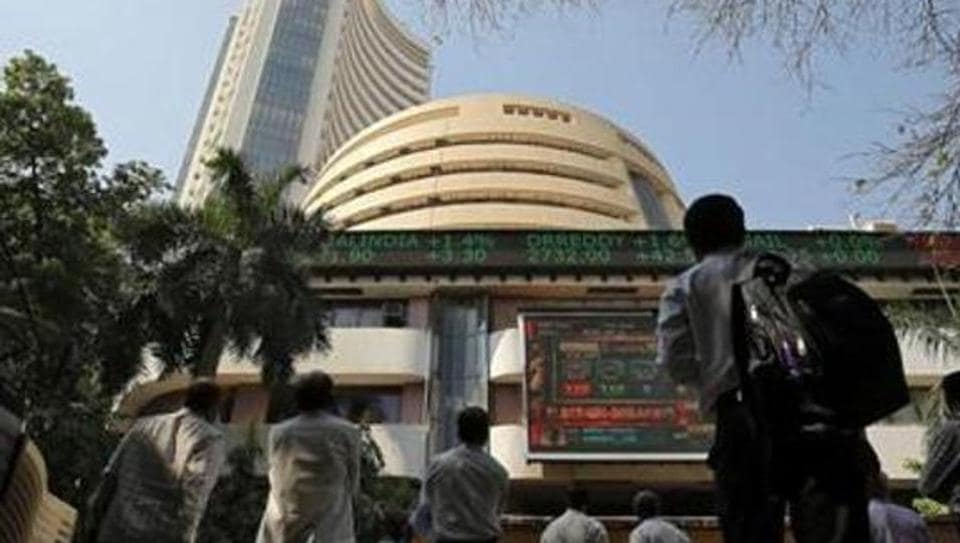
Investors lost around ₹2.55 lakh crore (in terms of market value) on Tuesday, the first day of trading after Friday; Monday was a holiday for the markets.
Sensex closed 769.88 points down. In percentage terms, the 2.06% fall is the highest since October 11, 2018 when the index fell 2.18%.
The Indian currency too fared badly, closing at ₹72.28 per dollar, the lowest since November, 2018.
The broader Nifty index of the National Stock Exchange fell around 2%. Thus far this year, the index has returned -.8% to investors, among the lowest across Asian markets.
“The benchmark Nifty 50 is likely to fall 10% over the next three months to 9,500-10,000 levels,” Marcellus Investment Managers’ founder Saurabh Mukherjea told Bloomberg Quint. “We expect the market to correct further towards a ‘fair valuation’. However, that does not give a reason to sound alarm bells as there are still opportunities for investors to make money every month,” he added.
While global factors played a part — the Dow Jones Industrial Average opened lower Tuesday and was trading at around 1.23% (325 points) down at 8.30 pm IST — domestic factors were largely responsible for the carnage in the markets.
On Friday, the Central Statistics Office said growth in the first quarter of 2019-2020 was 5%. The unexpectedly low number has caused several securities brokerages and investment banks to downgrade their growth forecast for the Indian economy for the current fiscal year.
According to media reports, projected GDP growth has been revised downwards by anywhere between 40 basis points and 100 basis points by most. One basis point is one hundredth of a percentage point. For instance, Nomura has revised its growth projection for the year to 6% from 6.5%.
“This data has shown that growth is much slower than we expected,” said Siddhartha Khemka, head of retail research at Motilal Oswal Securities, adding that the slowing private consumption was a major worry. “While the market is expecting the government to boost spending to revive demand, the economy is not giving much legroom to do that,” Khemka said.
The government, on August 23, announced measures to boost the economy, including making credit more easily available to companies, a roll-back on a tax on foreign portfolio investors that had roiled the markets since its announcement in the budget, and ways to revive demand in the stressed auto sector, although it stopped short of a full-fledged fiscal stimulus.
On Sunday, finance minister Nirmala Sitharaman said the government was trying to address the issues sectorally. “We are responding to industry requirements. Across the board there is no one particular answer that I can give, saying this is the magic wand,” she said at an event in Chennai.
Tuesday’s losses in the stock market were spread across sectors. Metals, energy and consumer durables suffered the most with losses to the tune of 3.2%, 3%, and 2.8% respectively. The BSE-Auto index lost 1.6%. Companies have reported a sharp decline in car sales in August as well.
Data available with the Centre for Monitoring Indian Economy (CMIE) shows that car sales have been declining for 13 consecutive months now. August reporting by companies suggests that it’ll extend to a 14th consecutive month.
“In the near term, weak domestic sentiments and uncertain global cues may continue to have a negative impact on the Indian markets. Hence, we continue to remain cautious until there are meaningful signs of revival in the economy,” Ajit Mishra, vice president, research, Religare Broking Ltd, told online business news website Moneycontrol.
The BSE-Bankex lost 2.4% with bank stocks reacting badly to Friday’s announcement of the merger of ten state-owned banks into four.
To be sure, the stock market has been facing headwinds for quite some time now. The BSE Sensex had reached an all-time high of 40,267 on 3 June, 2019. Sentiment worsened after the first budget of the newly elected government announced higher taxes on the so-called super rich and capital gains and stayed clear of announcing a stimulus for the economy. Between 4 July, 2019 (a day before the budget) and 3 September, 2019, the Sensex had lost 8.38% of its value.


