
 E-Paper



Why bonds are becoming the smart investment choice for Indian investors
Bonds offer the stability of deposits with better returns, which equities often lack.

 Prefer HTon Google


Most Indian households are familiar with stocks, gold, and fixed deposits. What often gets overlooked is the role of bonds in India. For years, bond investment in India has been seen as a backroom instrument, meant for banks and big institutions. Yet if you step back and look at today’s financial landscape, bonds in India might be the missing piece for ordinary investors who want stability without giving up on returns.
What are Bonds?
Bonds are promise-to-pay fixed-income instruments issued by the government or corporations to fund capital expansion, boost liquidity, or prepay debt. Types of bonds in India include government and corporate bonds, among others.
When you buy a bond, you are essentially lending money to a company or the government. In exchange, you receive regular interest at a predetermined interval and your capital back at maturity. Bonds are not volatile because, unlike stocks, you are not betting on quarterly earnings or market moods. You are relying on a promise to pay. That makes bonds less thrilling, but also less nerve-racking. Learning how to invest in bonds can help you unlock safe investments in India and diversify your portfolio.
Bonds are the Link Between Equities and FDs
Investing in India usually swings between two extremes. On one side are equities, which can multiply wealth but come with sleepless nights. On the other hand are FDs, which are safe but slow, often generating returns that do not keep pace with inflation.
Fixed-income investments in India, like bonds, sit comfortably in the middle. They tend to pay more than deposits, while sparing you the gut-wrenching swings of the stock market. Additionally, bonds in India also provide a secondary source of income, as they pay interest at regular intervals. They’re considered steady income investments.
Why Bonds Matter More in India Today
If you’ve tracked the Nifty50 over the past year, you know the story. Despite all the noise and daily rollercoaster, the index has yielded close to zero returns over the last 12 months. The journey, however, was anything but smooth; constant ups and downs left investors second-guessing their decisions. Even gold, which many Indians consider a safe bet, has delivered negative returns in some years of the past decade.
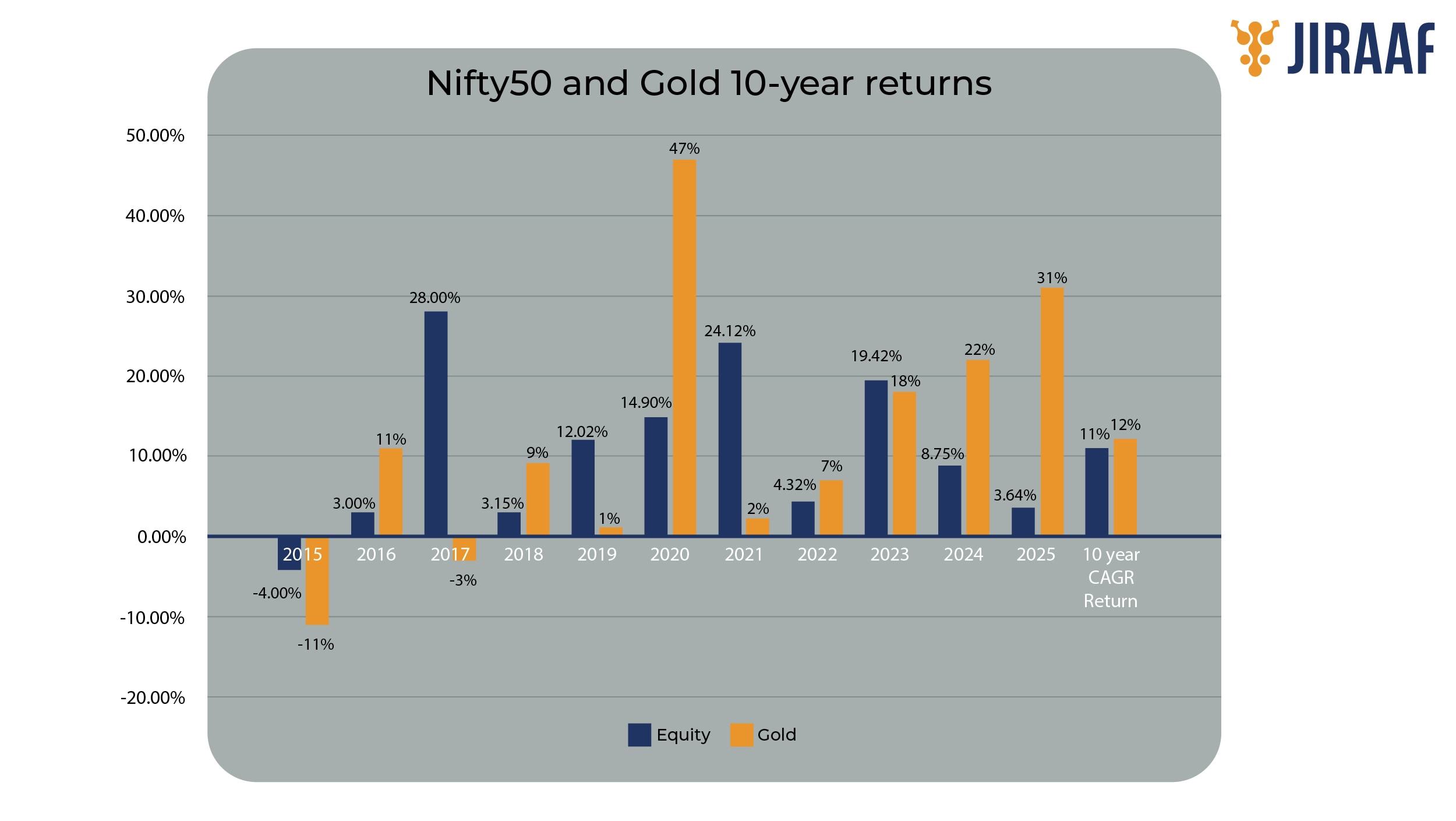
Both Gold and Equity have yielded negative returns over the past decade. This is where the best bonds for Indian investors start to shine. They offer predictability at a time when both traditional growth assets and traditional safe havens can falter. You know what bond yields in India to expect, and you know when your money will be returned. In a country where investors are increasingly looking for balance, bonds are stepping into the spotlight as a reliable inflation hedge investment.
An Inflation Hedge and Goal-based Fit
Inflation quietly eats into savings. A ₹1,000 FD growing at 6 percent doesn’t feel as comforting when inflation runs close to 6 or higher. Investment-grade bonds, which often offer yields of 8 to 14 percent, provide investors with a real cushion. Understanding debt mutual funds vs bonds also helps in strategizing for long-term goals.
They also work beautifully with specific goals. Think of saving for a child’s education due in five years or putting aside money for a home down payment. Equities can grow wealth, but may fall sharply just when you need the funds. FDs will protect the principal but may not grow it enough. Bonds, with their defined maturity and steady payouts, are better suited for such timelines, offering portfolio diversification for Indian investors.
A Portfolio Example
Take the case of a 35-year-old with ₹10 lakh to invest. The 100 minus age rule is a straightforward method for determining asset allocation: 65 percent in equities and 35 percent in debt. That means about ₹6.5 lakh in stocks and ₹3.5 lakh in fixed income.
If you're wondering how to invest in bonds as part of this allocation, here’s where diversification makes the difference. The debt slice should not be allocated to a single bond or issuer. Spread it across the bond market in India, including companies, maturities, and credit ratings. A mix of investment-grade corporate bonds, well-rated NBFC paper, and medium-term issues can give balance. With such a spread, the debt side can realistically target an average yield of 10-11 percent, with corporate bond returns contributing to steady portfolio growth.
Now compare the outcomes. Equities are essential for long-term growth but can leave you frustrated in sideways markets, as seen with the Nifty50 in the past year. Gold has had its down years, too. Bonds in India bring in steadiness. They ensure the portfolio grows, but without the constant drama of stocks or the unpredictability of commodities. Meanwhile, high-yield FDs can still serve as an emergency fund, providing liquidity and safety for unforeseen expenses.
The result is not a portfolio swinging wildly with every headline, but one that balances growth with calm through fixed income investments in India.
Opening the Doors for Everyday Investors
For a long time, the Indian bond market was a closed club. Institutional investors had easy access, while retail investors were left out. That picture is changing. Online Bond Platform Providers (OBPP) and tighter SEBI rules have brought transparency and smaller ticket sizes, making it possible for ordinary investors to participate. Learning how bonds work grants investors access to more safe investment options in India.
As Vineet Agarwal, co-founder of the investment platform Jiraaf, explains: “For too long, bonds were seen as the domain of institutions. At Jiraaf, we’re changing that by opening access for everyday investors. We believe everyone deserves the stability bonds in India provide, not just the big investors. By simplifying the experience and weaving bonds into everyday portfolio conversations, we are helping people secure income, diversify risk, and build confidence.”
The Road Ahead
The appeal of bonds is not about replacing equities or FDs. It is about striking the right balance. Equities continue to drive long-term wealth, and deposits still provide a sense of security. But bonds add a layer of stability, protect against inflation, and ensure that investors are not entirely at the mercy of volatile markets. Portfolio diversification through bond investment in India is a smart move for steady income investments and inflation hedge investments.
As retail participation grows and awareness deepens about how to invest in bonds, they are likely to move from the margins into the mainstream of Indian investing. For anyone looking to build a portfolio that lasts through market cycles, ignoring types of bonds in India, like government and corporate bonds, is no longer an option.


