
 E-Paper



Industrial production growth falls to 4-month low of 3.6% in Sept
India’s economy seemed to be sputtering, with latest industrial output data suggesting that factories are not producing goods and people are not buying at a pace fast enough to push growth.


India’s economy seemed to be sputtering, with latest industrial output data suggesting that factories are not producing goods and people are not buying at a pace fast enough to push growth.

Industrial output growth — the closest approximation to measure production activity among thousands of factories — fell to a four-month low of 3.6% in September — pulled down by a muted manufacturing and consumer non-durables sector.
Factory output, measured by the index of industrial production (IIP), had grown 6.2% in August and 2.6% in the same month of the previous year.
The manufacturing sector, which accounts for 75% of India’s industrial output, grew by a tepid 2.6% in September, compared to 2.7% in the year-ago period.
Consumer non-durables sector growth, a broad metric to measure sales and production of goods such as toothpastes, contracted 4.6% in September from a 1.3% growth in the same month of the previous year.
Capital goods output, a proxy to gauge investment activity, grew at 10.5% in September against a growth of 12.3% a year ago.
Business leaders expect investment and consumer spending to pick up in the coming months, buoyed by festival season shopping.
“We expect a pick-up in the third quarter. Data indicate that demand for products such as passenger cars and two-wheelers have been strong in the run-up to the festive season,” said Chandrajit Banerjee, director-general, Confederation of Indian Industry (CII) said.
“We expect a significant recovery in consumer demand in the second half on the back of lower interest rates. Investment demand is also picking up, as public sector projects are being implemented by the government,” Banerjee added.
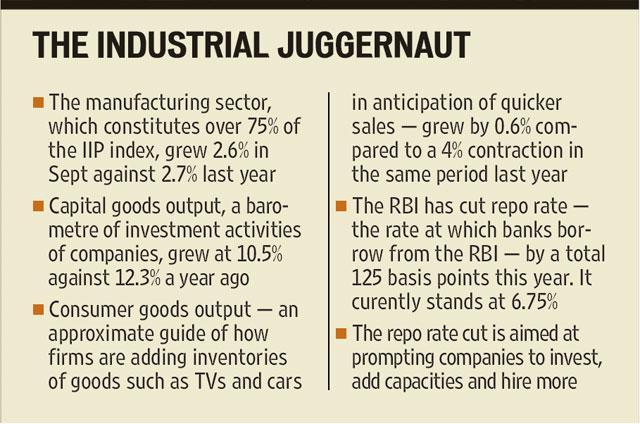
In September, the Reserve Bank of India (RBI) cut its key lending rate — the repo rate — by 0.50 percentage points to 6.75%, setting the stage for cheaper loans for consumers ahead of the festival season and more affordable bank capital for companies.
A lower repo brings down banks’ borrowing costs, which in turn, prompts them to slash “base rates”, the floor interest rate on which lending rates for final home, auto and corporate borrowers are fixed.
The repo rate cut is aimed at goading companies to invest, add capacities, hire more, and prompt people to spend on houses, cars and other goods, which mostly peak during the festival season in October-December.
A lower repo has also lowered some floating home loan rates, which move in tandem with base rates.
The impact of lower borrowing rates on festive season buying will reflect in shop-end data for November.


