E-Paper



Why Walmart Is Overhauling Its Approach to AI Agents
Walmart built so many AI agents, things started to get confusing. Now the retail giant is looking to simplify.


 Prefer HTon Google


Walmart is overhauling its AI agent strategy as it aims to simplify the user experience.
Agents refer to artificial intelligence tools that can independently take some action on behalf of a user, and Walmart in recent months has built dozens. Maybe too many, since they were typically accessed through different interfaces in different systems, and things were starting to get confusing for users.
Now the retail giant is taking a step back and consolidating all those agents into four discrete interfaces it calls “super agents.” One is for customers, one is for employees, one is for engineers, and one is for sellers and suppliers, the company said. The super agent for each group will tap the capabilities of a number of behind-the-scenes agents, all in a single unified experience.
The company plans to announce the changes Thursday.
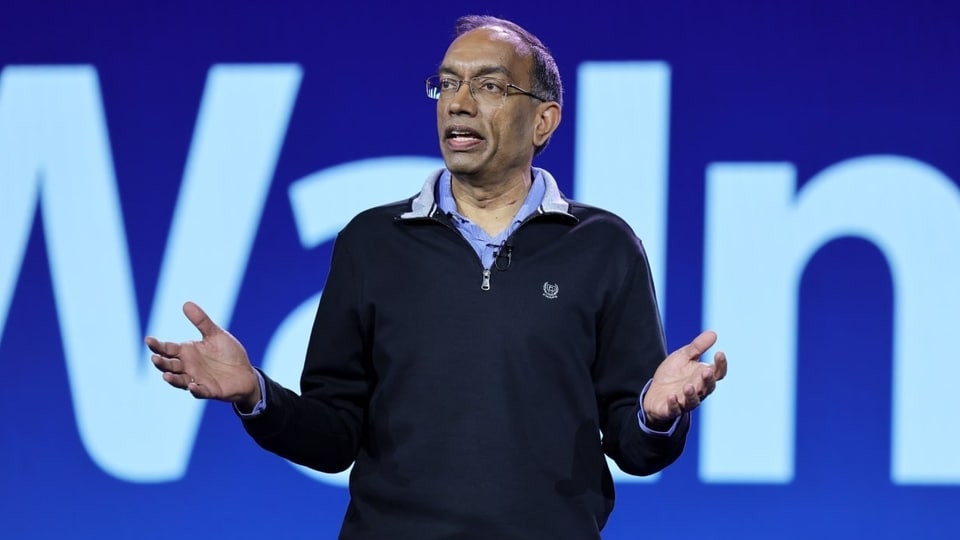
“It became very clear that we could dramatically simplify,” said Suresh Kumar, Walmart’s chief technology officer and chief development officer. “If I have an agent that helps you with your payroll and I have a different agent that helps you with identifying merchandising trends, you shouldn’t have to remember that and switch between those two.”
Kumar said the shift is a natural evolution based on the fact that the company found so many different use cases for AI agents. The technology has buy-in at all levels at Walmart, starting with the leadership at the very top, he said.
“Artificial intelligence is already changing how we work,” said Walmart Chief Executive Doug McMillon. “Learning and applying what we learn, as we build new tools, is the responsibility and an opportunity for all of us to improve experiences for our customers, members and fellow associates.”
Deepening its AI push, the company Wednesday said it hired Daniel Danker, an executive at Instacart, as the head of global AI acceleration, product and design, reporting to McMillon. The company said it also is recruiting an AI platforms leader that will report to Kumar.
John Furner, CEO of Walmart’s U.S. division, said it is critical to stay ahead of the technology curve in an area like retail, where the top 10 retailers can change dramatically decade to decade.
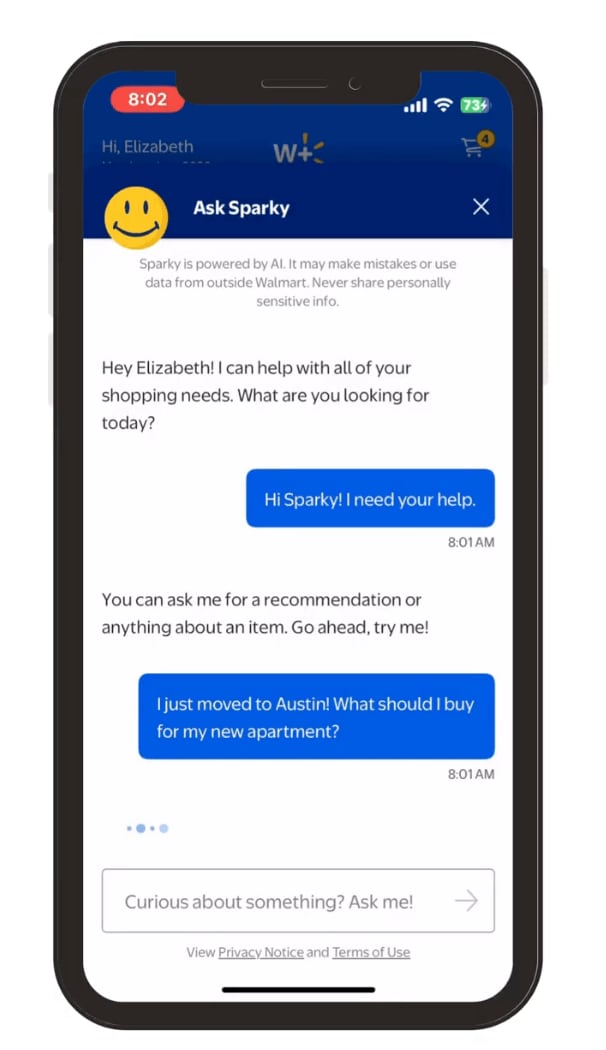
Walmart’s customer-facing super agent, Sparky, is live.
Furner said he believes AI agents will help deliver top-line growth, as they give customers more personalized and enticing shopping experiences, as well as bottom-line savings, where they can help manage supply chains and inventory more efficiently, among other areas.
Walmart’s situation is unique, with most companies still figuring out how to deploy even one AI-powered agent that can perform a task autonomously or in coordination with humans.
The four super agents are at different stages of development. The customer-facing super agent, Sparky, is already live, although it will continue to expand its capabilities from here.
Marty, the supplier-facing super agent, is expected to launch in the coming months, according to the company, and will ultimately include functions like checking the analytics on purchases and suggesting and putting into motion advertising campaigns.
The employee and engineering super agents are expected in the next year.
The employee agent will ultimately be able to take actions like checking in on an employee’s eligibility if they report losing their discount card, and then issuing a new one.
Walmart said it is connecting these various agents using an open-source standard known as Model Context Protocol, or MCP, which was introduced by AI company Anthropic in November. MCP enables the super agent interface to call other smaller agents as well as internal apps and data sources.
But when Walmart first started building agents, MCP wasn’t super widespread, Kumar said. Now the company is going back and making sure older agents conform with the standard, he added.
But the upshot is big, Kumar said. A simplified interface is likely to drive much more adoption of the tools, he added.
Having too many agents in too many disparate locations wasn’t very intuitive for users, Kumar said. “That’s what we’re trying to avoid.”
Write to Isabelle Bousquette at isabelle.bousquette@wsj.com