
 E-Paper



First day first show: The message in ‘MSG’- faithful indulgence
The world now has only two kinds of people. Those who have seen ‘MSG: The Messenger’, and those who have not seen ‘MSG: The Messenger’.

 Prefer HTon Google


The world now has only two kinds of people. Those who have seen ‘MSG: The Messenger’, and those who have not seen ‘MSG: The Messenger’.
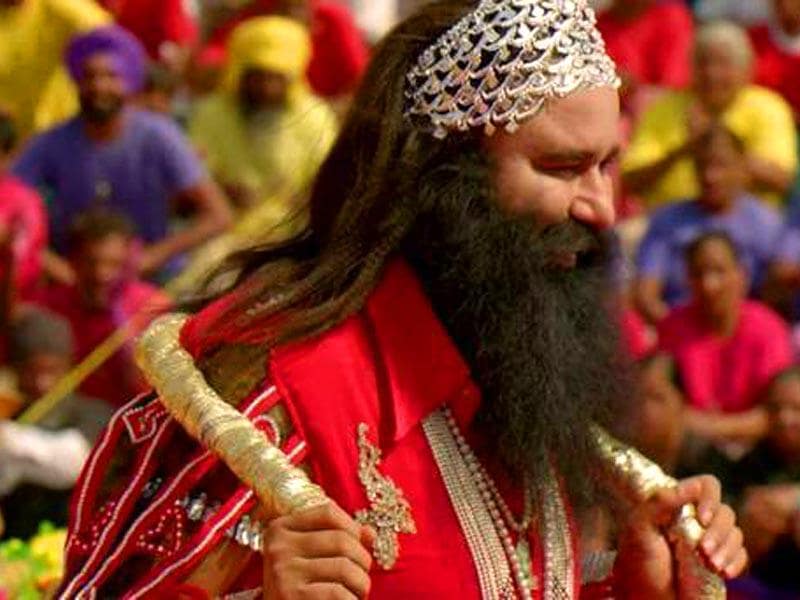
Nothing — no sense of humour, irony, bad taste, or even a regular watching of Sunny Deol, Salman Khan and Arnold Schwarzenegger’s movies for a month — can prepare you for the sheer epicosity of what can blandly be termed the big-screen debut of Dera Sacha Sauda chief Gurmeet Ram Rahim Singh. It doesn’t matter that it doesn’t make sense as a movie. A movie it’s not anyway.
As to what is it, it is hard to tell between two definitions. Is it a massive advertisement for the dera’s welfare activities packaged as movie that has the dera head as a superhero? Or, is it a massive display of vanity by the dera head in the garb of an awareness campaign? The answer lies in the realm of faith. And faith, as someone once said, is a deeply personal indulgence.
For believers, it’s a romp through and through. For non-believers who went through the 197-minute string of sales pitches — co-directed, written and so clearly packaged by the dera head himself — it is not much fun at the start. For 15 minutes at the beginning, ‘Pitaji’ or ‘Papa G’ or ‘Papa Rock’ overplays his non-existent humility, explaining, among other things, how the political establishment’s repeated requests made him take security. So much so, that the pleading politician has a band going ecstatic when ‘guru-ji’ agrees.
His favourite dialogue takes it further: “Koi humein sant kehta hai, koi kehta hai farishta, koi kehta hai guru, koi kehta hai bhagwaan; par hum toh hain, sirf ek Insan!” The insistence is that it is the people who call him God, while he considers himself a mere Insan, a human being. Don’t be misled. Can mere human beings cure AIDS? Or invent a sport, called ‘Gul-stick’, a cross between cricket, baseball and gulli-danda? Wear those clothes? Or, well, fly? He can.
In a plot that never seriously threatens to emerge, the character of the baddie carries a message. He is a druglord -cum-media magnate, who owns a channel with an amazingly self-aware name, ‘Chillam News’, and a logo that further leaves nothing to imagination!
Throughout the movie, though, there is the threat of numbers — he claims to have 5 crore followers — directed especially at journalists. In one such scene, when his followers are ready to kill the people who show the baba in bad light, it is only the baba’s benevolence that stops them. The message is clear: His followers can kill. (No wonder I couldn’t laugh at the hilarity in a hall filled with Insans, besides a handful of other creatures who became victims of curiousity.)
There is an exception for a foreign journalist (from Ukraine!), a ‘gori’ who pleads for, and gets, permission to make a documentary on the Spiritual Superman. This documentary angle gives him a chance to display the dera’s philanthropy — cleanliness campaigns, blood donation camps, prostitute rescue-rehab, free food, et al — even though his patriotic superpowers require the help of some oddly shaped vehicles and Japanese-cartoon-style special effects.
Spoiler: Walking on water is one thing; the Love Charger baba riding a Harley Davidson on the surface of a pool on a concert stage with dolphins jumping around is quite another. Does that, too, create social awareness? Nope. But if you’re looking for that, you are missing the point.


