
 E-Paper



The year of the pandemic: Punjab’s financial capital’s losses and recovery
The pandemic peaked in the district between July to September as the cumulative Covid tally and death toll touched 955 and 720, respectively

 Prefer HTon Google


The state’s financial and industrial capital, which once buzzed with activity, was brought to a standstill when it ranked among the worst pandemic-hit districts in Punjab soon after the first case was detected in March.

Despite the government imposing a nation-wide lockdown, the highly contagious novel virus took 103 days to cross the 1,000 mark, but it merely took 27 days to reach the 2,000 figure. Once lockdown restrictions were lifted, the virus infected a record 3,000 people in eight days. Come August, the district was raring to cross 10,000 cases.
The crisis peaked between July to September as the cumulative Covid tally and death toll touched 955 and 720, respectively. In late August and mid-September, Ludhiana accounted for 22% of all virus-related cases and 29.4% of deaths reported in Punjab.
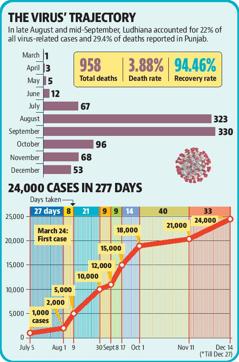
The district, which was once known as the industrial capital, earned the dubious distinction of being the Covid capital of the state, especially in July when shortage of ventilators and oxygen cylinders forced the health department on the back foot. On September 5, Ludhiana ranked among the top 15 cities in the country with a high Covid fatality rate. By the time December rolled around, the district had reported 24,000 infections and 958 deaths.
Even as fear and uncertainty gripped the public as they faced the deadly pathogen, the administration, police and health functionaries pulled out all stops to contain the contagion, with numerous frontline workers getting infected or succumbing in line of duty. The year, 2020, which began with the scare of the virus looming large, ends on a positive note with hopes of a vaccine being rolled out coming to fruition.
The health department is set to carry out a dry run of the vaccine on December 28 in Shaheed Bhagat Singh Nagar. The health department is also planning to hold the third sero-survey in the district to assess the public’s exposure to the deadly virus. The previous survey had indicated that Ludhiana, with 54.6% total positivity and 71.7% urban positivity, may have attained herd immunity.
Leaders cutting across the political spectrum, including cabinet minister Bharat Bhushan Ashu, Congress MLA Sanjay Talwar and SAD MLAs Manpreet Singh Ayali, Sharanjit Singh Dhillon, tested positive for the virus. Many top-ranking bureaucrats, cops and business men also caught the infection.
Anticipating an outbreak of the coronavirus that had already brought multiple countries to their knees, the administration started preparing teams in February and started preparing for all possible eventualities in March. The police, administration, civic body and health department also partook in a combined mock drill in Qila Mohalla and Raikot where volunteers were shifted to the hospital in an ambulance or quarantined. The videos of such mock drills were widely circulated with misinformation regarding a virus outbreak, which sparked paranoia and panic among the people. The rumours were so widespread that the health department had to address a press conference to dispel residents’ concerns.
On March 24, a 55-year-old social activist, who resided in Gurdev Nagar, became the first person to test positive for the virus. The health department contact traced all people who may have come in contact with her and asked them to get themselves tested. The confirmation of the first Covid case triggered panic in the district with private medical institutions drawing down their shutters and numerous doctors, mostly senior, going on mass leaves. Patients were left to the mercy of new recruits and nurses. Such was the apprehension that hospital staff, especially technicians, that they refused to work without personal protective equipment.
A top doctor, requesting anonymity, said, “We had a hard time explaining that even a face shield and proper precautions can prevent the virus from spreading.”
It was also rumoured that Dayanand Medical College and Hospital (DMC&H) principal Dr Sandeep Puri and a professor Dr Rajesh Mahajan had been isolated after they reported flu-like symptoms. Bonn Group MD Manjit Singh was also suspected to have been infected. Finally, the three parties had to dispel the rumours through a video message.
While doctors in government hospitals bravely continued to treat positive patients. Rural medical officers (RMOs) also joined the Covid warriors and served at Covid isolation facilities with limited PPE kits and face masks. Civil hospital was converted into a Covid hospital while OPD services were shifted to ESIC Hospital near Bharat Nagar Chowk. Air conditioners and washing machines were also installed in the wards after patients had complained of lack of facilities. Several government doctors remained in isolation for weeks and did not meet their families for over two months.
A 42-year-old woman became the first to succumb to the deadly virus. The Amarpura resident, who complained of severe cough and chest congestion, died on March 30 at Government Rajindra Hospital in Patiala. Following her death, many departments, both in the civil hospital and ESIC hospital, where the patient had undergone tests were closed and Amarpura became an impregnable fortress. The woman’s two sons, daughter and a few women who had come in her contact were quarantined.
Fear paralysed people to such an extent that the relatives of a 69- year-old woman of Shimlapuri, who had died at private hospital on Chandigarh Road after returning from Mohali, refused to claim and cremate her body. After much deliberation, the administration cremated the dead body on April 6 and also organised a bhog .
When assistant commissioner of police (ACP) Anil Kohli, 52, who had been posted on crowd control duty at New Sabzi Mandi succumbed to the virus, it sent shock waves through the state. The Covid warrior, who was taken ill on March 30 and died on April 18, a day after the death of Kanungo Gurmail Singh, who had also died of the virus. Soon district mandi officer (DMO) Jasvir Kaur and SHO Jodhewal Arshpreet Kaur also tested positive.
The health department, police and administration launched a major drive to isolate those who had attended the Tablighi Jamaat congregation in Delhi in March as many attendees had tested positive. Three men, two from Jagraon and one from Doraha tested positive and around 100 people were quarantined.
As many as 56 devotees, who were stranded in Nanded, Maharashtra, during the lockdown returned from Takht Sri Hazur Sahib on April 27. However, they were rushed to the civil hospital the very next day as some pilgrims had tested positive in other districts. The quarantined devotees raised the matter of poor quality of food at the isolation centres. On May 10, a 56-year-old Nanded returnee from Manuke village, Jagraon, succumbed to the coronavirus disease at the civil hospital.
With face masks, PPE kits and sanitisers flying off the shelf, these essential items began to be sold in black and many spurious products flooded the market. In May, doctors at the civil hospital also staged a protest against the substandard face masks and PPE kits. A month later, a team led by Zonal Licensing Authority (Drugs) Kulwinder Singh, seized 1,048 bottles of spurious sanitisers.
A 49-year-old head constable of the Railway Protection Force (RPF) lost his life while over 60 RPF personnel tested positive leading to the closure of the RPF office at the Ludhiana Railway station.
There was acute shortage of high-flow oxygen cylinders and ventilators in hospitals in July with around 100 patients approaching private hospitals. The death of a 49-year-old on July 24 due to non-availability of a ventilator bed in DMC&H led to a clamour for better facilities in hospitals. Sadly, his body could not be cremated for three days due to a long waiting list in the crematorium. Bursting at the seams, several hospitals such as DMC&H converted their auditorium into Covid case centres to accommodate patients. The government also converted meritorious schools near Nehru Rose Garden and mother and child hospital in Vardhman and several other institutions into isolation centres. At the beginning civil hospital was ill equipped to tackle serious patients of covid-19. They were being referred to Rajinder Government Hospital Patiala. The four ventilators that were allocated to civil hospital were being operted by CMC&H as there was not enough staff for monitoring the ventilators. However, things improved as civil hospital received 18 ventilators.
On September 15, Ludhiana reported the highest single-day spike of 438 new Covid cases and 19 deaths. While 323 people lost their lives to the virus in August, September logged 330 deaths.The case fatality rate (CRF) was also the highest in September at 4.3%. However, the percentage of recovered patients also increased with the district reporting a 90% recovery rate. There was decline in infections in October and November. A total of 97 deaths were reported in the month of October. However, the tally of positive cases crossed the 20,000-mark in October. Despite experts predicting a second wave of infections, the district did not witness a significant jump in winter.
The health department had warned against a second surge in December. Soon after, the government imposed night curfew. However, no such rise in Covid cases has been witnessed. Recently, state health minister Balbir Singh Sidhu said Covid vaccination will start in January.


