
 E-Paper



Wildbuzz: Siberian specks in a PGI sky
How about rare birds delivered at the proverbial doorstep of a householder? Yes, to none else but the Covid-19 curfew can be attributed the credit for an astounding


How about rare birds delivered at the proverbial doorstep of a householder? Yes, to none else but the Covid-19 curfew can be attributed the credit for an astounding avian sighting. Bird watchers cooped up in their balconies have maintained a hawkish eye on surrounding flora and the skies above while seeking to alleviate curfew boredom. One of them grabbed a fleeting opportunity to photograph the cryptic passage through our lives of rare Black storks from the Siberian Palearctic.
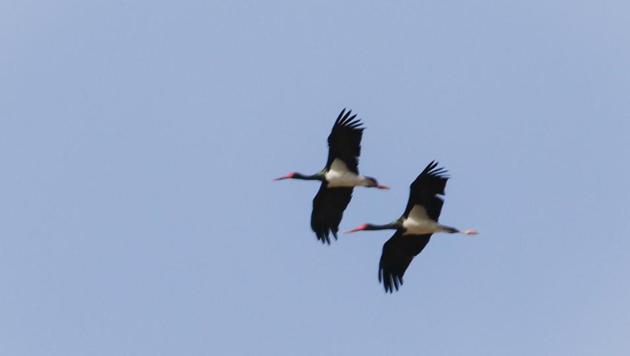
It so happened that Upendra Goswami was sipping evening tea in his balcony at Chandigarh’s Post Graduate Institute of Medical Education and Research (PGIMER) residential quarters last Sunday when he noticed four to five storks coming in from the city’s south-east and circling high above amid the soars of local Black kites. They were specks but his keen eye had gleaned a novelty. He fetched his long lens and captured the storks before they took a graceful glide to the north-west horizon where nestle Shivalik check dams.
Very few of these storks wintering in India halt in the tricity’s adjoining wetlands. They halt briefly before migrating to western/central India in early winter or while journeying back to Siberia as the Indian spring’s first sparks singe their Palearctic wings. Over the decades, the tricity’s well-heeled and fast-wheeled covey of birders has notched up less than a dozen sightings from Morni hills, Chakki Modh, Kaushalaya/Siswan dams etc. Goswami’s photographs are a first in that they capture a tricity flyover by these rare birds. His unique capture elevated Covid-19 balcony birding to an entirely different pursuit, distinct from the staple curfewed fare of native sunbirds, parakeets and hornbills photographed while making merry in our untended gardens!
Were Covid-19 not upon us like the most horrific of sci-fi nightmares, some birders would have ventured out of the tricity to birding hotspots and trudged knee deep through marshes. Photographers staying put at home would not have kept their eyes peeled outwards while sipping balcony tea, presumably in deference to the routine remonstrations of their better halves! So, there was a good chance that had normal times prevailed birders would have missed spotting the flyover of last Sunday’s storks over urban density.
To lend a life story to the fleeting black specks or put in another way, those blessed migrants not needing curfew passes to head home, I consulted Gopinathan Maheswaran, a scientist with the Zoological Survey of India. He authored a research paper, Black Stork Odyssey, with Czech ornithologists, Miroslav Bobek, Lubomir Peske and Frantisek Pojer. They assessed migration based on satellite tracking of storks under the project, New Odyssey. An assessment by other Indian ornithologists regards the species as “an uncommon, wary, winter and passage migrant to India” and sounds an alert: “The wintering population of storks in India reduced alarmingly.”
“The Black storks that visit India mostly come from Siberia and Mongolia. The storks that visit western/northern India come from Siberia while storks that visit eastern India come from Mongolia. I strongly believe that the storks that visit Chandigarh region should belong to the Siberian population, which breeds there in such regions as the Ob river,” Maheswaran told this writer.
I put to Maheswaran questions on possible routes storks take from the Chandigarh region, estimated distances they fly and days taken to reach Siberia. “If these storks sighted over Chandigarh follow the same route taken by storks earlier (as revealed through satellite telemetry studies), they might have crossed Pakistan, Afghanistan, part of South-west China, Kyrgyzstan, Kazakhstan, Turkmenistan and then to Siberia. These storks on an average travel 4,000-5,000 km one way and it takes roughly 15-20 days; it clearly shows that they stop in between and that is how a few storks were sighted in Chandigarh,” explained Maheswaran.
A perilous passage lies ahead for our storks, who passed us by like stoic, aerial marathoners on a Lindbergh odyssey. Satellite tracking revealed that storks were shotgunned while flying over or halting in Pakistan, POK and Afghanisthan. For example, a satellite-tagged stork christened, ‘Katerina’, was hunted in the Indus Valley near Nanga Parbat while on a brief halt after having flown over the mighty Karakorams, ‘Petr’ was likely shot in the Afghan Hindukush and ‘Altynai’ on the Indus river.
vjswild1@gmail.com


