
 E-Paper



Air quality goes from poor to very poor in Chandigarh on Diwali
But crackers are not to blame. Stubble burning, humidity in the air and lack of winds are major contributors, say pollution panel and weatherman


Air quality this Diwali was the poorest in the past three years, according to data available with Chandigarh Pollution Control Committee (CPCC).
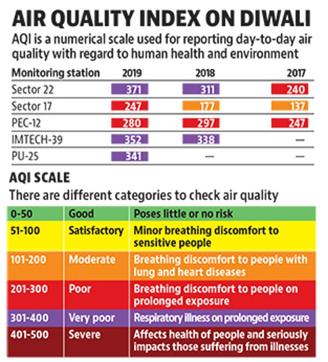
The air quality index (AQI) reached as high as 372 at the monitoring station in Sector 22, entering the “very poor” bracket. In layman terms, prolonged exposure to such air can lead to respiratory illnesses. However, noise pollution largely remained unchanged in the city as compared to 2018.
AQI is a numerical scale used for reporting day-to-day air quality with regard to human health and the environment.
According to CPCC data, at all five monitoring stations — at Sector 17, Sector 22, IMTECH in Sector 39, PEC in Sector 12 and PU in Sector 25 — AQI readings were above 200, placing it in the “poor” bracket. The poorest air quality was recorded at Sector 22 and IMTECH, where AQI surpassed 350.
“Air quality has been deteriorating after Diwali celebrations, but it is not only due to firecrackers,” said CPCC vice-president Debendra Dalai. “Since noise pollution levels didn’t stray beyond the permissible limits, the quantity of crackers burst in the city actually went down.”
Highlighting major reasons behind this spike, he said: “Stubble burning, humidity in the air and lack of winds are to be blamed while crackers made only a small contribution. There is humidity in the air making it difficult to disperse the pollutants.”
CPCC member secretary TC Nautiyal said it is a cause of concern that respirable suspended particulate matter (RSPM) levels have gone up in the city.
The highest levels of RSPM were recorded in Sector 22. While RSPM 2.5 stood at 212, RSPM 10 was recorded at 280, three times higher than that measured on an average day.
“RSPM are the most dangerous as these are easily absorbed in the bloodstream,” said Nautiyal.
AQI to stay high the whole week
Speaking about how much time it will take for the air to clear, India Meteorological Department (IMD) director Surender Paul said, “No weather disturbances are present in the region, so air quality is expected to stay poor at least till the end of the week. High humidity and inversion of temperature are the main factors behind this rise in AQI. Around November 1, winds around 30 km/h are expected to blow, which will disperse the pollutants.”
AQI was poor even on Diwali eve, when it hit 237 at the Central Pollution Control Board (CPCB)’s monitoring station in Sector 25, the highest this year. However, after Diwali, this station, which is the only one in the city that measures AQI in real time, didn’t register as much a spike as the other centres, and peaked at 272. On Monday, it stood around 250.
Noise pollution remained low
According to the CPCC, this Diwali remained quieter than past ones. Readings were taken every hour at four monitoring stations in the city — Sector 22, Sector 17, IMTECH and PEC.
At Sector 17, higher levels as compared to last year were detected between 6pm and 8pm and 10pm and 12am on Sunday.
Apart from Sector 17, the only centre where higher levels were recorded was at Sector 22, between 6pm and 7pm.


