
 E-Paper



‘Conflict of interest’ new challenge for Karnataka Cabinet
Though it remains a common feature in the Cabinets--state and union--, public officials and others, the glaring possibility of any conflict of interest is overlooked, activists and constitutional experts said.


After dissent over portfolios within the party, eyebrows are now being raised over portfolios of few ministers which attract conflict of interest. While the Bharatiya Janata Party (BJP) and its national leaders have taken into consideration aspects like regional and social representation in the Cabinet, the possibility of a conflict of interest doesn’t appear to have been their top priority.
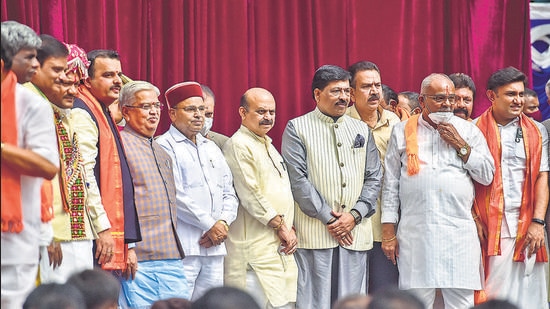
Murugesh Nirani, who heads the business conglomerate MRN Group, was named the minister for large and medium industries in Karnataka as part of the new Cabinet, while
Anand Singh, the former mining baron, who has over dozen cases lodged for violating the Forest Act, has been demanding that he be given the forest portfolio which he was entrusted with in the BS Yediyurappa Cabinet.
“This is my family-run agriculture and agro-based industries. I don’t hold any office or position in these industries. I am a full time public servant,” Nirani told Hindustan Times in a statement on Sunday.
He added that it was the prerogative of the chief minister who chose to give these portfolios after “due diligence and thorough thought”. Nirani said that he had already established these industries before his electoral debut in 2004 and served in the same portfolio under three different chief ministers between 2008-2013.
“For (the) past few years, I am nowhere directly or indirectly related or holding any position or office in any of businesses or industries. I am (a) full time public servant. My family members look after the industries. The industries, which are family-run has nothing to do with the current portfolio I am in-charge,” the minister clarified.
N Nagaraju (MTB), one of India’s richest legislators who has a real-estate empire, owning and renting large buildings and a host of other businesses, is Karnataka’s minister for Municipal Administration, Small Scale and Public Sector Industries.
He has been demanding to get the housing portfolio, which he handled during the HD Kumaraswamy-led coalition government in 2018.
Nagaraj and Anand Singh could not be reached for comment.
Transparency International defines conflict of interest as “confronted between choosing between the duties and demands of their position and their own private interests.”
Though it remains a common feature in the Cabinets--state and union--, public officials and others, the glaring possibility of any conflict of interest is overlooked, activists and constitutional experts said.
In February 2015, E.M. Sudarsana Natchiappan, a former member of Parliament from Sivaganga in Tamil Nadu, introduced for the second time The Prevention and Management of Conflict of Interest Bill, only for it to get lost in the duel between the ruling and Opposition banters and deafening voices.
Natchiappan told Hindustan Times on Sunday that the reason for bringing up such a bill was that senior IAS officers and others who join large corporations soon after the “cooling period” in plum posts were unethical as it endangers the interests of the country for corporations.
He said that when officials and politicians work out of such conflict, “they are not working for the country, but their own individual interests.”
The possible cases for conflict of interest, however, is not limited to Karnataka as several politicians are known to operate big businesses, educational and medical institutions. And this has been the case for decades.
Former power secretary P Abraham, who was heading the ministry of environment and forest (MoEF) expert appraisal committee (EAC) on river valley and hydropower projects was alleged to be on the board of at least half a dozen power companies, citing a clear conflict of interest, Hindustan Times had reported on June 17, 2009.
Disgraced liquor baron and former member of the Rajya Sabha, Vijay Mallya, was a member of the standing committee on fertilizers despite the fact that his own UB Group had a sizeable stake in a fertilizer company.
Shyama Charan Gupta, who owns the over ₹350-crore Shyam Group of Industries which includes the popular Shyam Bidi works was on the Central committee to enforce bigger pictorial warnings on cigarette packets.
Professor Ravi Kumar Varma, former advocate general of Karnataka and a constitutional expert told Hindustan Times on Sunday that there is an increasing trend in India where democratic processes are “hijacked” by vested interests.
“It is a clear indication that vested interests are able to hijack the entire democratic process which are supposed to work against such interests,” he said.


