
 E-Paper



Traffic police start process to decongest city roads, hire external agency to collect data
Gowda said that the police have also tasked a private agency to study the junction, changes and its impact for which data is being collected and the same will be used to implement long-term changes.


With an aim to decongest the city roads, the Bengaluru police on Friday began its experiment in trying to reduce traffic near Hebbal junction in the northern part of the India’s IT capital.
“For the first day’s experience (especially) during morning peak hours, the results were positive. We will be studying the traffic pattern for another 15 days,” joint commissioner of police (traffic) for Bengaluru, BR Ravikanthe Gowda said on Friday.
The police said the measures taken were ‘short-term’ as they managed to avoid criss-crossing of vehicles from the service lane into the main flyover towards the city from Bengaluru International Airport. The police said that vehicles moved with more ease on Friday compared to the long traffic snarls that has become a common sight on the Hebbal flyover.
Gowda said that the police have also tasked a private agency to study the junction, changes and its impact for which data is being collected and the same will be used to implement long-term changes.
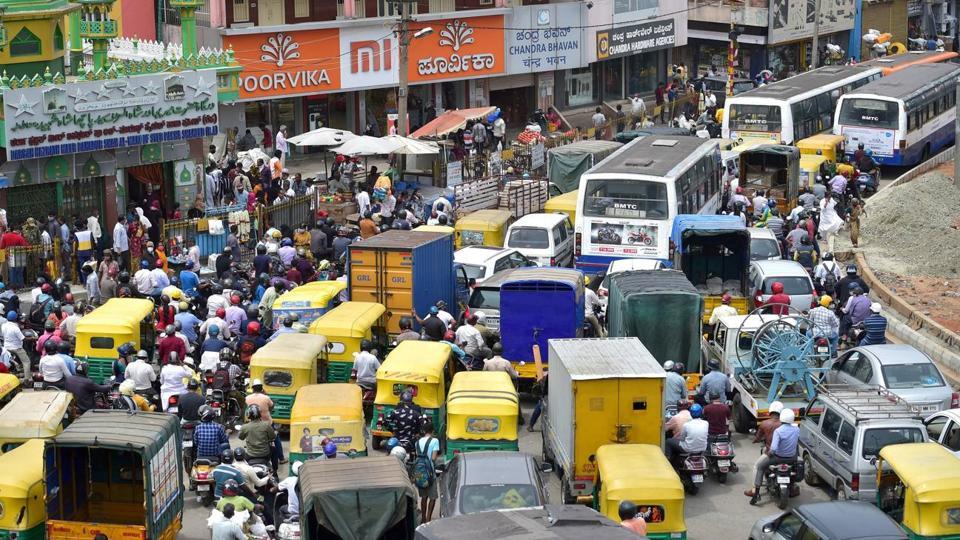
Bengaluru, a city that is known globally for its prowess in technology, startups, aerospace and other sectors, is also synonymous with traffic snarls as over 10 million vehicles occupy the narrow and unplanned road network in the 800 square kms area.
According to the government data, the number of vehicles in Bengaluru has increased from 50.33 lakh in 2011-12 to 1.04 crore till March 2022. Of the total vehicles registered in the city, more than 69.31 lakh are two-wheelers and 21.97 lakh are cars, according to a report in The Hindu.
According to the city traffic police department, of the total vehicle density, two-wheelers account for 70% of all vehicles, 15% are cars, 4% are auto rickshaws and the remaining are buses, vans and tempos.
With metro and suburban rail networks delayed and lower occupancy on buses, the number of cars and two-wheelers have seen an exponential increase.
The Covid-19 pandemic has also instilled fear of public transport as more people choose private vehicles to avoid contracting the virus. The commuters in Bengaluru lost over 110 hours of time per year caught in traffic jams, according to a 2021 report by Netherlands-based TomTom.
In addition to the increasing number of vehicles on the roads, unplanned civic infrastructure with poor quality of roads laden with potholes, lack of planning and vision, lack of green corridors and excessive dependence on private transport are among the other factors adding to the traffic jams in Bengaluru, experts say.
Constant digging of roads in the guise of “developmental works” by multiple civic agencies has not helped either.
Previously, chief minister Basavaraj Bommai had directed his administration to ease the traffic in at least 10 choked junctions of the city. Bommai has also made easing traffic in Bengaluru a priority ahead of the Bruhat Bengaluru Mahanagara Palike (BBMP) elections, which is likely to be held later this year.
“Usually, in cities around the world, when a major infrastructure project is carried out, a lot of attention is given to the likely disturbances in the neighbourhoods around the project, and a workaround for driving as well as walking is created. But not in Bengaluru. Why?” Ashwin Mahesh, an urban planner, asked on Twitter.
“Perhaps since driving and walking were not possible in a sane way even before a project is begun. BBMP feels that there is no need for one during construction either. It was a pain to begin with, and it’s just another kind of pain now. People will endure, as we always have,” he added.
The Bengaluru city administration is deliberating over several solutions like automatic signalling, studying traffic movement at junctions and other technical interventions which it believes would help reduce the congestion in India’s IT capital. This includes trying to channel CSR (corporate social responsibility) by private companies to partner with various government agencies like traffic, city corporation and department of urban land transport among others, officials in the know of development said.
Automatic signalling, signal-free corridors and other ‘solutions’ have been tried in Bengaluru before also but have barely made any impact on the ground as the travel time has nearly doubled compared to a decade ago.
Gowda said that the short-term solution used in Hebbal cannot be used in other junctions as each locality faces challenges that are unique. “Different junctions require different treatment altogether as the same treatment may not work in other places,” Gowda said.


