
 E-Paper



200 inmates running drug racket from jails shifted to Bathinda’s ‘dead zone’
Authorities have shifted 200 inmates lodged in prisons across Punjab to Bathinda Central Jail, a “dead zone” where there is no signal to operate mobile phones.


Chandigarh
Struggling to curb drug smuggling rackets being run from jails, authorities have shifted 200 inmates lodged in prisons across Punjab to Bathinda Central Jail, a “dead zone” where there is no signal to operate mobile phones.
The experiment, planned by the Punjab Police special task force (STF) against drugs, has already been implemented. Inmates who are involved in drug smuggling have been shifted to the Bathinda jail’s special cells, an official familiar with the development said.
These smugglers have been lodged in “dead zone” where there is no mobile connectivity within a 2km radius. All communication from the jail by the staff or prisoners (facility available at a fixed time) is being done via landline, said another official.
The STF has done an extensive technical intelligence-based study to identify these smugglers who were running drug rackets, including bringing consignments from across the border, from jails in Punjab, said an official. A senior STF official said that it is easy for hardened criminals, gangsters and smugglers to run rackets from ordinary prisons due to easy availability of mobile phones. Moreover, the jammers installed in these prisons are not effective, he added.
Bathinda Central Jail is the only prison in the state which has been made the “dead zone”.
STF chief and special DGP Kuldeep Singh said smugglers who are repeated offenders have been lodged in special cells of the Bathinda jail after detailed analysis of their past records and intelligence inputs.
“As these smugglers were involved in the supply chain right from receiving or bringing drugs from Pakistan to running the supply networks in Punjab, the experiment of lodging them in the dead zone of Bathinda jail has so far remained successful. Our inputs are pointing towards decrease in the availability of heroin in the market and increase in its prices because of lower availability,” he claimed.
The timing of shifting of drug smugglers to the Bathinda jail holds significance as a large cache of drugs, mostly heroin, are pushed into the Indian territory from Pakistan when the rivers are flooded.
The main riverine routes used by smugglers are the Sutlej — which criss-crosses between Pakistan and Punjab in Ferozepur seven times — and Ravi, which flows along the Indo-Pak border for 80km before entering Pakistan. In monsoon, flooded rivers make it easy for smugglers to pump in heroin using their conduits sitting across the border.
According to the Border Security Force (BSF), smugglers hire divers to navigate the riverine area in Ferozepur, Gurdaspur and Amritsar sectors to smuggle drugs into the Indian territory.
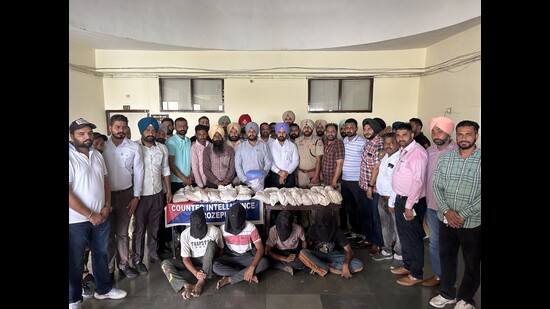
In August last year, the counter-intelligence wing, Ferozepur, nabbed four smugglers in separate cross-border smuggling rackets while they were trafficking 77.8kg of heroin (41.8Kg+36Kg) from Pakistan from the river route. According to police, the accused first crossed to Pakistan and stayed there for a few days and brought heroin consignment in tyre tubes when Sutlej was flooded.
Seizures and arrests
Punjab Police have arrested nearly 350 big fish between March 2023 and July this year who were involved in commercial drug trade by seizing a record 13,86kg of heroin.
“Heroin smuggling is a lucrative business and even if you lodge a big fish in the jail, he manages to run the racket using mobile phone. Lodging them in dead zones is the only alternative before us in such a scenario. Only arresting the big fish is of no use till we break their network,” a senior superintendent of police posted in the Malwa belt said.


