
 E-Paper



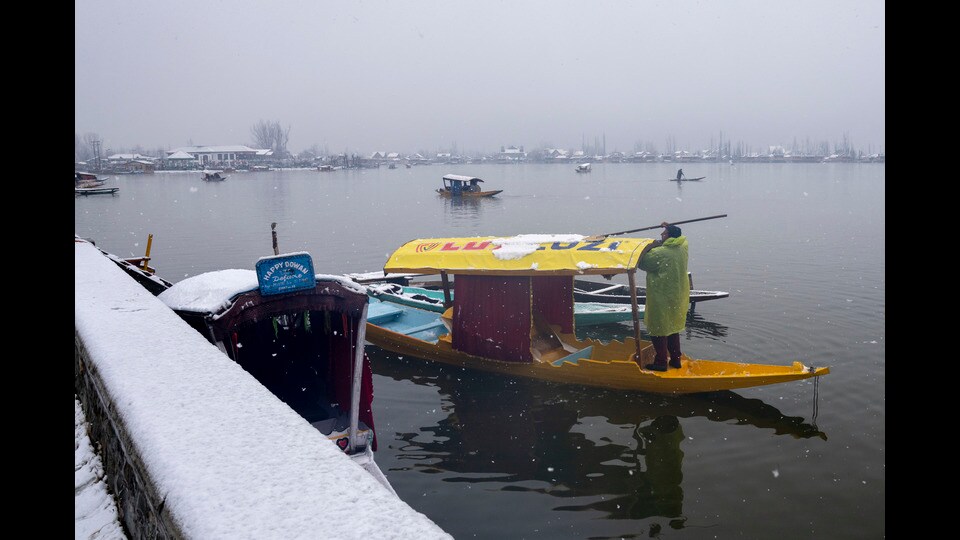
After days of rains and snow, weather improves in Kashmir
The weather improved across Jammu and Kashmir on Wednesday after three days of incessant rains and snowfall. While Srinagar-Jammu National Highway was partially restored for a couple of hours after two days to allow single way traffic of vehicles stranded between Nashree and Banihal, it was blocked again due to shooting stones.

 Prefer HTon Google


The weather improved across Jammu and Kashmir on Wednesday after three days of incessant rains and snowfall. While Srinagar-Jammu National Highway was partially restored for a couple of hours after two days to allow single way traffic of vehicles stranded between Nashree and Banihal, it was blocked again due to shooting stones.
“The Jammu-Srinagar NHW (NH-44) blocked due to landslide at Kishtwari Pather and due to shooting stones at Mehad- Cafeteria, Rampari, Gangroo, Chamalwass etc. People are advised to avoid journeys on the NH-44 till the road is clear,” the traffic police said in an update at 3.40 pm.
Meanwhile, the day temperatures improved as there was bright sunshine in many parts of the Valley including summer capital Srinagar after three days of precipitation.
“The weather improved at many places with intermittent light rain/snow at isolated places,” said Mukhtar Ahmad, director of J&K meteorological centre in Srinagar.
The MeT informed that among the weather monitoring stations of J&K, a cumulative snowfall of 130 cm or 50 inches was recorded in the ski resort of Gulmarg in north Kashmir between February 18 and 21 followed by 50 cm or 20 inches in the southern tourist resort of Pahalgam.
The highest accumulated rainfall of 215 mm was measured in Banihal in Ramban district followed by 148 mm in Kashmir’s Gulmarg and 141 mm in Qazigund, the gateway into Kashmir in the south. The summer capital Srinagar recorded about 60 mm of rainfall in these four days while there was 16 mm rainfall in winter capital Jammu.
Owing to the accumulation of snowfall over the slopes, the J&K disaster management authority (J&KDMA) issued a fresh avalanche warning for the 10 districts of the union territory.
While a low danger level avalanche warning was issued for Anantnag and Kulgam districts, the medium level avalanche warning was issued for the districts of Bandipora and Baramulla districts in the next 24 hours.
“Further, avalanches with high danger level are likely to occur above 2,200 metres over Doda, Kishtwar, Poonch, Ramban, Kupwara and Ganderbal districts in the next 24 hours,” it said in an advisory and urged people living in these areas to take precautions and avoid venturing in the avalanche prone areas
The MeT predicted no major wet spell till February 26. “No significant weather activity till February 26. Light to moderate rain/snow at scattered to fairly widespread places expected between February 27 and 29,” Ahmad said.
The MeT issued an advisory saying there were chances of landslides in view of the heavy to very heavy snowfall over a few middle and higher reaches. “General public over hilly areas are advised not to venture in avalanche prone areas and sloppy areas. There are chances of landslides/mudslides and shooting stones at few places,” the MeT advisory said.
The minimum temperature during the night was recorded at zero degree Celsius in summer capital Srinagar and gateway to Kashmir, Qazigund on the intervening night of Tuesday and Wednesday. “Gulmarg was the coldest at -9.4 degree Celsius during the night,” a MeT official said.


