
 E-Paper



After stern HC deadline, police remove protesting sarpanches from UT-Panchkula border
Panchkula police clear protest paraphernalia by 9 pm to reopen major inter-city route for traffic; detain around 100 protesters amid sloganeering against Haryana government


It took an order from the Punjab and Haryana high court to get the police moving over 72 hours after sarpanches protesting against Haryana government’s e-tendering policy laid siege to the Chandigarh-Panchkula border on March 1, completely clogging the busy inter-city route taken by thousands daily.
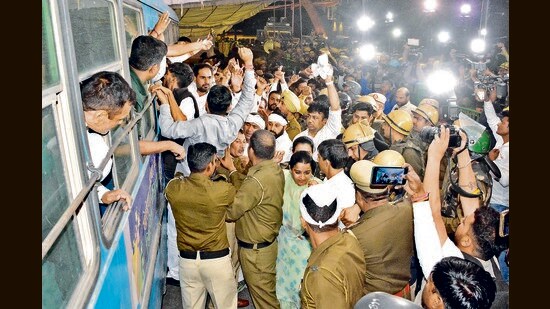
Within hours after the high court on Saturday ordered them to clear the road of protesters by 10 pm , following a plea by harrowed residents, Panchkula police reached the site with heavy force and removed the protesters amid sloganeering against the Haryana government.
Hearing the residents’ plea despite a holiday, the high court bench of justice AG Masih and justice Vikram Aggarwal had also sought a compliance report from the Panchkula commissioner of police and deputy commissioner by Monday, failing which the duo were categorically told to remain present in court to explain the non-compliance of orders.
Acting swiftly, deputy commissioner of police Sumer Partap Singh, ACP (law and order) Surender Kumar Yadav and officials from the district administration rushed to the spot by 7.45 pm, backed by around 300 policemen.
However, refusing to budge, the protesting sarpanches sought some time, as their delegation had gone to meet DIG OP Narwal. “We gave them half an hour, but even after the delegation returned, the protesters decided not to move from the spot till their demands are met,” ACP Surender Kumar Yadav said.
Moving in around 8.30 pm, police detained nearly 100 protesters and made them leave on three police buses.
Over the next few minutes, the policemen hurried to clear the protest paraphernalia, including tents, mattresses and blankets, and by 8.55 pm reopened the crucial traffic lifeline for public, much to the relief of commuters harried for nearly four days.
“The detained protesters were taken to the Sector-14 police station and taken into custody. A police report will be filed. Their names and details will be noted and then they will be released,” said ACP Yadav.
Meanwhile, Ranbir Samain, president of Haryana Sarpanch Association that was spearheading the protest since March 1, said, “We are returning from Panchkula today, but if our demands are not fulfilled by the chief minister by March 9, we will gherao his residence in Karnal on March 11.”
Doctor, lawyer moved court
The HC order came on a plea by Neetu Bajaj, a doctor, and Shivani Sahni, a lawyer, both residents of Panchkula, who had sought directions to the administration to remove the blockade, as it was resulting in huge traffic jams on the roads between Panchkula and Chandigarh.
Though it was a holiday in high court, the petitioners’ counsel Vishal Garg made a request for a special hearing and special bench was ordered to be constituted. The matter was eventually taken up in the afternoon.
The counsel told the court that the road blockade was not only causing inconvenience to residents, but creating lot of problems for ambulances and school buses, apart from pedestrians. “Because of the blockade, there is extra rush on the other ancillary and capillary roads that connect Panchkula with Chandigarh. People commuting to Chandigarh on a daily basis are finding it difficult to reach their places of work on time, leading to suffering not only at the end of commuters but also at the end of beneficiaries of the services provided by Panchkula residents working in Chandigarh,” it was submitted.
Appearing for the Haryana government, additional advocate general Deepak Sabharwal said one side of the road had been made functional and an FIR had also been registered against the protesters. But admitted that no action had been taken thereafter. Efforts are being made for amicably resolving the impasse and the chief minister has given the protesters time of March 9 for a meeting, he informed the court.
The court, however, noted that an impasse should not have been allowed to take place in the first place. “Leniency and refrain to the extent that does not put the general public to peril and inconvenience is understandable. But when associations and organisations and even people at large get together to block any public road, the administration should take immediate steps to not let such a thing happen, which in our considered view, the authorities have failed to take note of, leading to the situation which we are faced with,” the bench said, adding that protests were permitted only at earmarked sites.
“Each citizen has the right to commute and especially when they are going to perform their duties, whether it be students who are studying, doctors going to hospitals/clinics, teachers going to schools/colleges and even government employees going to offices. Permitting law to be taken in hand by a few people is not acceptable,” he court said.
“Protesters don’t have the licence to...cause difficulty not only for people at large but virtually harassing them to put pressure and force the government to accept their demands,” it further noted.


