
 E-Paper



2-day annual meet on cotton begins at Ludhiana’s PAU
Delegates from various state agricultural universities and ICAR institutes as well as agricultural experts from PAU attended the inaugural session


The two-day annual group meeting 2022-23 of All India Coordinated Research Project (AICRP) on cotton was inaugurated at Punjab Agricultural University (PAU), Ludhiana, on Thursday.
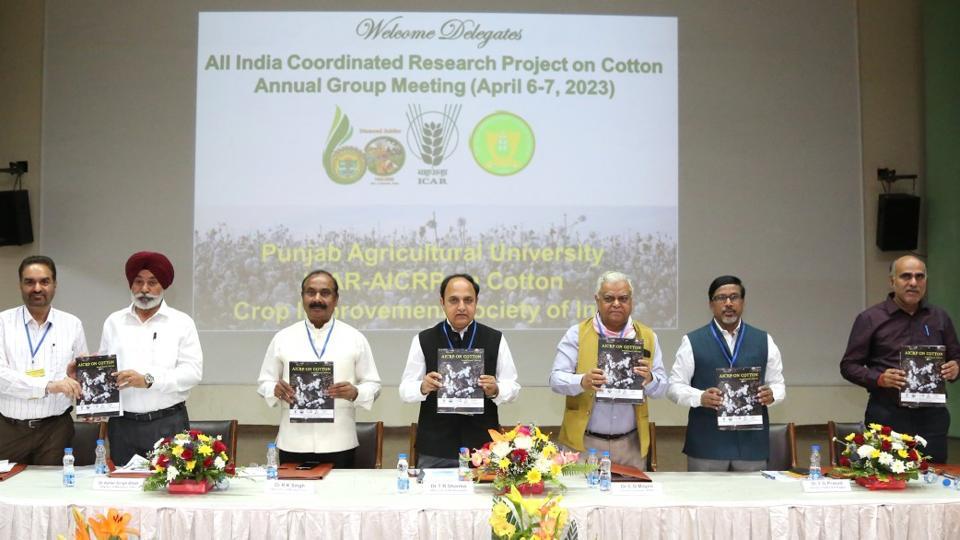
TR Sharma, deputy director general (crop sciences), Indian Council of Agricultural Research (ICAR), New Delhi inaugurated the meet emphasising the need to speed-up the process of varietal development, especially, the hybridisation programme of cotton by placing focus on Bt gene, large boll size, resistance towards diseases and mechanical harvesting.
Delegates from various state agricultural universities and ICAR institutes as well as agricultural experts from PAU attended the inaugural session.
Calling universities as important channels of releasing technologies to the farmers, the ICAR expert stressed upon enhancing farmers’ income through cotton lint or edible oil seeds.
Agricultural Scientists Recruitment Board former chairman CD Mayee, who also worked at PAU 50 years back, underlined the need for integrating private companies with universities for the development of Bt cotton hybrids.
“Cotton in North India is suffering because of more water, while in South India, it is suffering due to of less water,” he observed, while calling for addressing the problem of water logging in cotton cultivation. Impressing upon the development of HDPS hybrids of cotton, Mayee reiterated the integration of public-private partnership in this direction.
Expressing concern over the issue of florescence being faced by the spinning industry, SK Shukla, director, ICAR- Central Institute for Research on Cotton Technology, Mumbai, said it was due to the wanton use of pesticides. He also raised concern over the difficulties cropping up during cotton harvesting and called upon the breeders to come up with HDPS hybrids as a solution for the same. Shukla also discussed in detail the fibre quality of cotton and the parameters being followed by the Spinning industry.
Bollworm management in the Central, North and South zones of the country urged the experts to step up the efforts in this regard as well as for monsoon deficit.
Rathinavel, project coordinator, ICAR-AICRP on cotton, while presenting the highlights of the report, told that India, Bangladesh, Egypt and Pakistan are the largest consumers of cotton. He also referred to various cotton varieties and hybrids, and the area under this crop in Punjab, Maharashtra, Rajasthan, Gujarat, etc.


