
 E-Paper



Akal Takht gives Punjab MLAs one-month ultimatum to amend anti-sacrilege law
Sikh clergy questions AAP MLAs over legislative oversight and failure to prosecute Dera head in sacrilege and Maur; lawmakers ordered to put Act on hold.

 Prefer HTon Google


Akal Takht, Sikhism’s highest temporal seat, on Monday issued a one-month ultimatum to all Sikh MLAs of Punjab to remove objectionable clauses from the recently enacted Jaagat Jot Sri Guru Granth Sahib Satkar (Amendment) Act, 2026, and put the law on hold till it is amended.
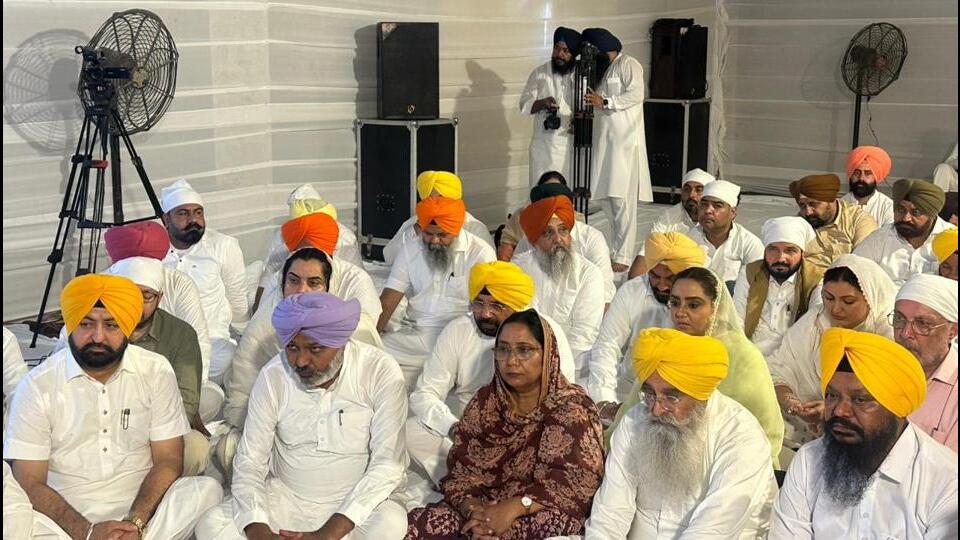
The directive came during a two-hour hearing, where legislators cutting across party lines — including the ruling Aam Aadmi Party (AAP), Congress and Shiromani Akali Dal (SAD) — appeared before the five Sikh high priests to explain the lack of community consultation prior to the Bill’s passage in April.
Also read: Punjab CM announces 7,000 km pipelines to take canal water to every farm
Passed by the Punjab assembly on April 13 and subsequently assented to by the governor, the new law amends the 2008 principal Act to provide for a term of up to life imprisonment and fines up to ₹20 lakh for criminal conspiracy in desecrating the “saroop” (copy) of Guru Granth Sahib. However, the Act also contains some clauses that did not go well with the Akal Takht and other Sikh organisations.
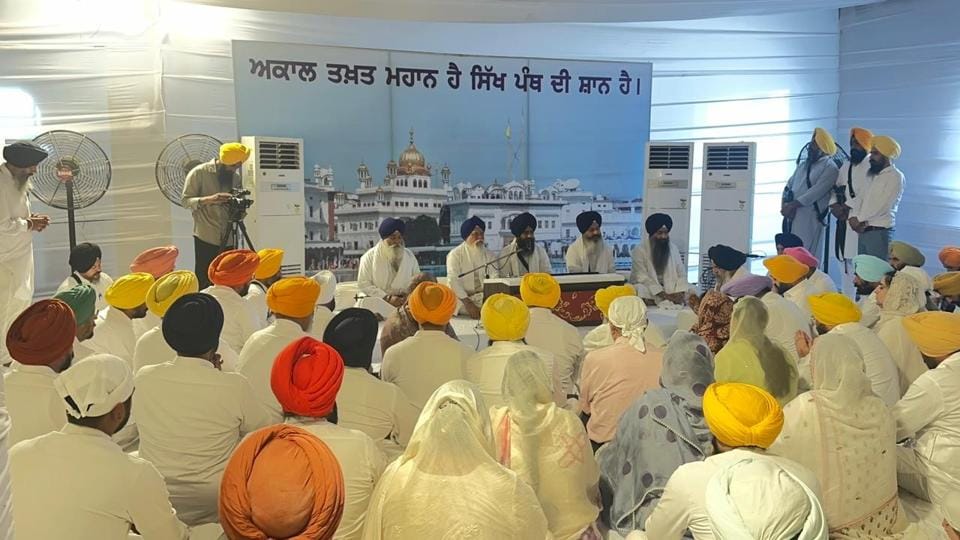
Speaking to the media after the meeting, Speaker Kultar Singh Sandhwan, along with finance minister Harpal Singh Cheema said that once the proposed amendments and objections are conveyed by the Akal Takht, the government will deliberate and take a decision. “We have one month to deliberate over the objections and proposed amendments and will take a decision,” Sandhwan said.
Raising objections over certain clauses of the Act regarding the SGPC, Sikh Rehat Maryada, custodian, terminology etc, the Sikh clergy-led by Akal Takht acting jathedar Giani Kuldeep Singh Gargaj issued a decree on June 15 from the highest temporal seat and asked all Sikh MLAs of Punjab, barring CM Bhagwant Mann, to appear before the Takht with clarification, besides seeking an explanation from the non-Sikh cabinet minister.
Also read: Rain spell likely in Ludhiana from July 1; IMD warns of gusty winds
In compliance with the decree, as many as 87 MLAs appeared before the Sikh clergy at the Takht secretariat on Monday—69 from the AAP, 15 from the Congress, one independent, and one each from the SAD and Akali Dal (Waris Punjab De). AAP MLA Daljit Singh Grewal (Ludhiana East) and minister Tarunpreet Singh Sond (AAP’s Khanna MLA) could not appear before the Takht as they are abroad. Two Hindu MLAs of the Congress—Aruna Chaudhary (Dinanagar) and Naresh Puri (Sujanpur)—also appeared.
The Sikh clergy, which also comprised Takht Damdama Sahib jathedar Giani Tek Singh Dhanaula and Darbar Sahib granthis Giani Baljit Singh, Giani Kewal Singh, and Giani Mangal Singh, subjected the lawmakers to sharp questioning.
Giani Gargaj started the proceedings by showing two videos of the speeches of chief minister Bhagwant Mann in which he is seen saying that if an accused of “beadbi” is found mentally retarded, his or her parents will face action under the new law. The jathedar sought clarification from the attendees on whether this is mentioned in the law in explanation of the clause related to “custodian”.
As the AAP MLAs failed to give a clear answer, former minister Dr Inderbir Singh Nijjar requested Giani Gargaj to issue directions.
Joining the discussion, leader of Opposition in Punjab assembly and Qadian MLA Partap Singh Bajwa said: “During the discussion on the Bill in the Vidhan Sabha, I had urged the Speaker to extend the special session by a few more days so that the views of the jathedars of all Takht Sahibs, SGPC, Sikh scholars, Sant Samaj and other Panthic stakeholders could be obtained and incorporated. Unfortunately, the government chose haste over consensus.”
AAP MLAs put govt in tight spot
The proceedings took a dramatic turn when Giani Gargaj confronted AAP MLAs Jagroop Singh and Kulwant Singh, asking if they had even read the draft of the Bill before voting for its passage. Both MLAs admitted they had not, with Jagroop defending his actions by stating that the draft was not provided to them in time for review.
Congress MLAs Pargat Singh, Tript Rajinder Singh Bajwa, Sukhpal Singh Khaira and rebel SAD MLA Manpreet Singh Ayali, who recently joined the Akali Dal (Waris Punjab De), also admitted that they received a draft of the bill late at night on April 12, a day before the special session.
On being questioned about who is considered custodian in the law, AAP MLA Manjit Singh Bilaspur gave an unclear response. The jathedar criticised the response, saying it did not answer the question.
Questioned raised over ‘inaction’ against dera head
Beyond the text of the law, the jathedar questioned AAP MLAs over their administrative failures in key state investigations. The clergy demanded answers on why the government failed to seek police remand for Dera Sacha Sauda chief Gurmeet Ram Rahim Singh in the 2015 Bargari sacrilege case, which involves the theft and desecration of Guru Granth Sahib. They further questioned why no decisive action had been taken against the Dera head following the 2017 Maur bomb blast case, a targeted explosion during an election rally that killed seven people, including five children.

Divided in seating, united in resolution
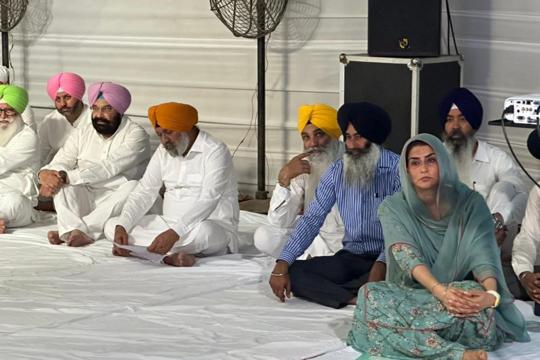
The layout of the hall reflected the state’s deep political fractures, as Congress MLAs sat at a distance from the ruling AAP legislators, while SAD’s lone MLA, Ganieve Kaur Majithia, maintained a separate presence. However, as the floor was opened, a rare political consensus emerged.
Giani Gargaj detailed every theological and procedural objection to the law’s terminology, asserting that any legislation dealing with sacrilege must strictly align with the sentiments of the Sikh Panth (community). Concluding the session, the jathedar ordered the MLAs to put the legislation on hold and resolve the crisis by amending the Act within 30 days.
The jathedar also called for the inclusion of a provision under which the head of a dera, deemed anti-Sikh, would also face legal action if a follower or an associate committed sacrilege.
Row over live telecast
As the proceedings began, AAP MLA Dr Inderbir Singh Nijjar requested the jathedar not to telecast the proceedings live on the SGPC’s YouTube channel, saying: “It is a sensitive matter. We are ready to do what you ask”. The jathedar declined the request, saying the Punjab chief minister had himself demanded that every proceeding be telecast live.
About an hour into the proceedings, the jathedar said the live telecast on several news channels has been stopped and asked the AAP MLAs, including Sandhwan, to intervene to restart it.
Case timeline
April 13, 2026: Punjab Vidhan Sabha passes the Jaagat Jot Sri Guru Granth Sahib Satkar (Amendment) Act, 2026, which is subsequently granted assent by the governor.
May 8: Vidhan Sabha Speaker Kultar Singh Sandhwan is summoned to Akal Takht and appears before acting jathedar Giani Kuldeep Singh Gargaj to discuss the legislation.
June 29: All Sikh MLAs appear before Akal Takht. The Sikh clergy officially hands over a detailed, written list of objections to Speaker Sandhwan, issuing a strict 30-day ultimatum to put the Act on hold and amend it.
Key objections raised by Akal Takht
The highest temporal seat of Sikhism has demanded the complete removal or overhaul of several core clauses, citing government overreach into internal Panthic affairs:
Removal of traditional terminology (Clause 2): Akal Takht strongly objects to the legal removal of the words ‘bir’ and ‘birs,’ terms deeply rooted in Sikh customs and the Rehat Maryada (code of conduct). It demands they be reinstated alongside ‘saroop’ and ‘saroops.’
Custodian trap (Section 2 Amendment): The clergy argues that the definition of a “Custodian” conspiratorially shifts the legal blame for sacrilege onto devout Sikhs, gurdwara committees, granthis, and families hosting recitations. Philosophically, no human can be designated a ‘custodian’ of the Guru.
Unique identification numbers (Sections 3A & 3B): The law mandates that the Shiromani Gurdwara Parbandhak Committee maintain a central register assigning a unique identification number (UIN) to each ‘saroop’. Akal Takht declared this an intolerable tampering with the sanctified form of the Guru, asserting the state has no authority to regulate the status of holy scriptures.
Security risk of online databases: The amendment requires uploading records of where ‘saroops’ are located to the SGPC website within 45 days. Drawing a parallel to the November 1984 anti-Sikh violence—where voter lists were used to target households—the clergy warned that public online tracking exposes global Sikh devotees to anti-Sikh and mischievous elements.
Criminalising code of conduct violations (Section 5): The law proposes up to 5 years’ imprisonment and a ₹10 lakh fine for rule violations outside of actual sacrilege. Akal Takht notes this weaponises the law against sewadars and granthis for internal administrative or Maryada slip-ups, which fall strictly under the jurisdiction of Akal Takht, not state police.
Unilateral rule-making (Section 6A): The clergy condemned the state government for retaining the power to frame rules via official gazette notifications without consulting apex Sikh institutions like the SGPC and Akal Takht.
Disrespectful language & legal protocol: Commercial words like ‘store’, ‘storage’, and ‘supply’ should be replaced with respectful terms like ‘sewa sambhal’. Additionally, it mandated that desecrated holy material must never be taken to police stations or courts as evidence; instead, their cremation rites must be respectfully performed at Gurdwara Sri Baoli Sahib, Goindwal Sahib, Tarn Taran.


