
 E-Paper



At 306, Bathinda air quality worst in state
As per Central Pollution Control Board, AQI in Bathinda was measured at a scale of 306 on Saturday. This level leads to ‘poor respiratory illness on prolonged exposure’


: As the trend of paddy residue burning continued unabated in the Malwa belt of Punjab, for the first time in this kharif season this year, Bathinda reported an air quality index (AQI) at the ‘very poor’ level on the weekend.
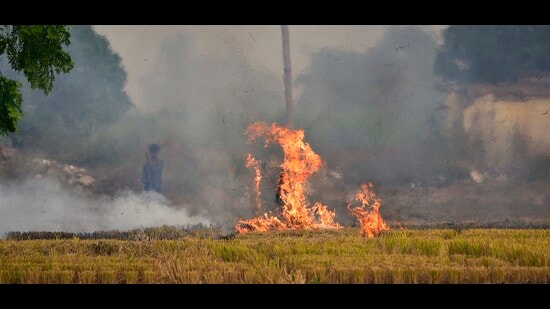
It was for the third occasion this week when the AQI deteriorated to dismal levels in Punjab.
As per the Central Pollution Control Board (CPCB), AQI in Bathinda was measured at a scale of 306 on Saturday. This level leads to ‘poor respiratory illness on prolonged exposure.’
Data says this season, AQI of ‘very poor’ was first recorded in Patiala on October 31 at a scale of 348.
To date, Bathinda and its adjoining eight districts, including Sangrur and Barnala, have reported 15,558 cases which was 53% of total stubble burning cases of 29,400.
However, on half of the occasions in the last 17 days, the AQI of Bathinda has not been recorded on the database of the national database for unspecified reasons.
Bathinda is the only place in the southwest region whose seven districts have a past trend to contribute every year about 45% of total paddy residue-burning events.
As the region continuously witnessed a high number of paddy stubble burning, the absence of AQI data for Bathinda for eight days raises questions.
Sub-divisional officer of the Punjab Pollution Control Board (PPCB) in Bathinda Ravipal Singh on Friday feigned ignorance over the issue.
“The AQI data collection is done online by the management of a private cement factory in Bathinda. I will look into the reason why the calculation was skipped on several days,” said the official.
Analysis of AQI data of the CPCB, air quality information of Bathinda was unavailable for several days from October 20.
The AQI information was absent continuously for four days from October 22-25. Then again on October 28, 30 and November 2, air analysis was not available in the public domain.
The CPCB’s daily bulletin highlights a disclaimer stating “the data available at the (CPCB) portal is provided by different agencies.”
Hazy days are here again
For the fourth consecutive day on Saturday, Bathinda witnessed hazy conditions throughout the day.
Experts say the current conditions are the indicator of environmental pollution and not smog.
According to the Punjab Agriculture University (PAU) observatory at the Bathinda-based regional research centre, since Wednesday, the average bright sunshine hours were between 0-4 hours.
VK Garg, professor of environmental science and technology at Bathinda-based Central University of Punjab (CUP), said the burning of crop residue in the region is a key factor for ongoing hazy conditions.
“It is not smog as the region has not seen foggy days. As paddy harvesting is at its peak, air pollution has intensified due to the increased movement of vehicles transporting the crop and its cleaning operations. Since the temperature is going down, particulate matters are suspended in air and low wind speed was not allowing the dust to disperse,” said Garg.


