
 E-Paper



Chandigarh: Sex ratio at birth plummets to 838, lowest in region
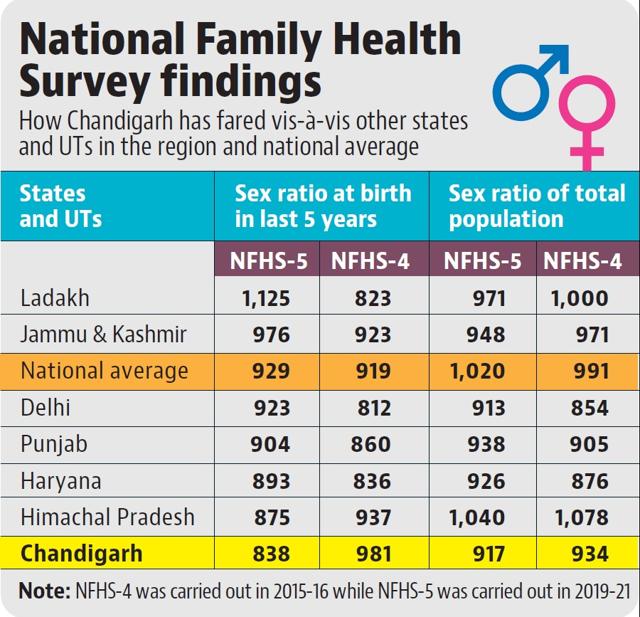
According to National Family Health Survey-5, only 838 females were born in Chandigarh for every 1,000 males in last five years, down from 981 in last survey

 Prefer HTon Google


The sex ratio at birth in Chandigarh has dropped to 838 females for every 1,000 males, a significant drop of 14% in the last five years, the data compiled under the National Family Health Survey-5 (NFHS-5) has revealed.

When considering the ratio in urban pockets of Chandigarh, the ratio is even worse: 820. In the NFHS-4, which was conducted in 2015-16, the sex ratio at birth was as high as 981 in Chandigarh, highest in the region. Now, the UT is languishing at the bottom.
The NFHS-5 (2019-21) conducted by the Union ministry of health and family welfare is the fifth in the series and provides information on population, health, and nutrition for India and each state and UT.
In Haryana, which historically had one of the lowest sex ratios in the country, the ratio stands at 893, an improvement from 836 in the previous survey. The national average stands at 929 females per 1000 males. The sex ratio at birth is defined as the number of girls born for every 1,000 boys born, for a given population and over a given period of time.
The survey also revealed that the sex ratio of the total population (females per 1,000 males) in Chandigarh’s urban areas is 918, and 868 in rural areas. The cumulative average is 917, still lower than 934 in 2015-16. Also, total fertility rate (children per woman) in Chandigarh has dropped from 1.6% to 1.4%.
Due to the Covid-19 situation and the imposition of lockdown, the survey fieldwork for Chandigarh was conducted from January 2020 to March 2020 (prior to the lockdown) and from December 2020 to March 2021 (after lockdown). Information for the survey was gathered from 761 households that included 746 women and 104 men.
UT health dept contests data
Meanwhile, the UT health department has questioned the report, while sharing its own data.
“As per the health department’s ratio, 934 females are being born for every 1,000 males, which is even better than the national average,” said Dr Suman Singh, director, health services, Chandigarh.
Commenting on the possibility of female foeticide being behind the dropping sex ratio, she said: “The UT health department is very vigilant on sex determination tests and no such complaints have been received. The survey also includes migrant population and people might be visiting neighbouring states to get the illegal tests conducted.”
Meanwhile, UT health secretary Yashpal Garg said: “The trend of dropping sex ratio in Chandigarh is unusual and the UT’s figures show different data. We will analyse the data and if the central government’s data shows different figures, we will definitely write to the authorities to re-examine the situation.”
Improvement in some areas
However, in some good news, the survey also shows that the facilities for “maternity care and delivery care” have improved in Chandigarh. The percentage of mothers who had an antenatal check-up in the first trimester has increased to 82.3% from 67.4%.
Births at institutions or hospitals have increased to 96.9% from 91.6%. Also, 97% of the newborns were attended by skilled health personnel in Chandigarh, against 93.3% in the previous survey.
Chandigarh has also improved significantly when it comes to gender-based violence. The recent data shows that 9.7% of presently or previously married women (age 18-49 years) have experienced spousal violence. The figure was as high as 22.5% in 2015-16.
Also, no such woman experienced physical violence during pregnancy in Chandigarh, while the figure stood at 3.5% in the last survey.
Lifestyle diseases continue to pose risk
The National Family Health Survey-5 (NFHS-5) shows growing risk of lifestyle ailments in Chandigarh, including diabetes, hypertension, obesity and diseases associated with smoking and alcohol and drug abuse.
As per the survey, around 12% of the females (age 15 and above) have high blood sugar level in Chandigarh while the percentage in men stands at 8.8%. Also, around 16.6% men are dependent on medicines to control the blood sugar while 19% women consume such medicines.
Hypertension among adults (15 years or more) was most commonly found in men. As many as 18.7% men have mildly elevated blood pressure while 8.7% have moderately or severely elevated blood pressure. Among women, 14.5% have mild hypertension and 5.6% have moderate to severe problems.
If one goes by the NFHS-5 data, 44% Chandigarh women are overweight in the age group of 15-49. Besides, 35% men are overweight with excessive body mass index in the same age group.
The use of tobacco and alcohol consumption among adults (age 15 years and above) was found more in men. Around 12% men aged 15 years and above use some kind of tobacco while 18.6% consume alcohol. In comparison, only 0.6% women use tobacco and 0.3% consume alcohol.
Dr Sonu Goel, professor, department of community medicine and school of public health, Post Graduate Institute of Medical Education and Research, said: “In Chandigarh, people have a busy lifestyle. It has drastically changed their eating habits and people now prefer to eat junk, fast or packaged food. This is inviting serious lifestyle issues.”


