
 E-Paper



Chandigarh’s ambitious pan-city tertiary treated water plan sets sail
Chandigarh administrator inaugurates ₹71.58-crore project to lay pipelines across the city to supply recycled water


In 18 months, all 1,800 parks in Chandigarh, roundabouts and industrial areas will be supplied tertiary treated water for irrigation purposes.
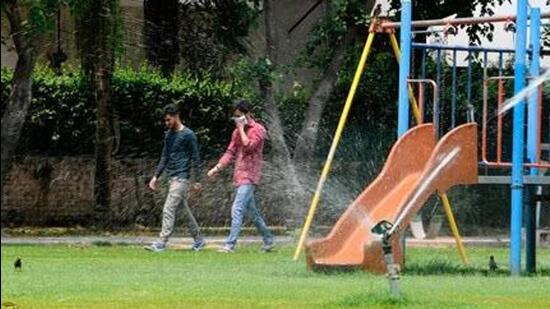
Aiming to conserve potable and ground water by recycling waste water, the Chandigarh municipal corporation (MC) on Saturday kick-started the work of expanding the tertiary treated water supply system across the city.
To be completed at an estimated cost of ₹71.58 crore, the project was inaugurated by UT administrator Banwarilal Purohit in the presence of city mayor Kuldeep Kumar Dhalor, UT adviser Rajeev Verma, local government secretary Nitin Kumar Yadav and municipal commissioner Anindita Mitra.
It is expected to save approximately 20 to 25 million gallons of potable/fresh water per day, leading to significant groundwater conservation.
Through tertiary treatment, sewage water is made suitable for irrigation after chemical treatment and sedimentation process. It is the final stage of the wastewater cleaning process to make it suitable for irrigation and related activities. The treated water’s bio-chemical oxygen demand (BOD) should be less than 10 mg.
Use of tertiary water for agriculture and related activities is one of the main objectives of the City Water Action Plan (CWAP) as it will reduce dependence on ground and potable water.
“This project will be a boon for the conservation of drinking water as by treating and supplying nearly about 20 MGD tertiary treated water to the city for irrigation purposes, precious potable water will be saved. All six STPs have been upgraded with Sequencing Batch Reactor (SBR) technology under Smart City Mission, resulting in a considerable improvement in the quality of tertiary treated water which will eliminate public complaints of foul smell,” Purohit said.
City mayor Kuldeep Kumar detailed, “Under this initiative, all parks, green belts, road berms and roundabouts in the city will receive treated water for irrigation purposes. Furthermore, upon successful completion of the project, the recycled water will also be supplied to units in Industrial Area, Phase 1 and 2.”
Work to begin from Industrial Area
Municipal commissioner Anindita Mitra said this initiative marked a crucial milestone in the quest for a greener and more water-efficient future in the City Beautiful. “Previously, tertiary treated water was supplied solely from the Diggian STP. However, after the completion of this project, TT water will also be supplied from STPs in Raipur Kalan, 3BRD and Maloya.”
“The project has been handed over to a private firm that will take 18 months to complete it. We will start laying the system from Industrial Area so that tertiary treated water can be used in industries,” Mitra said.
MC had started laying tertiary water pipelines in 1990 and initially covered Sectors 1 to 12, and 16. Over three decades later, almost 80% of the sectors have been covered. At present, 10 MGD (million gallons per day) of it is being used to maintain parks, green belts and fountains.
“By increasing the supply to 20 MGD, MC plans to increase the tertiary treated water’s consumption. The city has multiple open spaces, parks and houses with big lawns, where water is required for irrigation. As many as 680 parks and green belts are using tertiary treated water and after expansion, water will be supplied to all 1,800 parks in the city. Also, the under-construction public toilets are being given dual pumping so that tertiary treated water can be used,” said Mitra.
Under the Water Bylaws, MC made tertiary water connections mandatory for all houses sized 500 square yards and above. While around 7,000 houses are eligible for tertiary water connections, around 2,000 are yet to be covered.
The 12.6 lakh-strong population of Chandigarh consumes 386 million litres daily (MLD), which is estimated at 245 litres per person (capita) per day (LPCD). As per MC, the daily consumption and availability of water is much higher than the estimated requirement of the citizens, which stands at 225 MLD or 150 LPCD. The daily consumption also includes 35% wastage, which is about 135 MLD.
Executive engineer suspended as sound system malfunctions
Municipal commissioner Anindita Mitra on Saturday suspended an executive engineer of the electrical department after the sound system malfunctioned during the event. Executive engineer Kuldeep Singh was responsible for fixing the sound system for the inauguration of the tertiary treated water project.
But during the speech of the UT administrator, the microphones and speakers did not function properly, resulting in delay.
“The superintending engineer of electrical department had specifically asked him to check the wiring for the sound system. He was also asked to be present during the event, but he skipped it. He has been suspended till further orders and he will be chargesheeted,” said Mitra.


