
 E-Paper



Chandigarh’s daily Covid tally goes past 200 after six months
Prime Minister identified Chandigarh as one of the 12 states and UTs with “districts of concern” because of the steady rate of increase in cases this month

 Prefer HTon Google


For the first time since September 24 last year, the daily tally of Covid-19 cases crossed the 200 mark on Wednesday, which also pushed the number of active cases to 1,330, highest in the past six months.
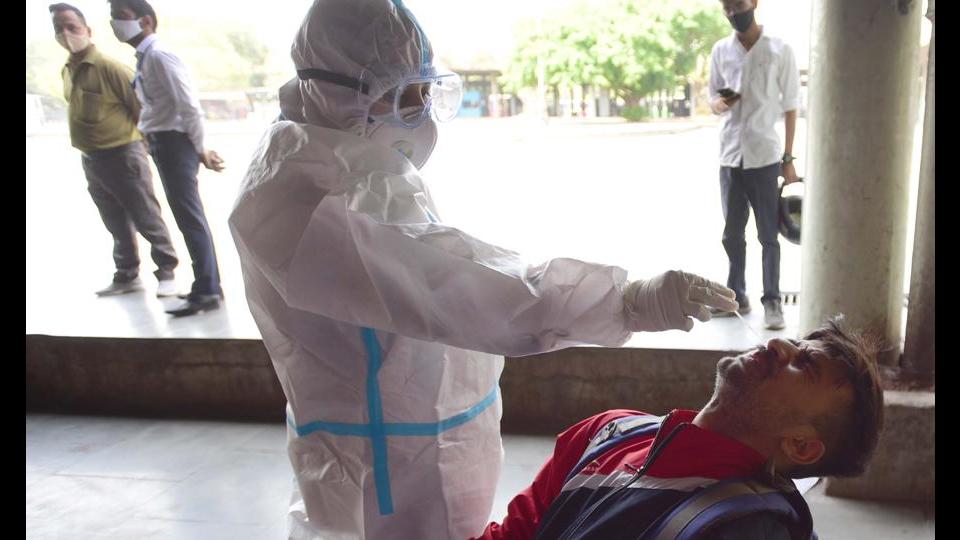
As many as 201 people tested positive in the past 24 hours, taking the total to 23,592. While 21,903 patients have recovered, 359 have succumbed to the virus to date.
In fact, the Prime Minister on Wednesday identified Chandigarh as one of the 12 states and UTs with “districts of concern” because of the steady rate of increase in cases between March 1 and 15.
However, amid the spike, the Chandigarh administration has ruled out night curfew.
“The infection spread is increasing, but fatalities have not shown any spike. We are monitoring the situation closely, and if things go beyond a certain point, the option of more restrictions is always open. However, there will be no knee-jerk reaction, such as night curfew,” said UT adviser Manoj Parida.
Parida said testing is being ramped up and more micro-containment zones are being demarcated, including six on Wednesday, to deal with the present surge.
The health department has already warned of a second wave, like the one witnessed in September, mostly due to people ignoring the Covid appropriate behaviour.
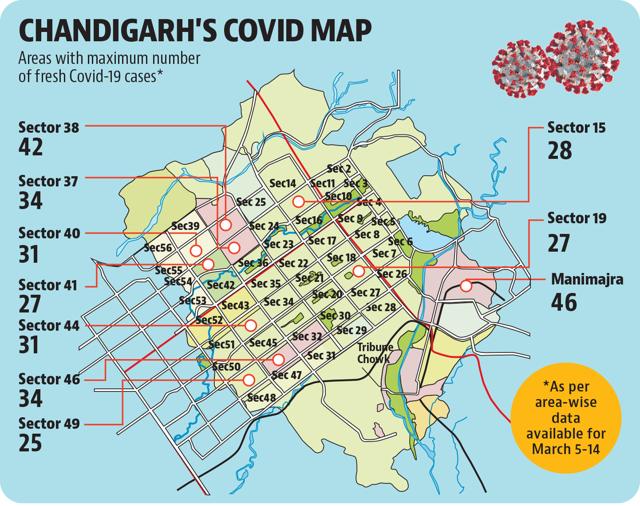
10 areas reporting maximum cases, though scattered
The new cases being reported in the city this month are concentrated in a few pockets out of 71 localities in the city, official data suggests. As many as 35% of the cases reported between March 4 to 15 surfaced in Manimajra and nine sectors, mostly in southern parts (see map).
“The clusters that may have developed are dependent on various factors, such as the population density. Also, infection spread in previous waves determines how much population is still vulnerable,” said Dr Rajesh Kumar, former head of the school of public health and department of community medicine at PGIMER.
Health department officials said that within the sectors that are reporting high numbers, the cases are scattered, making it difficult to demarcate micro-containment zones.
“At least two houses vertically or horizontally should have been affected due to the virus to demarcate a micro-containment zone. However, presently the cases are scattered within sectors,” said a senior UT health official, not wishing to be named.
Ramp up testing, ensure strict enforcement: Badnore
Chandigarh administrator VP Singh Badnore on Wednesday directed the health department to ramp up testing and told the police to ensure strict implementation of Covid norms, after attending a video conference with Prime Minister Narendra Modi regarding steps to be taken to control the resurgence of the pandemic.
In his address during the virtual meet that was also attended by chief ministers of various states, Badnore said that though there has been a substantial rise in cases this month due to various relaxations and removal of restrictions on gatherings.
After the meeting, Badnore directed senior UT officials to follow the principle of 3-Ts (Testing, Tracking and Treating) to combat the virus.
The health department was told to enhance the number of tests, particularly RT-PCR, and to send genome samples to Pune to determine the strain of the virus.
Badnore said that school teachers, students and people coming from outside at the railway station and bus stands should be regularly tested, and shopkeepers should get themselves tested as they come in contact with many customers.
The administrator directed the director general of police to intensify challaning in public places, eateries and markets to ensure that people wear masks and follow social distancing.
According to data shared by Badnore with the PM, the UT administration has already conducted 2.8 lakh tests against a population of around 12 lakh. He also mentioned that 57,000 people have been vaccinated, and the dose wastage is as low as 2%.


