
 E-Paper



Chandigarh’s new high: Drugs now fly in from Pakistan via drones
Till 2020, the city’s drug supply was primarily routed through Delhi, sourced largely from Nigerian cartels, backed by cyber-criminal networks


The narcotics trail leading into Chandigarh has undergone a dramatic shift in the past five years.
Till 2020, the city’s drug supply was primarily routed through Delhi, sourced largely from Nigerian cartels, backed by cyber-criminal networks.
But post-2020 investigations reveal a new pattern: most of the consignments now enter through Punjab’s border areas with Pakistan, aided by advanced drone technology and cross-border handlers.
Since 2023, Chandigarh Police have busted more than five major interstate and cross-border drug syndicates, each tracing back to Pakistan-based handlers. In these crackdowns, police uncovered how local peddlers in the tricity are just the last link in a chain stretching from Lahore and Kasur to Amritsar and Ferozepur, and ultimately to Chandigarh’s streets.
From sky to city streets
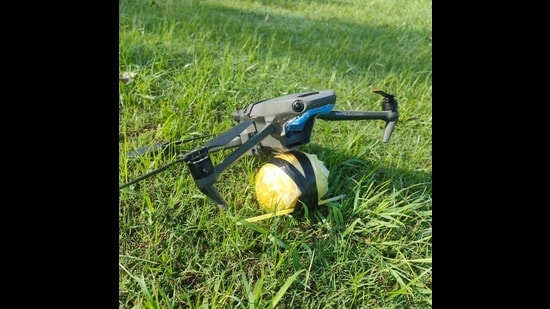
Unlike the earlier Delhi-Nigeria route, traffickers are now leveraging drones to push consignments across the Punjab border.
According to investigators, Pakistan-based handlers use small, geolocated drones to drop parcels of 500 g to 1 kg during daytime, often in fields or near marked pillars along the international fencing.
The compact design makes them nearly invisible to the naked eye. These Chinese drones are GPS-enabled with geolocation mapping so the parcel can be dropped at a precise pre-marked spot.
The human link
Locals at the border, known as “pandi”, play a crucial role in securing these drops. Their job is simple but high-risk: retrieve the packets, store them temporarily, and hand them over at pre-decided locations.
Each retrieval fetches ₹1.5 lakh, and with every additional link in the chain, the commission multiplies. “The system is built on trust and money. The more hands involved, the higher the operational cost, but also the better the concealment. The location is shared on WhatsApp,” said a senior police officer in the crime branch.
In August this year, Chandigarh Police dismantled a syndicate with direct links to Lahore-based handler Zubair Rana. The operation began with the arrest of Pooja, daughter of notorious Sector 38 drug queen Bala, after 54 grams of cocaine was recovered from her. Her interrogation led police to Amritpal Singh, alias Gopi, of Amritsar, identified as the kingpin.
Investigations revealed that Amritpal was in direct contact with Zubair Rana through Instagram and WhatsApp. Using a local receiver, Amritpal arranged drone-based consignments that were later distributed in Chandigarh.
Earlier this year, Chandigarh Police unearthed another drug trafficking network backed by Pakistan’s ISI (Inter-Services Intelligence), arresting nine individuals, including kingpin Gurmeet Singh. The crackdown started with a small catch — 35 gm heroin from peddlers Balkar Singh and Navneet Kaur — but spiralled into a multi-state probe.
Here, the cartel used a different technique: pushing heroin through 4-inch pipes installed near border fencing.
Once BSF patrols passed, smugglers across the border from Kasur, including Riyaz Sarwar and Aabid Ali, discreetly pushed packets into India. Local operatives, often relatives of Gurmeet Singh, would retrieve and store them.
Police found that each smuggler was paid ₹1.5 lakh per retrieval. Over the years, the cartel smuggled more than one quintal heroin into India since 2019. Gurmeet himself was a Facebook friend of Pakistani smuggler Riyaz Sarwar, highlighting how social media platforms were used to maintain direct cross-border connections.
Tightening the net
With multiple high-profile busts since 2023, Chandigarh Police are now focusing on backward linkages and identifying handlers, financiers, and international collaborators, instead of stopping at street-level peddlers.
Investigations by Chandigarh Police have established that the main handlers of these cartels are operating from Pakistan. Using social media and encrypted apps, they control the movement of consignments into India through drones, pipes and local receivers along the Punjab border.
“Earlier, action used to stop at the arrest of street-level sellers. Now, every link is being followed back to the handler across the border. This approach has weakened supply chains, cut off local distributors and forced handlers in Pakistan to alter their smuggling tactics,” a senior officer in the crime branch said.


