E-Paper



CHASCON- 2023: India’s space missions, vaccine supremacy in focus on Day 1
India's 'vaccine war' and space exploration program were the highlights of Day 1 of the Chandigarh Science Congress. India's success in vaccine production and its space missions were discussed by experts. The event will continue for three days.

 Prefer HTon Google


India’s ‘vaccine war’ and space exploration programme were the main highlights of Day 1 of the Chandigarh Science Congress (CHASCON), organised by Panjab University (PU), that started on Thursday.
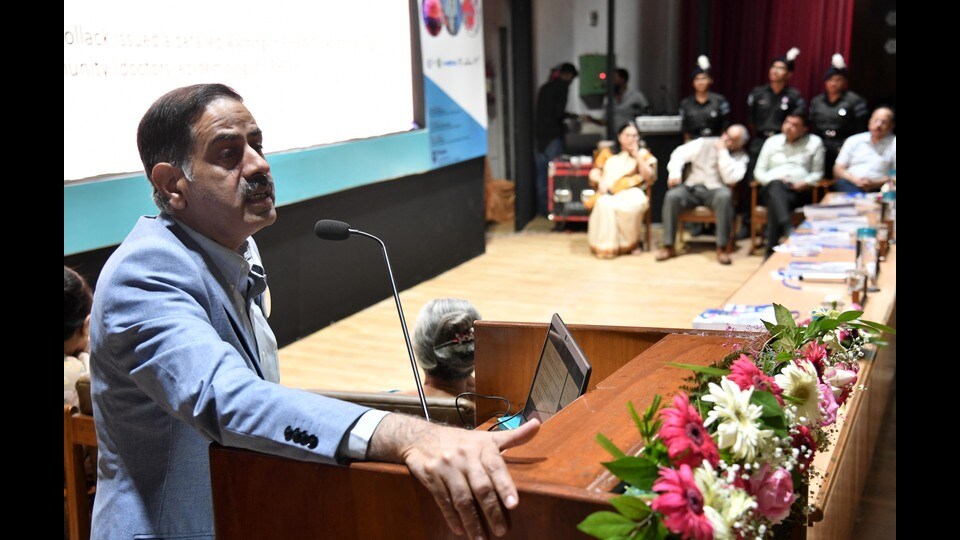
Dr Balram Bhargava, who was the director general of the Indian Council of Medical Research during the peak of Covid pandemic and was closely involved in the development of Covaxin, spoke about how India proved to be the pharmacy of the world by making expensive medicines for cheap. “India is now a vaccine superpower. We proved this when we made Covaxin.”
Bhargava showed a picture of India post-Independence, when Canada gave it penicillin. He then proudly stated that in 2021, India returned the favour by delivering Covaxin to Canada.
“The success of the vaccine is evident from the fact that 92% of those who died during the Omicron wave were those had not taken the vaccine,” he added and went on to speak about the Nipah virus outbreak in Kerala and delivery of vaccines by drones in the North East.
Post Graduate Institute of Medical Education and Reseach (PGIMER) director Dr Vivek Lal, who was the guest of honour, revealed how he was one of the first 10 people in the country to get the vaccine and how that had helped him discharge his duties at hospital efficiently during the pandemic.
He also applauded the bravery and professionalism of PGIMER staff, who, he said, braved the pandemic and other situations, including the recent blaze. He said that it was because of the bravery displayed by the staff that around 550 patients were shifted to safety.
Annapurni Subramanium, the director of India Institute of Astrophysics in Bangalore which was also involved in the launch of Chandrayaan 3, spoke about the importance of reigniting man’s interest in the moon after a period of 50 years. She also provided an update on the Aditya L1 mission and said the mission is in a halo orbit as it nears the Sun and Earth L1 point. Speaking about herself, she described how the sky had always fascinated her and thus she got into astrophysics.
Former PGIMER director Dr Yogesh Chawla spoke about the menace of fatty liver disease and advised people to take up exercising for 45 minutes a day, avoid alcohol, sugar and mustard oil and use olive oil for cooking.
Vilas Tonapi, director of Indian Institute of Millets Research, Hyderabad, spoke about the benefits of growing and eating millets. Bruce Alberts of University of California held a special online lecture on why science education is more important than most scientists think.
CHASCON is a three-day event and will continue on Friday at the PU Law Auditorium.