
 E-Paper



Coming up in Chandigarh, a policy to push cycling as a habit
Draft policy proposes host of suggestions to upgrade infrastructure, give priority to cyclists in traffic for safe movement and encourage employees to cycle to work Perks for cyclistsFour-second head start for cyclists every time the signal turns green, facilitating their safe movement across junctionsHalf-day leave for every seven days cycled for government employees, besides monetary incentives, commendation certificates and awards EMPHASIS ON SECURITY Creating safe refuge points for women and persons with disabilities by introducing 24x7 CCTV surveillance and panic button Track designs that optimise natural surveillance via adequate street lighting, street vendors and active frontagesMaps for cyclists providing safe and short routesSubsidised cycle safety equipmentCovered parking space at workplaces Perks for cyclists

 Prefer HTon Google


Hoping to push cycling as a preferred alternative to driving in a city teeming with cars, Chandigarh Smart City Ltd has readied a Cycling Policy.
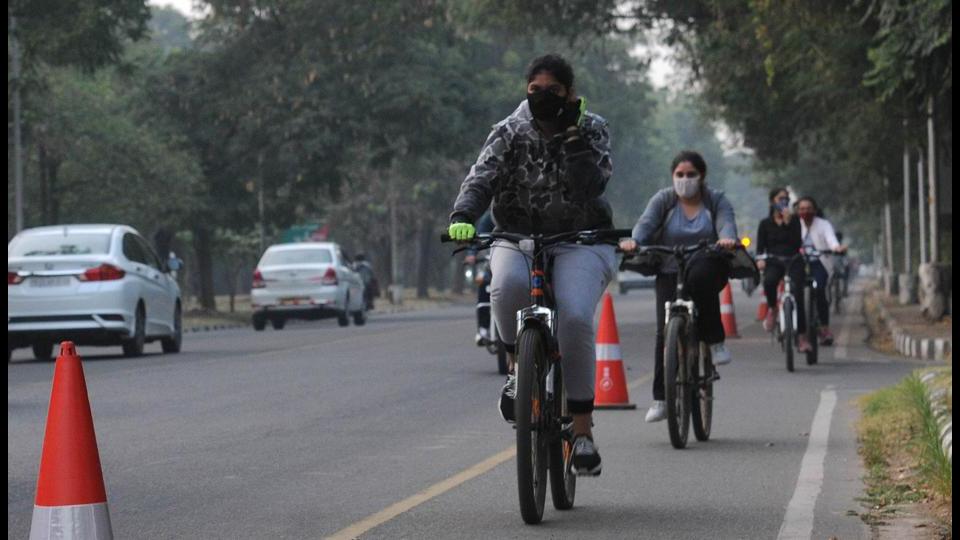
To be notified only after approval from the UT administrator, the policy envisages major upgrade of the city’s cycling infrastructure, including creation of dedicated cycle underpasses, mandatory roof-covered cycle parking in offices and giving priority to cyclists in traffic.
A range of incentives will also be given by government departments, such as leave credits, monetary benefits and facilities to employees, who opt for cycling.
“Cycling Policy can be a powerful tool for the government to encourage citizens to take up cycling. The city has the highest per capita ownership of motorised vehicles in the country, which is creating severe parking and environmental issues. Promotion of cycling as a means of travelling can contribute towards sustainable urban travel,” said NP Sharma, chief general manager, Chandigarh Smart City Ltd (CSCL), which has formulated the draft policy.
Chandigarh currently has cycle tracks running across 200km. About 60km of the cycling network has been identified for underpasses near V-2 (like Madhya Marg, Dakshin Marg and Jan Marg) and V-3 roads (roads around sectors).
In addition, the existing cycle tracks along V3 roads will be improved and provided with proper integration, along with zebra crossings near intersections, the draft policy states.
MORE PARKING SPACE FOR CYCLES
Provision of a large number of cycle bays will be made at every station and parking lot, much more than those for cars. “The parking will be created in such a manner so as to enable a quick and comfortable flow of bicycle traffic. This will include provision of cycle boxes at all signals, along with four-second head start for cyclists every time the signal turns green, facilitating their safe movement across junctions,” Sharma said.
INCENTIVES, SUBSIDIES
Each government office will have a separate policy for their office to encourage commuting to work by cycle.
Employees, who adopt cycling, will get special incentives like half-day leave for every seven days cycled. Monetary incentives for particular distance travelled by cycle will also be offered.
The policy also advocates commendation certificates, awards and other recognitions for cycle users in every department. The private sector firms will also be encouraged to give similar incentives to their workforce.
Employer-based health and wellness programmes will be created, which will incorporate subsidised annual memberships for employees.
Besides, the policy advocates cash incentives, shower rooms, space for drying cycling clothes and borrowable cycles for short trips from the office. Every office will also have to provide covered parking space.
INTEGRATING ROAD NETWORK, TRANSPORT ROUTES
The draft policy lays emphasis on integration of cycle tracks with various modes of public transport for better connectivity.
“An integrated payment system that allows use of both transit and bicycle-sharing system will be the way forward. By providing real-time information to commuters about multiple public transport modes at bus stops, railway stations and public bicycle sharing stations, integration can be achieved,” said Sharma.
“Cycle tracks should be set up in such a manner that they are well connected with work, entertainment, commercial and green areas, so that cyclists have a facility for smooth/easy/safe access to above spaces,” reads the draft.


