
 E-Paper



Cop Priya Thakur breaks glass ceiling, trains to be Himachal’s first woman K9 handler
ITBP’s NTCD is now training the first-ever woman dog handler from the Himachal Pradesh Police, Priya Thakur, a 26-year-old constable. She will soon be joined by the maiden batch of women ITBP K9 handlers


Nose twitching and tail wagging, a curious six-month-old German Shepherd pup picks up a scent and assiduously follows it under the watchful eyes of a woman constable at a dummy theft site at the Indo-Tibetan Border Police’s (ITBP’s) National Training Centre for Dogs (NTCD) at Bhanu near Chandigarh.
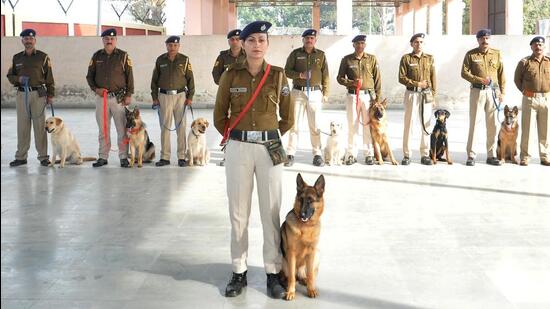
Dogs have been a sight at the centre for years, but what is new is the distinctly feminine voice giving commands to the budding K9 warrior or as dogs are called in the police lingo. Storming yet another male bastion, the snow-clad Himalayan frontiers or even the Naxal-infested jungles of Chhattisgarh would soon see the ITBP deploying women dog handlers on security duties.
For the first time, a number of women constables, who have recently completed their basic training, have volunteered for ITBP’s animal transport (AT) cadre that is responsible for dogs, horses and ponies in the service. So far, barring a few women veterinarians in the officer ranks, all dog handlers in the service have been male.
Opening a new chapter, the NTCD is now training the first-ever woman dog handler from the Himachal Pradesh Police, Priya Thakur, a 26-year-old constable. She will soon be joined by the maiden batch of women ITBP dog handlers as the force is finalising its new training schedule.
Ask Thakur why she chose to join the dog squad and she says, “Women have made incredible progress in all walks of life. When I joined the HP Police department, I got to know about the dog squad. And also got to know that there were no female handlers there. Being a dog lover, I jumped at the opportunity to volunteer for the squad.”
“Softy is my first police dog. Of the nine-month training, we have completed three months,” says the proud handler.
On the secret to training a dog, she says, “Dogs are like babies, you have to bond with them. Scold them, and they get angry. It is love and affection that makes Softy perform well,” adding that training to become a dog handler is no cakewalk. The intricate process requires not only a fondness for animals, but also a deep understanding of canine behaviour. Some courses such as tracking or urban patrolling take up to 36 weeks. “All through service, the handler and dog remain devoted to each other,” she says.
Women dog handlers will undertake such duties as patrolling the borders, detecting explosives and narcotics, search and rescue missions, tracking and restraining suspects and perimeter security.
ITBP inspector general Ishwar Singh Duhan, who oversees the NTCD, says, “Opening the AT cadre to women constables gives them more professional avenues and empowers them with a skill that is beneficial not only for the force but can also be helpful after they leave the service.”
“With the number of women personnel in the ITBP increasing, we have recently started the intake of women in several other non-general duty cadres and trades to meet administrative requirements and also to do away with any discrimination in employment,” he added.
The recent batch of ITBP non-general duty constables to pass out had 76 women, of which many shown a willingness to serve in the AT cadre. The ITBP has 56 operational units and each unit is authorised four dogs. Women dog handlers posted to such units will be assigned combat duties and other operational tasks in tough terrain and dangerous situations, an ITBP officer said.
Across the world, there has been an increase in the number of dog handlers, and thankfully the trend is also catching on India, with a handful of women dog handlers joining state police and paramilitary forces.


