
 E-Paper



Day after launch, project to clean Buddha Nullah hits roadblock
The Punjab Water Regulation and Development Authority has slammed the move saying it will lead to large-scale poisoning of the Sutlej river.


With the Punjab Water Regulation and Development Authority asserting that the move to release 200 cusecs of freshwater into the Buddha Nullah each day may lead to an ecological disaster and disturb the fragile biodiversity of the Sutlej River, the Ludhiana municipal corporation on Monday found itself embroiled in yet another controversy merely a day after it launched the ₹9.8-crore project.
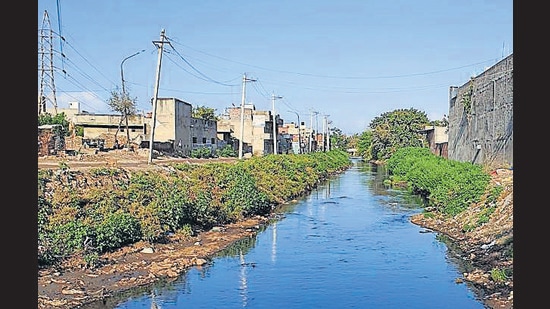
Nixing the corporation’s hypothesis that releasing water in the Buddha Nullah will increase oxygenation, PWRDA member SS Kukal said, “How can mixing polluted effluents in fresh water increase oxygenation? Oxygenation will not take place until effluent discharge is treated.”
Kukal, who was formerly the dean of Punjab Agricultural University’s college of agriculture and has guided research work in soil physics, irrigation and water management, and environmental science, said, “Heavy metals discharged from the industry in the form of untreated effluents cover a distance of approximately 15km before finally mixing with the Sutlej’s waters. The process takes some time. However, releasing fresh water into the rivulet has sped up the pollution of the Sutlej River. The increased water pressure will poison the river on a larger scale and adversely affect the ecosystem within and around the waterbody.”
The PWRDA will raise the issue with the Punjab Pollution Control Board (PPBC) and the Ludhiana civic body. “We will seek an explanation as to why they decided to release fresh water into the polluted rivulet and also ask them to stop the project until such time that the common effluent treatment plant (CETP), sewage treatment plants (STPs) and other projects that pertain to water treatment are completed,” said Kukal.
Urging stakeholders to not take a hit-and-trial approach, the former professor, said, “Cleaning the polluted rivulet is not as easy as cleaning pigeon droppings, which can be removed by pouring a bucketful of water. A permanent solution needs to be found.”
A sound move, contends activist
However, social activist Rahul Verma, who was involved in building an escape regulator channel from the Sirhind feeder canal near Neelon village, rebutted Kukal’s theory. “Firstly, only 50 cusecs of water is being released in the initial stages of the project. Secondly, the chemical oxygen demand, and biochemical oxygen demand (COD and BOD) levels showed improvement a day after the water was released into the nullah. Thirdly, rain water is already entering the rivulet from different sources. If Kukal’s theory is to be believed then the rain water should also be stopped from entering the nullah!” Verma said.
Mayor Balkar Singh Sandhu also reiterated that only 50 cusecs of water was being released from the channel. The mayor said work had already started on two new sewage treatment plants (STPs) with a combined capacity of 285 MLD – Jamalpur 225 MLD and Balloke 60 MLD; the rehabilitation of existing STPs with a treatment capacity of 418 MLD; two effluent treatment plants (ETPs) for the treatment of 6 MLD wastewater from two dairy complexes in Tajpur and Haibowal; six intermediate pumping stations; and the laying of a 10-km pipeline under the ₹650-crore Buddha Nullah rejuvenation project. “The project will be completed by December 2022,” he maintained.


