
 E-Paper



Diversification plan: Farmers in Fazilka experimenting with dates
Horticulture scientist Anil Kamra says as the farmers growing kinnow and cotton in the southwest region of Punjab are undergoing economic stress, a planned push to adopt farming of the commercial crop of dates can be a game changer.

 Prefer HTon Google


BATHINDA
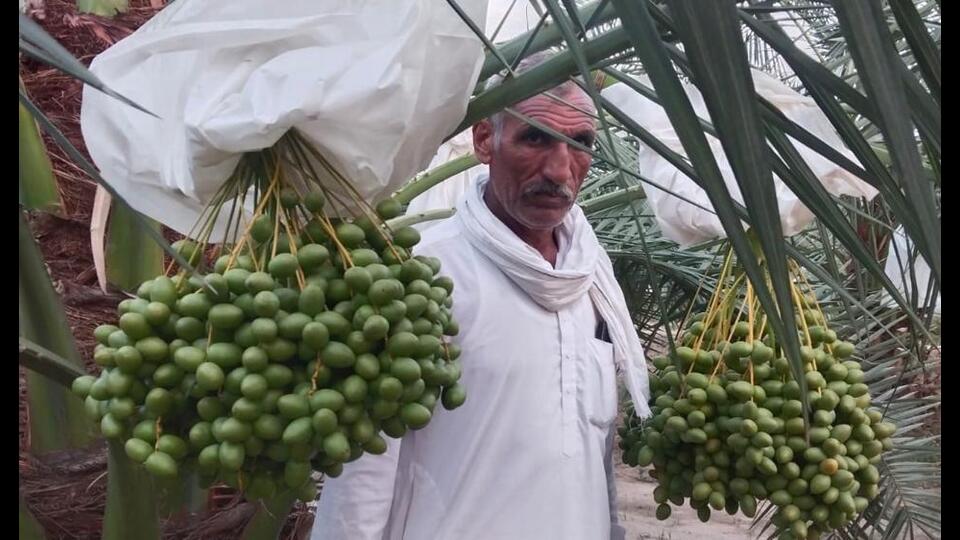
Backed by a monitored farm demonstration near Abohar, horticulture experts of Punjab Agricultural University (PAU) have favoured boosting date palm cultivation in the southwest districts of Punjab under an organised crop diversification plan.
Experts emphasise emulating the successful model of Rajasthan under which the government provides a 75% subsidy on tissue culture of the “hardy plants”, or the plants that can survive in all climatic conditions.
Anil Kamra, the horticulture scientist working on date palms at the PAU’s regional fruit research station in Abohar town of Fazilka district, said as the farmers growing kinnow and cotton in the southwest region of Punjab are undergoing economic stress and a planned push to adopt farming of the commercial crop of dates can be a game changer.
PAU study says “barhee” and “hillawi” varieties of dates are the most appropriate for cultivation in Punjab. These varieties can be grown even in the areas affected by saline groundwater, a problem in a sizeable area of the south Malwa districts.
These varieties ripe on trees and the fruit can be consumed raw. The low-quality dates are processed to make “chhuara” and used in jams, mouth fresheners and even distil wine.
Financial assistance from the government can motivate farmers to adopt date palm cultivation as a plant produced from tissue culture costs around ₹4,500. It is recommended to grow about 70 saplings in an acre, said Kamra.
“Date cultivation is a conventional crop for the arid parts of Gujarat whereas Rajasthan adopted it about a decade ago on a big scale. A government-supported plan has yielded results in date palm cultivation where farmers have started earning a handsome income from lands with low water availability. Our study shows that topography of Fazilka, Bathinda, Muktsar, Mansa and other areas possesses immense potential in this sector,” said Kamra, who also had a stint with Rajasthan’s date palm promotion programme.
Nachhatar Kaur Brar, a progressive farmer, started experimenting with growing 20 plants produced by tissue culture on her land at Khippanwali in 2011. The field is being used as a demonstration site by the PAU to push date palm farming.
She bought plants from a private laboratory in Jodhpur, the same facility that supplies tissue cultures to the Rajasthan farmers.
“Due to acute waterlogging, we had to uproot kinnow orchard spreading over eight acres in 2010. Since the Rajasthan government had started promoting date palms, we stuck with the idea of experimenting in our field. Tasting success, we sowed date palms on another four acres in 2019 and added another 3.5 acres in 2021,” she added.
Farmer Dara Singh, who has been hired by the Brar family to upkeep the demonstration field, says that date palm is less labour-intensive and one worker can take care of the crop on the two acres.
A state award-winning orchardist from Abohar, Arvind Setia, said date palm cultivation can be a viable option for the region but harvest time during the monsoon season poses a threat to the health of ripe crops.
Dispelling the concerns raised by Setia, the Brar family said plastic bags can be used to cover the bulky bunches to protect the fruit.
“A date palm plant starts bearing fruit after four or five years and in the next couple of years one may recover the cost of investment. Our experience says after spending about ₹3.5 lakh on 80 plants in an acre without any subsidy in 2021, it costs about ₹30,000 per year on maintenance. Plantation in 2019 has started giving fruit and we expect a good harvest next year,” said a member of the Brar family.
Horticulture director Shailender Kaur could not be contacted.
Fazilka deputy commissioner Senu Duggal said she would submit a detailed report to the state government about promoting date palms after the Khippanwali farm harvests fruits in the next few weeks.
“In an earlier visit to the farm, the PAU scientists had briefed me about a substantial market of non-perishable fruit. This fruit crop can potentially help in pushing diversification in the long term,” she added.


