
 E-Paper



Dragon fruit, apple could soon be growing in Punjab, PAU develops new horticultural varieties for cultivation
PAU vice-chancellor Satbir Singh Gosal, said the new recommendations, including five fruit crops, 11 vegetable crops and two flower crops will leg-up the cultivation of horticultural crops, thus, paving way for crop diversification as well as income enhancement of the state farmers


After Punjab Agricultural University (PAU) successfully experimented with the cultivation of dragon fruit, apple, tarwanga and many other fruits, and vegetables in Punjab’s climatic conditions, these could soon be seen flowering and bearing fruits in the state.
PAU has developed and recommended 18 new varieties of horticulture for cultivation in Punjab.
PAU vice-chancellor Satbir Singh Gosal, said the new recommendations, including five fruit crops, 11 vegetable crops and two flower crops will leg-up the cultivation of horticultural crops, thus, paving way for crop diversification as well as income enhancement of the state farmers.
The crops includes vaniglia sanguigno of citrus (sweet orange), red dragon 1 and white dragon 1 of dragon fruit, dorsett golden and anna of apple, PKH 11 cucumber, Punjab sarda of muskmelon, Punjab jamuni and punjab roshni of carrot, Punjab khushboo of coriander, Punjab vegetable guar I of cluster bean, Punjab tarwanga I of tarwanga, Punjab potato 101 and Punjab potato 102 of potato, Punjab himmat of brinjal, Punjab lalima of okra, Punjab bahar guldaudi 1 and Punjab bahar guldaudi 2 of flower crops.
The varieties were approved during the meeting of the state varietal approval committee held under the chairmanship of Punjab horticulture director Shailender Kaur.
Giving details, research director AS Dhatt and director of extension education Ashok Kumar said the approval has been given after detailed discussion on the salient characteristics of all varieties.
Vaniglia sanguigno, whose average yield is 47 kg/tree, is recommended for the arid irrigated zone of Punjab. The fruits of red dragon 1 and white dragon 1 could be seen flowering and bearing from July to November under Punjab’s climatic conditions. Their average yield after the fourth year of planting is 8.35 kg/pillar and 8.75 kg/pillar, respectively.
Dorsett golden and anna are low chilling and early maturing varieties of apple. Their average yield is 30 kg/plant and 32 kg/plant, respectively.
PKH 11 is the first parthenocarpic gynoecious cucumber hybrid suitable for cultivation in poly/net houses only. Its total yield is 320 q/acre and 370 q/acre in September and January sown crop, respectively.
Punjab sarda has high firmness, long shelf life and is suitable for distant transportation. Its average fruit yield is 56.0 q/acre yield.
Punjab jamuni is a tropical variety which gets ready for harvesting in 92 days after sowing. Its average root yield is 218 q/acre. Punjab roshni, another tropical variety, gets ready for harvesting in 96 days after sowing. Its average root yield is 207 q/acre.
Punjab Khushboo’s average yield of green leaves and seed is 184 q/acre and 3.16 q/acre, respectively. Punjab vegetable guar 1 is an early variety and ready for first harvest in 51 days after sowing. Its average green pod yield is 39 q/acre.
Punjab tarwanga’s leaves are green and vines medium with intermediate intermodal length. It yields 78 q/acre during the spring season.
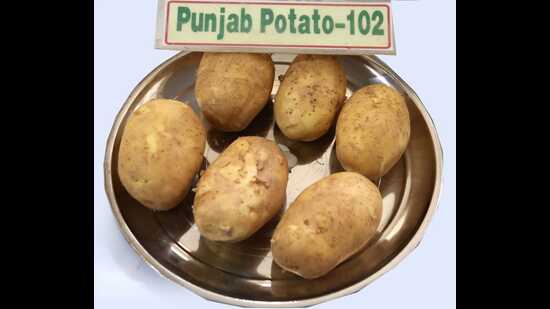
Punjab potato 101, which is a table purpose potato variety with early bulking potential, has average tuber yield of 178 q/acre. Similarly, Punjab potato 102, a table purpose potato variety, is an average tuber yield of 184 q/acre.
Punjab himmat variety belongs to the long fruit group in brinjal. It yields 242 q/acre in normal soils conditions. It can also be grown in salt affected areas with an average yield potential of 204 q/acre.
Punjab lalima has tolerance to yellow vein mosaic virus disease and is rich in anthocyanin and iodine content. Its average marketable yield is 50 q/acre.
Punjab bahar guldaudi 1 and Punjab bahar guldaudi 2 are suitable for loose flower production with average yield of 2.294 kg/m2 and 1.668 kg/m2, respectively.


