
 E-Paper



Guest Column: Dear doctor, dear no more
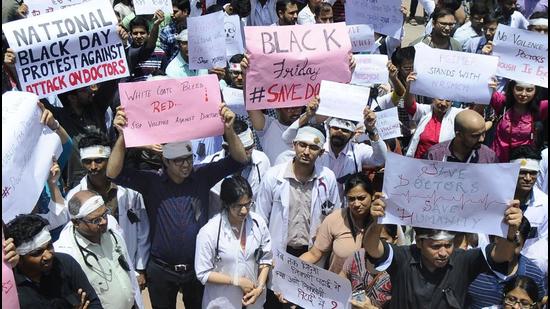
Doctor’s Day, which is observed to celebrate and thank medical professionals for their tireless services, sounds hollow nowadays with increasing instances of assault against medics, and patients denouncing the frontline warriors as merchants of death


“What is there to celebrate?” my colleague had shot back when I mentioned that Doctor’s Day (July 1) was just around the corner. Clearly, he was not yet over the ill-considered remarks of an acquaintance.
The latter had begged my friend to arrange an ICU bed for his father whose oxygen levels had dipped dangerously after contracting Covid. My doctor friend had taken great pains to have him admitted to a private hospital despite a scarcity of beds. A week later, after his father had passed away, the same acquaintance was seen accusing doctors of unnecessarily putting patients on ventilators and expensive drugs to make money. He scathingly called them “maut ke saudagar.”
The epithet, “merchants of death”, had me thinking and took me back to my introduction to this ‘merchandise.” I was a third-year medical student in the midst of a rigorous month-long maternity duty. Sadly, the lesson was delivered by a set of triplets born two months too early. They were tiny, under 800g each. The first was stillborn, the second gasped and turned blue, while the third died 15 minutes later, despite our fervent attempts to save her. For months after the incident, I was jolted out of my sleep by the weak whimpering of the preemies who had died before they were expected to be born.
I was told that the guilt and grief of losing a patient hits the hardest the first time around and then it gradually becomes easier to process. However, the truth is that doctors lose a part of themselves with each patient that passes away in their care. Thus, I was apprehensive when the government recently recruited medical students to carry out Covid duties. Apart from the danger of being exposed to the infection, I wondered how they would cope with the turmoil. They may possibly become cynical, suffer from post-traumatic stress syndrome, or be scarred for life as they watch medical science kneel before the might of a tiny non-organism. More importantly, I deliberated on whether it was fair to toss them into situations that may cause emotional and psychological distress before they had developed the requisite resilience?
A deluge of assaults
I was struggling with these thoughts when reports of assaults on medical professionals started pouring in. The trickle quickly transformed into a deluge. Petrified, I spoke to a friend, who said it was simple mathematics. In the first wave there were fewer patients and fewer deaths, and hence fewer assaults. With an increase in mortality during the second wave, there were bound to be more dissatisfied people who needed a target for their frustration and grief. Health professionals being ‘frontline warriors’ are an easy target. Irresponsible statements by the government and self-styled healers adds fuel to the fire.
Health professionals will continue to be assaulted till the time the perpetrators are not punished. Sadly, even if the miscreants are arrested, they are seldom charged. The conviction rate for mob fury, arson, assault, lynching and even murder is abysmally low in our country. Laws are in place but until they are used, they will not be a deterrent and transgressors will continue to do what they can get away with it.
Social psychologists need to delve into reasons for this trend of violence against doctors. In most cases, money will emerge as the common denominator. If the monetary factor is taken out of the equation, the dissatisfaction will be considerably less. We as a society save for marriages, education, houses and vacations, but few account for expenditure on disease and disability. This unpreparedness can be blamed on false promises of “free healthcare” made by successive governments. So, when sickness strikes, funds have to be borrowed or re-purposed. It is pertinent to mention here that the ‘free’ state-run hospitals are considered incompetent and are often the last resort. Even government officials are notorious for preferring privately run hospitals for their kith and kin. If the high and mighty cannot trust the system they have put in place, then how can the common man do so.
Unrealistic expectations
Earlier, small nursing homes were the backbone of the healthcare system in India. These were typically set up on loans by couples who worked day and night to provide patient care at nominal rates. Due to different laws and accreditation rules, they are slowly being replaced by swanky corporate hospitals, which have better facilities under one roof. Setting up a tertiary care centre that meets the requisite guidelines costs money, which will inevitably be recovered from the patients. In such a scenario, the state is being high handed in fixing impossible rates for the private sector to function in. If the government with all its paraphernalia cannot provide reasonable healthcare to the masses, how does it expect individuals to do so?
Medical professionals have faced the brunt of the Covid catastrophe. They have been subjected to the risk of exhaustion, illness and death. They have suffered moral distress while prioritising patients for ventilators and risked legal liability when asked to work beyond their core competency. They have been demeaned, discriminated against and have had their integrity doubted. There have been instances where they have been asked to vacate their homes in lieu of Covid duty. Let us ponder on that this Doctor’s Day.
dr_manjugupta@icloud.com
The writer is a Gharaunda-based gynaecologist . Views expressed are personal.


