
 E-Paper



Guest Column: Unleashing the power of animal-assisted healing
Problems with focus and panic attacks are not uncommon; add to this her obsession with having to set her personal and school stuff in a certain way or order, failing which further anxiety is triggered.


Sonal (name changed) twirls a pen in her hand, nervously, between her fingers. As her mother continues talking about her recent diagnosis – OCD or Obsessive Compulsive Disorder with chronic anxiety – the speed at which the pen hops between the fingers increases, ultimately falling to the ground, and earning a disapproving glance from her mother. Sonal is in Class 6, has difficulty waking up for school in the mornings, cannot even drink a glass of milk (let alone eat), and has clammy hands most of the time. Problems with focus and panic attacks are not uncommon; add to this her obsession with having to set her personal and school stuff in a certain way or order, failing which further anxiety is triggered.
“I have never been an animal lover, which can explain why I have never had a pet. However, when my best friend decided to take Sonal and me for a surprise visit to an animal NGO near me, and I saw my daughter’s response to the animals there, I understood that, perhaps, the answer lies in adopting an animal. Multiple visits confirmed this. Sonal’s visits to the animal shelter helped her relax, and let go of her inherent anxiety, which seemed to ebb away just a bit more, with each visit. Of course, her treatment continued alongside. Then one fine day, she found her ‘partner in crime’, a black and white, year-old Indi, who had lost a leg in an accident. ‘Ladli’ was promptly brought home. Love at first sight,” says Madhu, Sonal’s mother with a laugh.
Sonal’s agenda at the animal shelter continues to comprise mainly of feeding pups, with whom she feels extremely comfortable and safe. The feeling of being wanted, and caring for another living being, helps the child to relax, unwind and defocus from her obsessive behaviour. And Ladli serves as inspiration for young Sonal to overcome challenges no matter what. “She brings me hope, and underlines the fact that nothing lasts forever – not even the bad times,” says Sonal.
Anjana (name changed) was a 33-year-old suffering from terminal cancer of the brain. Her partner highlights the tough journey both of them had to undergo. “It was a nightmare when she was diagnosed, but the worst part unfolded thereafter: as treatment started, and as hope began to dwindle. The feeling of losing her and watching her die in front of my eyes, each day, with no hope in sight, was traumatic for both of us, says Mayank, Anjana’s partner.
It so happened that around that time, a female dog in the colony gave birth to a litter, the weakest of which drew the couple’s attention. “It was winter, and this little thing struggled, but what drew my attention was its never-say-die attitude. Somehow, it resonated with us. We named our new family member Spark. She eased Anjana’s journey of pain: the cuddling, the kisses, the devotion in her eyes. She stood by Anjana and me like a rock and helped me overcome the grief of loss that followed,” says Mayank.
“Depression would have been hard to overcome if Spark had not been around. It has been four years since, but she always spends some time in Anjana’s room, as if connecting with her, somehow,” he adds.
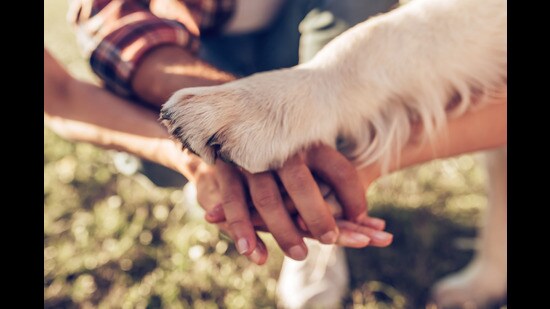
All of the instances above are indirectly or directly associated with animal-assisted therapy -- a therapeutic intervention that incorporates animals, such as horses, dogs, cats, and birds, into the treatment plan, and is used to enhance and complement the benefits of traditional therapy. Animal-assisted therapy is rooted in the bond that can develop between people and animals. Animals can provide a sense of calm, comfort, or safety and divert attention away from a stressful situation and toward one that provides pleasure. They can help combat loneliness and boost social support, both through interactions with the animal and interactions that involve other people. Animals can lead people to get more physical activity than they would otherwise. Advocates of animal-assisted therapy say that developing a bond with an animal can help people develop a better sense of self-worth and trust, stabilise their emotions, and improve their communication, self-regulation, and socialisation skills.
The role of therapy animals in helping terminally ill patients in their journey, in education as part of sensitisation classes, and in rehabilitation have been proven multiple times. Being a mother to a special child, I can vouch for the calming effect that my companion animal, Motu, has on me in extremely stressful situations, though he is not exactly in the prime of his life. Cuddling up next to him or just having him around is very reassuring. Amazingly, Motu is extremely perceptive to emotions, and when it is time for tears or joy, he just knows it, and adjusts his demeanor accordingly! For Sriyassi, my daughter, the joys lie in exploring Motu through his coat: she simply loves stroking him, ruffling his fur with her tiny hands. The important lesson that she has learnt over time is to ease her grip on him, and for him to guard himself accordingly – boundaries matter, and so does respect for the other. The balance these two have achieved over time is remarkable.
It brings to mind a famous quote by George Eliot: “Animals are such agreeable friends—they ask no questions; they pass no criticisms.”
A far cry from the human world, I would say.


