
 E-Paper



Gulmarg records season’s coldest night in Kashmir Valley
Kashmir Valley’s iconic ski resort town of Gulmarg in northern Kashmir witnessed bone-chilling weather, with temperature plunging to -12°C


Kashmir’s iconic ski resort town of Gulmarg in northern Kashmir witnessed bone-chilling weather on Monday with temperature plunging to -12°C — the lowest temperature recorded in Kashmir Valley so far this winter.
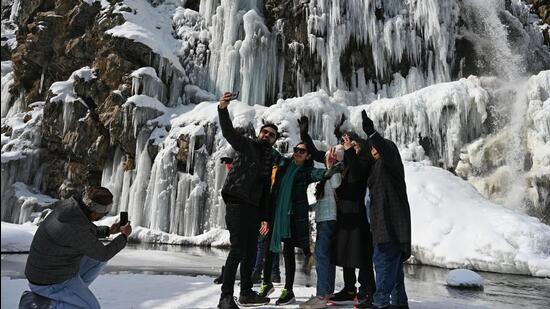
The meteorological department(MeT) said that the temperature in Gulmarg was 4.3 degrees below normal, adding that the minimum temperature in fellow tourist destination of Pahalgam in southern Kashmir also dropped to -10.2° C.
Kashmir Valley has received intermittent moderate snowfall since January 8, with Friday witnessing widespread snowfall and rains across plains as well as mountains — covering both Pahalgam and Gulmarg.
The temperatures, after climbing above zero on days that the valley received snowfall, have again dipped below freezing point at all the weather stations owing to clear skies during night.
The MeT update said that Srinagar recorded a low of -1.9° C against last night’s -0.6°C.
Northern Kashmir’s frontier district of Kupwara near the Line of Control witnessed -2.9° C while the temperature hit -6.6 °C in southern Kashmir’s Kokernag.
Jammu witnesses dry weather
MeT’s regional centre director Sonam Lotus said the weather mainly remained dry with fog in Jammu. “There was fog in the plains of Jammu and partly cloudy in the rest of the places,” he said.
Three of six weather stations in the Jammu division — Bhaderwah, Batote and Banihal witnessed sub zero temperatures at -1° C, -1.4° C and -1.5° C respectively. The winter capital Jammu, meanwhile, recorded a temperature of 4.1°C.
The MeT office has predicted the dry spell to continue until January 18, following which fresh Western Disturbances (WD) are likely to affect the region between January 19 and 24.
Lotus said the weather will be cloudy with chances of light rain/snow over isolated to scattered places mainly over the higher reaches between January 19 and 21.
“Between January 22 and 24, there is a possibility of light to moderate snowfall (rain in Jammu) in plains and moderate snow over middle and higher reaches most likely during the January 22-24 period [60% chance],” he said.
The weather office has advised people living in snowbound areas to remain alert and cautious while venturing in areas vulnerable to avalanches.
Nights to get colder: Weatherman
Predicting a drop in night temperature, Lotus said, “A fall in minimum temperature and rise in day temperature is expected. Moderate to dense fog most likely in plains of Jammu until 18 January.”
Notably, Kashmir is currently under the grip of Chillai Kalan — the harshest winter period that pans out in three stages, starting with the 40-day intense period from December 21. The same is followed by Chillai Khurd 20 more days where some respite is witnessed from the cold, and finally 10 days of mild cold as part of the Chille Bache.
The months of November and December for the major part were dry in Kashmir, recording below average rain/snowfall, the MeT said.
The same comes in the backdrop of monsoon rainfall returning to normal in 2022 after two years of deficit. The Kashmir Valley had received 270 mm average rainfall from June 1 to September 29, up 6% from the normal 254 mm.
The Jammu division similarly experienced 886 mm average rainfall in the four monsoon months, marking a 7% increase from the normal 826 mm.
Traffic disruption on NH-44
The traffic on Srinagar-Jammu highway (NH-44) had been halted after a tunnel near Panthyal was damaged due to shooting stones. However, the highway was soon cleared and traffic restored.
Informing about the development, Mohita Sharma, SSP Ramban tweeted, “Continuous shooting stones have damaged the steel tunnel to a large extent. The NH-44 is through for traffic after clearance. Travel with caution”.
Himachal braces for snow, rain from Jan 18
Shimla Himachal Pradesh is set for another spell of snowfall and rain from January 18, with two Western Disturbances (WD) likely to impact the north-western Himalayan region in quick succession.
“The first WD is likely to affect western Himalayan Region beginning the night of January 18, followed by another one on the night of January 20,” said Shimla MeT centre director Surender Paul.
WDs are storms originating in the Mediterranean region that bring sudden winter rain to the northern parts of the Indian subcontinent.
Eight districts of Himachal Pradesh, including Lahaul-Spiti, Kinnaur, Chamba, Kullu, Mandi, Shimla, Solan and Sirmaur, are expected to experience light to moderate rain or snow in the middle and higher reaches. The state’s plains, meanwhile, are likely to witness dry weather.
Meanwhile, the cold weather conditions would persist in the state on Tuesday with the MeT department forecasting dense fog in the isolated pockets of Una, Hamirpur, Bilaspur, Kangra, Solan, Sirmaur and Mandi districts.
“A cold wave is likely to sweep isolated pockets of Hamirpur, Una, Sirmaur and Bilaspur districts till January 17,” Paul said.
Kukumseri, coldest in state
Kukumseri in tribal Lahaul-Spiti was the coldest place in the state — recording a minimum temperature of -8.4° C, followed by -7.8 °C at the district’s administrative centre Keylong.
Kalpa shivered at -4.8 °C, Manali at -3 °C and Reckong Peo in Kinnaur at -2.1 ° C. The state capital Shimla, meanwhile, recorded a minimum temperature of 1.2 °C. and nearby hill-station Kufri 0.6 °C. Dalhousie was cold at 0.8 °C, Solan 2 °C, Mandi 3.4 °C, Dharamshala 5.2 °C and Palampur 2.5 °C.


