
 E-Paper



Gurdaspur encounter killing: Autopsy conducted under CJM supervision
The autopsy was carried out by a board of doctors constituted on the court directions, in accordance with guidelines governing deaths in police encounters

 Prefer HTon Google


The post-mortem of 19-year-old Ranjit Singh, who was killed in a recent police encounter in Gurdaspur district, was conducted on Tuesday evening under the supervision of the chief judicial magistrate (CJM) amid heavy security arrangements.
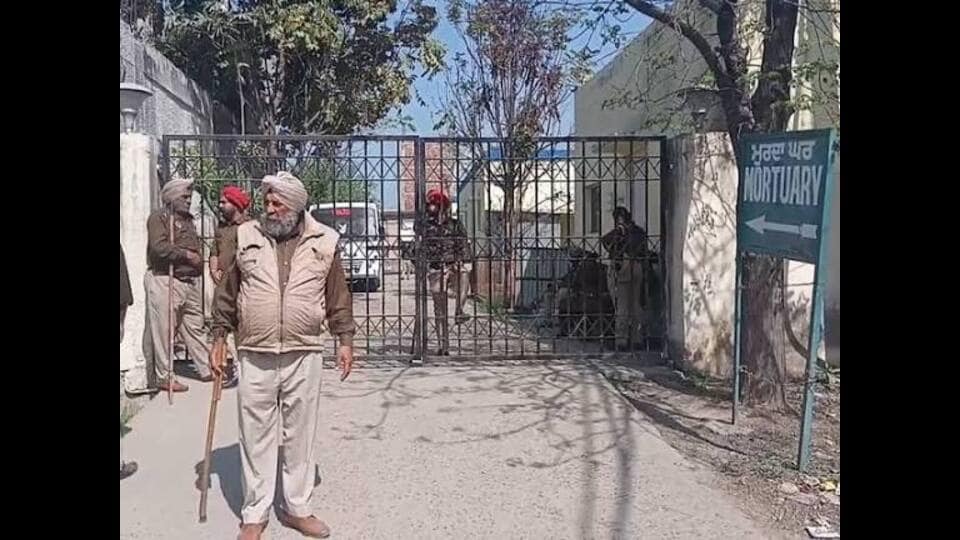
The autopsy was carried out by a board of doctors constituted on the court directions, in accordance with guidelines governing deaths in police encounters. The entire procedure was videographed. Senior superintendent of police Aditya said a judicial inquiry has been initiated and the post-mortem was conducted in the presence of the CJM to ensure transparency.
The case pertains to the February 22 killing of Punjab Police assistant sub-inspector Gurnam Singh and home guard jawan Ashok Kumar, who were found dead with gunshot wounds at a checkpost in Adhian village, close to the India-Pakistan border. Police later identified Ranjit Singh (19), Inderjit Singh (21) and Dilawar Singh (19) as allegedly involved in the attack, claiming they were acting at the behest of Pakistan-based handlers linked to the Inter-Services Intelligence (ISI). On February 25, Ranjit, a resident of Adhian village, was shot dead in what police described as an exchange of fire after he allegedly fled custody.
On March 2, the court of the chief judicial magistrate dismissed a plea filed by Ranjit’s mother, Sukhjinder Kaur, seeking that the post-mortem be conducted at the Postgraduate Institute of Medical Education and Research (PGIMER), Chandigarh. The court directed Gurdaspur senior medical officer to constitute a board of doctors locally, observing that several days had already passed since Ranjit’s death and that the post-mortem should not be delayed further.
Ranjit’s family requested the district administration to keep his body in the hospital mortuary until the return of his father, Vikramjit Singh, who is currently stuck in the strife-torn Middle East. They said the cremation would be performed only after his arrival.
As part of standard operating procedure, family members identified the body prior to the autopsy. Ranjit’s uncle, Harinder Singh Malhi, claimed the body bore two gunshot wounds — one each on the left and right side of the chest — along with injury marks near the neck. He further alleged that both of Ranjit’s hands were inside the pockets of his lower garment. The medical board has sent the viscera for chemical examination.
In a separate petition alleging that the encounter was “staged”, Sukhjinder Kaur sought a free and fair investigation. Acting on the plea, the Gurdaspur court on Monday directed the Punjab Police and telecom service providers to preserve call detail records (CDR) and GPS location data of the senior superintendent of police, officials of the crime investigation agency, and station house officers of Dorangla and Purana Shala police stations, along with other personnel involved in the operation, for the period between February 20 and February 28. The court also ordered preservation of the call records and mobile phone location data of the deceased.
The encounter and subsequent allegations have sparked political criticism, with opposition parties demanding a judicial probe into the incident.


