
 E-Paper



Haryana: Will trace culprits of Delhi blast even from netherworld: Shah
The conclave began after tributes were paid and two minutes of silence observed in the memory of those who lost their lives in the recent blast in Delhi and the explosion at Nowgam police station in Jammu and Kashmir


Reiterating the Prime Minister Narendra Modi-led NDA government’s commitment to “eliminating terrorism from its roots”, Union home minister Amit Shah on Monday assured that in line with the Union government’s track record, the culprits of the Delhi bomb blast will be traced from wherever they may be hiding and brought to justice.
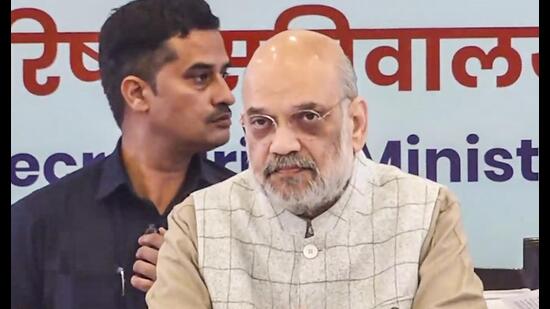
“The Union home minister said that under the leadership of Prime Minister Narendra Modi, eliminating terrorism from its roots is our collective commitment. In line with the track record of the Modi government, the culprits of the Delhi bomb blast will be traced even from the netherworld, brought before the country’s judicial system, and given the strictest possible punishment,” a spokesperson of the Haryana government said.
Shah chaired the 32nd meeting of the Northern Zonal Council in Faridabad of Haryana. The meeting was attended by Haryana chief minister Nayab Singh Saini, Punjab chief minister Bhagwant Mann, Himachal Pradesh chief minister Sukhvinder Singh Sukhu, Rajasthan chief minister Bhajan Lal Sharma, Jammu and Kashmir chief minister Omar Abdullah, Delhi CM Rekha Gupta, administrator of the Union Territory (UT) of Chandigarh Gulab Chand Kataria, Lieutenant Governor (LG) of Jammu and Kashmir Manoj Sinha, LG of Delhi Vinai Kumar Saxena, and LG of Ladakh, Kavinder Gupta, along with senior ministers from these states and union territories.
According to a statement by Haryana government, the conclave began after tributes were paid and two minutes of silence observed in the memory of those who lost their lives in the recent blast in Delhi and the explosion at Nowgam police station in Jammu and Kashmir.
Shah said that Prime Minister Modi’s vision is that strong states create a strong nation, and the Zonal Councils play a very important role in translating this into reality on the ground. Emphasising speedy investigation in cases of sexual offences and rape under the POCSO Act, Shah said that no civilised society can accept such heinous crimes. He said that the safety of women and children remains top priority.
Shah said that the original spirit and role of Zonal Councils is advisory, but in the last decade they have been accepted as action-oriented platforms and have delivered results. He said that with follow-up, we have not only accepted issues between states, between regions and states, and between the Centre and state governments, but also created concrete pathways for their resolution.
The home minister said that all states should work in mutual coordination to resolve water resource management and water-related problems.
He said that between 2004 and 2014 there were a total of 25 meetings of Zonal Councils and Standing Committees, whereas from 2014 to 2025 till now, 64 meetings have been held. He said that in these meetings, 1600 issues were discussed and 1303 issues (81.43%) were resolved.
Under the three new criminal laws, he said the conviction rate has increased by approximately 25 to 40%. He said that state governments need to make further efforts for effective implementation of these laws.
In Monday’s meeting, along with issues of the member states, several important national issues were also discussed, which included the implementation of Fast Track Special Courts (FTSCs) for speedy investigation and prompt disposal of rape cases against women and children, availability of brick-and-mortar banking within the designated radius of every village, issues related to water sharing, environment, higher education, etc., the Emergency Response Support System (ERSS-112), and other matters of common interest at the regional level.
Six issues of national importance were included in the agenda, which are — urban master planning, power supply system, strengthening of Primary Agricultural Credit Societies (PACSs), eliminating malnutrition in children through the ‘Poshan Abhiyan’, reducing school dropout rates, and participation of public hospitals in the Ayushman Bharat-Pradhan Mantri Jan Arogya Yojana.


