
 E-Paper



In Chandigarh, more men die by suicide than women
Despite mental health being more widely and openly discussed, and World Suicide Prevention Day being observed on September 10 annually to garner action to prevent such deaths, as many as 435 people took their lives in Chandigarh in the past four years


An alarming trend in suicide cases in Chandigarh has come to light, with data from the last four years (2021-2024) revealing a significant disparity between male and female suicide rates.
Despite mental health being more widely and openly discussed, and World Suicide Prevention Day being observed on September 10 annually to garner action to prevent such deaths, as many as 435 people took their lives in Chandigarh in the past four years.
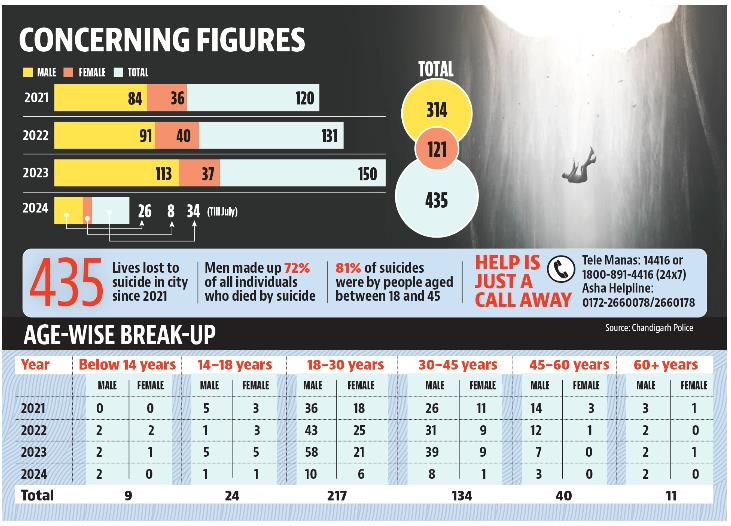
Among them, suicide affected men at a significantly higher rate, with 72% of all deaths attributed to males.
This aligns with national statistics, as in 2021, according to National Crime Records Bureau data, 56.51% of suicide victims were male, while 43.49% were female.
A breakdown of the data from January 2021 to July 2024 shows that a total of 314 males ended their lives compared to 121 females. Male suicide cases in the city consistently account for more than two-thirds of the total.
The annual statistics indicate that while the suicide rate among both genders fluctuates, the gap between male and female suicides remains considerable.
In 2023 alone, men made up nearly 75% of the total suicides. Even in the first seven months of 2024, men accounted for 26 out of 34 suicides, once again highlighting the gender disparity.
More suicides in productive age groups
Male suicides were more prevalent in the productive age groups, primarily affecting those between 18 and 45 years. The breakdown for 2023 shows that men aged 18-30 accounted for 58 deaths, while those aged 30-45 made up 39 deaths. Meanwhile, the female suicide rate in the same age groups was 21 and 9, respectively.
In 2024, 18 out of 26 men claimed their lives in the same age group.
“Men tend to be more vulnerable during their younger and middle-age years, particularly when dealing with societal pressures, career uncertainties and personal hardships,” said Dr Rahul Chakravarty, a psychiatrist at PGIMER who also oversees the institute’s mental health helpline.
‘Hanging most common cause’
Hanging remains the most common method of suicide among males, accounting for 88 suicides in 2021, 116 in 2022, 123 in 2023 and 27 in 2014. In contrast, drowning and poisoning were less common, but observed across all years.
Dr Preeti Arun from department of psychiatry, GMCH, Sector 32, said, “Women tend to use less violent methods, with poisoning and drowning being more common. While more women attempt suicide and are often saved, men are more likely to resort to violent methods, partly due to easier access to such means.”
‘Men are less likely to seek help’
“Men are less likely to seek help or talk about their emotional struggles due to societal expectations of stoicism and self-reliance. The pressure to ‘tough it out’ can result in men resorting to more drastic measures. A lot of men are dealing with unemployment issues and broken relationships, leading to early divorces,” added Dr Chakravarty.
He added, “Financial difficulties, unemployment and career stress can disproportionately affect men, who are often seen as primary breadwinners in many households. This burden may become overwhelming, especially for men in their prime working years. Men often have fewer emotional outlets or supportive social networks compared to women. While women may be more open to discussing their problems with friends or family, men may struggle alone.”
Adding to the factors, Dr Arun added, “Men are more likely to turn to alcohol or other substances to cope with stress or depression, which can exacerbate feelings of hopelessness and lead to impulsive decisions like suicide.”


