
 E-Paper



Jamun cultivation a juicy delight for farmers of Fazilka & Muktsar
A cluster of about five villages from Fazilka and Muktsar districts have emerged as a horticulture model by earning an additional income from jamun cultivation, a fruit that hardly needs any investment

 Prefer HTon Google


PANNIWALA FATTA (MUKTSAR): A cluster of about five villages from Fazilka and Muktsar districts have emerged as a horticulture model by earning an additional income from jamun cultivation, a fruit that hardly needs any investment.
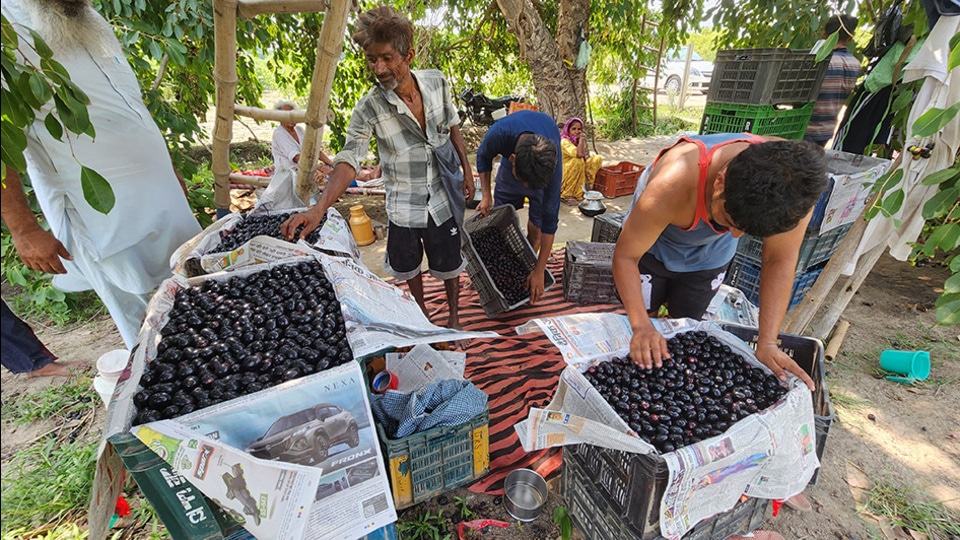
This entrepreneurial change is contributing to the local rural economy of farmers, harvesters from the Bawaria community and other villagers who participate as middlemen in fruit auctions.
Punjab Agricultural University (PAU) experts say sensing the remunerative market of this perishable fruit, a few farmers have even started developing orchards of jamun, which is also called black plum, in the semi-arid belt.
This summer fruit grown Mullinwali and Dhippianwali, the hub of jamun farming, in Fazilka has gained popularity among the fruit traders to the extent that Punjab’s only jamun mandi is held at Panniwala Fatta in Muktsar district.
Farmers of Jandwala and Jhoteanwala are also growing jamun on a big scale. Several take their produce in the local mandi whereas others transport it to other places for higher profits.
According to Muktsar district mandi officer (DMO) Rajnish Goel, this year 2,400 quintal of jamun have been sold till July 20 to the traders at the average price of ₹65 per kg.
The sale at the organised market indicates the fruit worth an estimated ₹1.56 crore was bought from traders from different states and various of Punjab.
In 2022, villagers sold 776 quintal jamun at the mandi which jumped to 1,626 in 2023.
“This time we started contacting fruit traders from Delhi, Uttar Pradesh and other places to visit the jamun mandi located on the Malout-Fazilka road. It is heartening to notice a significant surge in the sales of jamun this year and expect the sale to double than last year,” said Goel.
Sukhmander Singh from Panniwala Fatta said he sowed 20 plants on the boundary of fields in 2018 and he is making more than ₹60,000 extra income from jamun.
“About eight years ago, I had to uproot kinnow orchard after the groundwater level rose massively. Since the Malout area is a chronic waterlogged area, I hesitantly tried jamun cultivation about six years ago. A jamun tree takes about four years to bear fruits and I earn about 3,000 per tree from a deal with a fruit harvest contractor,” he said while adding that he is planning to plant more trees around his fields.
A random visit to areas around Malout and Arniwala area of near Muktsar-Fazilka belt shows a huge presence of jamun and jamuni, a wild variety.
A progressive farmer from Kamlawala in Fazilka district Amarjit Sandhu is managing jamun orchard spread over 15 acres with 50 trees in an acre.
Sandhu says he earns ₹6,000 per tree from the contractor who further sells the produce.
Extended winter season followed by unusually high temperatures during summers affected the growth of fruit this year and it yield was hit, said Bahadur Singh.
But due to a drop in production, traders are offering higher rates and we are able to make good money, he added at the mandi.
A 67-year farmer, Chanchal Singh Brar, said cultivation of this fruit promises additional income while it hardly requires any expense.
He said despite a large girth, the shadow of jamun tree does not affect the health of the crops shown underneath.
“I am doing conventional farming of wheat and cotton and earning well from jamun fruit and its wood. Farmers of southwest Punjab should adopt farming jamun to improve their financial health as traders are rushing to us to buy the produce. I used the jamun wood to make door frames for my house and had used the same for quality furniture for my daughter’s wedding gift,” said Brar.
A wholesale fruit trader from Kanpur, Ghanshayam, was impressed with the quality of the fruit produced in the area.
“In my first purchase from Panniwala Fatta, I have already purchased 40 crates (each box containing about 22-kg) fruit. A mini truck will take about 12 hours to reach Kanpur where it will be supplied to wholesale markets Delhi, Gorakhpur and other places in another 8-10- hours,” he added.
Anil Kamra, the horticulture scientist at the PAU regional fruit research station in Fazilka, said that the Indian Council for Agriculture Research (ICAR) recommends high-yield varieties of Goma Priyanka and Konkani for Punjab.
“For the last two years, a trend is picking up where farmers are investing in growing jamun orchards. PAU is working to produce ample plants in its nurseries to propagate fruit cultivation from next year,” said Kamra.


