
 E-Paper



Ludhiana district sees two-fold surge in resource saving farm practice
Fields cultivated using Direct Seeded Rice also show a slight increase of 1-1.5 quintals in the yield for the succeeding wheat crop in the Rabi season; this is because the absence of puddling means the subsoil retains its pores, providing better conditions for wheat


The district has experienced a significant increase in the area dedicated to Direct Seeded Rice (DSR) cultivation this Kharif season, more than doubling last year’s figures. With the transplantation process still halfway complete, the DSR cultivated area has already reached 4,000 acres, a considerable jump from the 1,800 acres recorded last Kharif season.
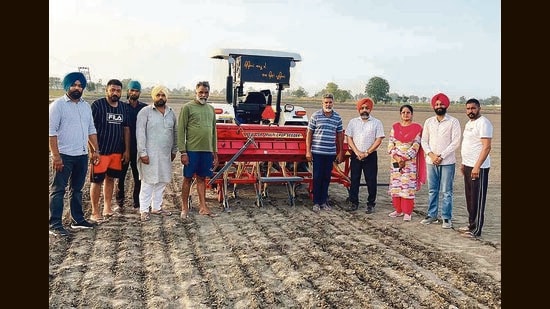
Chief agricultural officer Gurdeep Singh noted that while the total area under DSR was only 1,800 acres last year, this year has seen a substantial rise to 4,000 acres, even with transplantation expected to continue until July 15. The department anticipates that 2.58 lakh hectares of land will be cultivated with paddy this Kharif season, and Ludhiana district has already covered 50%-52% of this expected area.
Paddy experts highlight the multiple benefits of the DSR practice. Dr Buta Singh Dhillon from Punjab Agricultural University explained that DSR saves between 10%-20% of water in irrigation. This is primarily because it eliminates the need for nursery raising, which requires significant irrigation, and the subsequent puddling process to prepare fields for transplanting. Beyond water conservation, farmers also save on labour costs for nursery raising and transplanting, as well as on machine inputs for puddling and their associated maintenance. Dr Dhillon pointed out that DSR reduces the reliance on fuel-guzzling tractors for ploughing and intensive puddling, which often leads to tractors getting stuck and needing repair.
Furthermore, DSR practice aids in groundwater recharge. Singh elaborated that puddling creates a hardpan in the subsoil layer, over 15 cm below the surface, which prevents rainwater from seeping into the ground. When puddling is avoided, the subsoil remains porous, allowing water to infiltrate rather than evaporate, thereby replenishing groundwater.
Fields cultivated using DSR also show a slight increase of 1-1.5 quintals in the yield for the succeeding wheat crop in the Rabi season. This is because the absence of puddling means the subsoil retains its pores, providing better conditions for wheat, which unlike paddy, cannot tolerate excessive water and often turns pale after initial irrigation if the ground is compacted.
The DSR method utilises specialised machines that plant seeds directly with drills. Singh explained that this process, unlike traditional seed spraying, employs a geometric approach to ensure seeds are equally distanced, allowing them to optimally benefit from soil nutrition and solar radiation.


