
 E-Paper



Majority of ‘digital arrest’ victims in Chandigarh are women
The fraudsters, posing as law enforcement officials or government representatives, exploit fear and social stigma to trap their targets.


A recent trend in the rising cases of ‘digital arrest’ cyber frauds in Chandigarh shows that majority of the victims are women. According to police data, 13 digital arrest cases have been registered in the city so far in 2025, of which nine involved women victims while remaining cases involved men, most of them senior citizens over the age of 60.
The fraudsters, posing as law enforcement officials or government representatives, exploit fear and social stigma to trap their targets. According to Chandigarh police, the modus operandi involves callers impersonating officers from the CBI, NCB, or cyber cell, claiming that the victim’s bank account or Aadhaar has been linked to a crime. In many cases, victims are coerced into staying on video calls for hours, termed as a “digital arrest”, and eventually forced to transfer large sums of money to “secure” accounts.
Women disproportionately targeted
Police point out that women are particularly vulnerable due to the fear of reputational harm and the stigma attached to being linked to criminal investigations.
“Fraudsters know that fear works differently with women. They use intimidation tactics, claiming that their names will appear in public FIRs or media if they do not cooperate. This fear often overrides rational decision-making,” said DSP Cyber, Venkatesh.
In one recent case, a 72 year-old woman in Chandigarh was duped of ₹11 lakh after she was told her Aadhaar was used for drug trafficking. She was kept on a 16-hour video call, during which she was repeatedly threatened with arrest and defamation.
Divya Bansal, professor and head of cyber security and research at PEC said, “Women are often more vulnerable to cybercrimes and financial frauds, including “digital arrest” scams, due to a mix of socio-behavioural and structural factors. In many socio-cultural settings, women may exhibit higher trust in perceived authority figures and a stronger inclination to comply with official-sounding instructions. Fraudsters exploit this by using fear-based and urgent narratives to trigger quick, uncritical responses using psychological manipulation. Women engaged in online financial transactions or remote work may also share personal details more frequently, increasing exposure to data harvesting.”
Bansal added, “Limited participation in targeted cyber safety training further reduces awareness of evolving fraud tactics. Social conditioning also discourages challenging authority or engaging in confrontations can also make women less likely to question suspicious demands. These factors combine to make women particularly susceptible to manipulative, high-pressure cyber fraud schemes.”
‘Cyber awareness kiosks are being set up at public places’
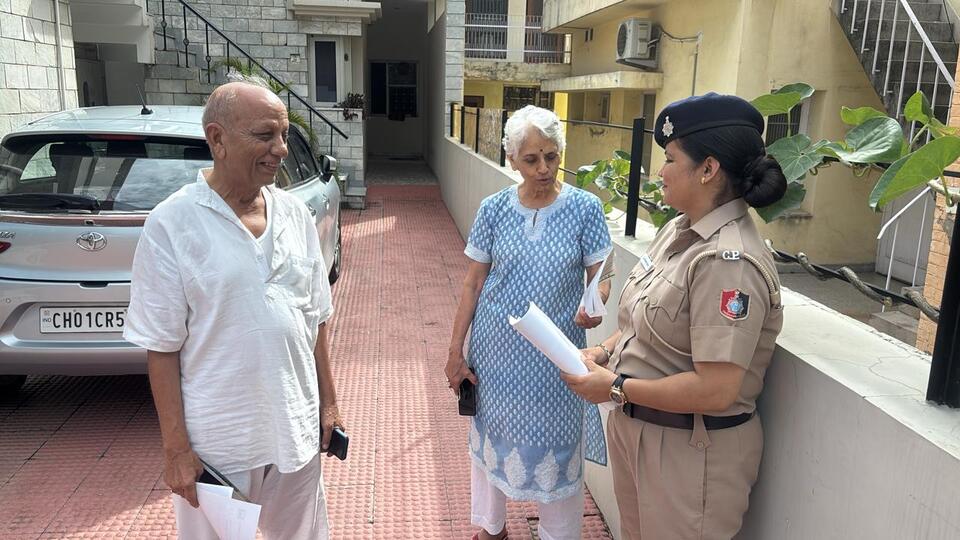
DSP Cyber, Venkatesh said, “We are going beyond traditional awareness drives. Advertisements are being run in theatres, and our Public Address System is being used to spread real-time traffic and cyber safety messages. Soon, we will launch the Cyber Swachta Mission to build a cleaner and safer digital space. Cyber awareness kiosks are being set up at public places, and our teams are visiting door-to-door to sensitise residents. The idea is to ensure that no citizen falls prey to fear-driven scams like digital arrests.”
Police are also collaborating with banks and telecom operators for quick freezing of suspicious accounts and numbers flagged in such crimes.
Woman duped of over ₹11 lakh (August 2025)
A resident of Sector 35 was defrauded of more than ₹11 lakh by someone impersonating a police officer. The fraudster falsely claimed her Aadhaar was linked to a parcel sent to Thailand containing narcotics. She was then connected to a supposed IPS officer from Delhi’s cybercrime cell and coerced into withdrawing her fixed deposits and transferring funds under the pretext of clearing the case.
Woman loses ₹77.4 lakh (July 2025)
A woman from Sector 34 fell victim to a “digital arrest” scam, in which perpetrators posing as law enforcement agents intimidated her into transferring ₹77.4 lakh.
Elderly woman duped of ₹1 crore (July 2025)
A major fraud racket was busted where an elderly woman of Sector 33 was tricked into transferring ₹1.01 crore. Perpetrators posed as CBI officials, used forged documents, and manipulated her to use multiple bank accounts. The cyber cell arrested ten individuals. However, only ₹36 lakh was frozen and is slated for return.


