
 E-Paper



Monsoon leaves Chandigarh with 29% shortfall
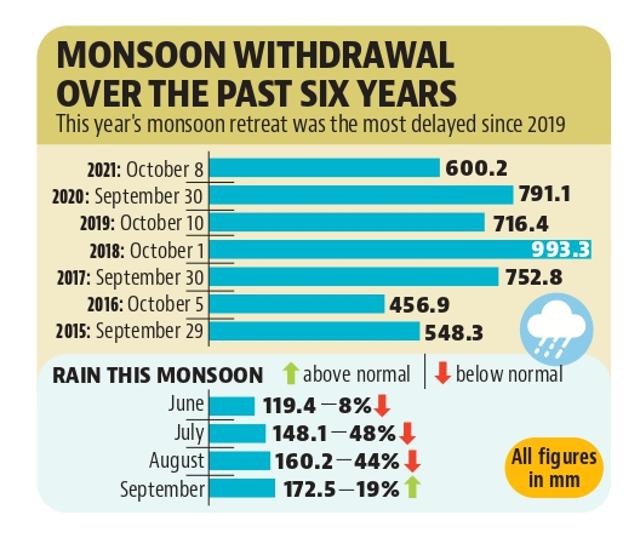
This is the most delayed rainy season withdrawal in Chandigarh since 2019, as per IMD officials. It retreated on September 30 in 2020 and on October 10 in 2019

 Prefer HTon Google


The India Meteorological Department (IMD) announced monsoon withdrawal in the region on Friday, 13 days later than its normal departure on September 25.
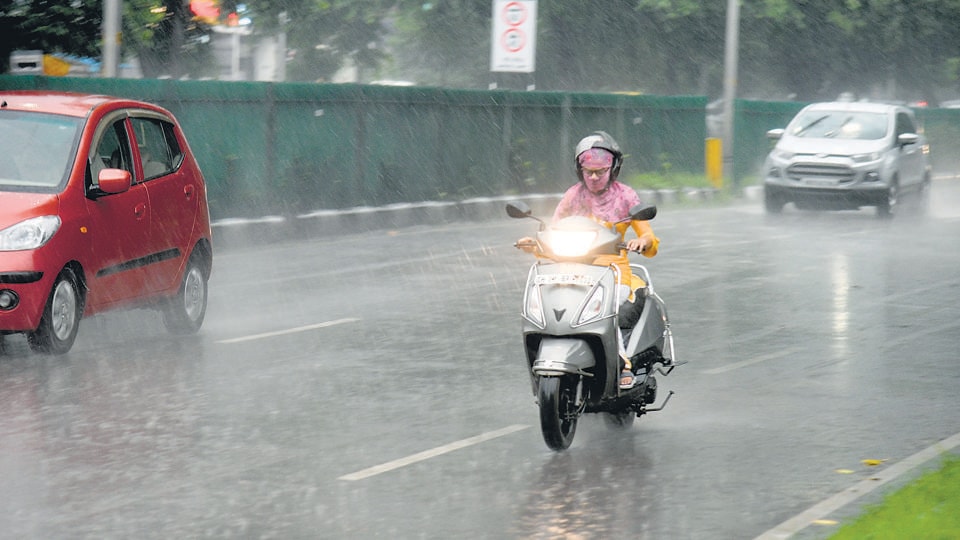
This is the most delayed rainy season withdrawal since 2019, as per IMD officials. It retreated on September 30 in 2020 and on October 10 in 2019.
According to IMD, monsoon withdrawal is announced when no rain is recorded in the whole region for four to five days in a row and an anti-cyclonic movement starts to form over the region.
“Rain continued till the end of September due to the formation of Low Pressure Areas (LPAs) over the Bay of Bengal and due to pressure differences in the region. LPAs had a huge impact on monsoon in this region this year,” said Manmohan Singh, director, IMD, Chandigarh.
Weakest monsoon since 2016
This year, the region received 600.2mm rain against a normal of 846.5mm, a deficit of 29%.
This made it the weakest monsoon since 2016, when 456.9mm rain was recorded.
“July and August, which are supposed to be the rainiest months of the year, didn’t see enough precipitation this time. In comparison, September was the wettest month, which is unusual, but has emerged as a trend in the recent years,” said Singh.
Monsoon had started off strong with 119.4mm rain in June, though it was 8% below normal. However, at 148.1mm, the rain in July was 48% deficient. The deficit continued in August that saw 160.2mm rain, a 44% shortfall.
September sprang a surprise with 172.5mm rain, which was 15% surplus, making it the only monsoon month this year with above normal rain.
Punjab and Haryana were wetter than Chandigarh
While rain remained on the lower side in Chandigarh, overall, the region saw sufficient rainfall.
Haryana received 30% excess rain (573.1mm), highest in the past 18 years, which brought along problems for farmers, delaying harvest and sowing of next crop.
Though rain was 7% deficient in Punjab (436.8mm), it was highest in the past eight years.
IMD officials said Chandigarh remained drier in particular due to local factors and pressure differences that developed over the city.
Dry weather ahead
On Friday, the maximum temperature went up from 33.7°C on Thursday to 33.8°C, one notch above normal. But the minimum temperature decreased from 22.3°C to 22.1°C, still four degrees above normal.
Dry weather is likely to continue in the coming days, which will see a drop in the night temperature. It is expected to remain lower than 22°C, while the day temperature will be between 33-34°C.


