
 E-Paper



Night temperature goes two notches below normal in Srinagar
The meteorological department of J&K said all the weather stations recorded freezing temperatures with lowest in Pahalgam and Gulmarg resorts


/ After hovering above normal since January-8 snowfall, the night temperature in Jammu and Kashmir’s Srinagar plunged to - 4.3°C on Wednesday, some 2.2 degrees below normal.
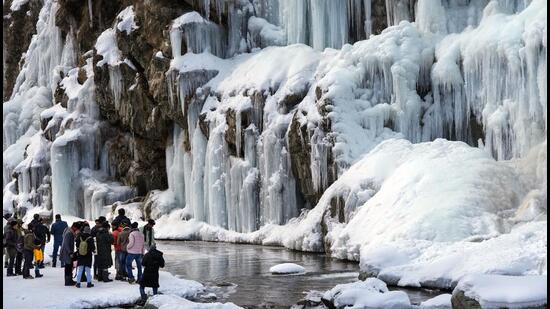
The meteorological (MeT) department of J&K said all the weather stations recorded freezing temperatures with lowest in Pahalgam and Gulmarg resorts.
The MeT update said that the south Kashmir resort of Pahalgam in Anantnag witnessed -11.7°C (4.5 degrees below normal), while it was -11.3°C in the ski resort of Gulmarg in north Kashmir’s Baramulla, some 3.6 degrees below normal.
North Kashmir’s frontier district of Kupwara near Line of Control witnessed -6.2°C (9.3 degrees below normal), while it was -6.3°C in South Kashmir’s Kokernag, some 2.4 degrees below normal.
Jammu division’s three out of six weather stations -- Bhaderwah, Batote and Banihal -- continued to witness subzero temperatures at -1.4°C, -0.5°C and -0.3°C, respectively. Jammu city witnessed 4.5°C, while it was 3.8°C in Kathua.
After witnessing intermittent rains and snow between January 8 and 13, Jammu and Kashmir is again bracing for two back-to-back western disturbances -- moisture laden weather systems from the Mediterranean -- which are expected to bring rains and snow for a week, particularly in Kashmir, from Thursday, the meteorological department had said.
The MeT update said that there is a possibility of light rainfall and snowfall at isolated places on Wednesday night with chances of light to moderate rainfall and snowfall over scattered to fairly widespread places from January 19 to 22.
From January 23 to 25, there is expected to be widespread moderate snowfall in Kashmir and rain in Jammu with moderate to heavy snow over middle and higher reaches.
“People living in snowbound areas are once again advised to remain alert and cautious while venturing out in the areas which are vulnerable to snow avalanches,” the MeT cautioned on Wednesday.


