
 E-Paper



No floor-wise units in Chandigarh’s first 30 sectors, says Supreme Court
Apex court rebukes Chandigarh admn for turning a Nelson’s eye to the increasing conversion of multi-storey residential houses into apartments


The Supreme Court on Tuesday ruled that first 30 sectors of Chandigarh carried the heritage status of Le Corbusier zone and, therefore, conversion of residential houses into floor-wise apartments cannot be permitted in these sectors.
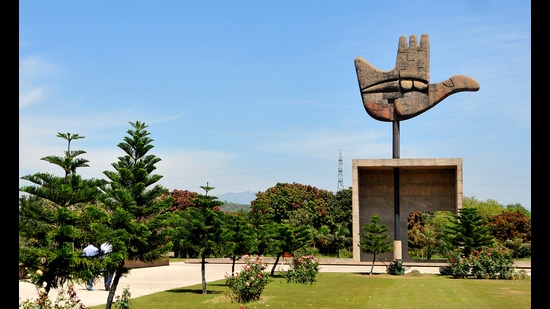
Haphazard developments must be arrested before they damage the environment and heritage status irretrievably, the SC bench led by justice BR Gavai underlined as it pulled up the Chandigarh administration for “blindly” permitting apartmentalisation in the city.
“The fragmentation/apartmentalisation of residential units in Phase 1 (northern sectors) of Chandigarh is destructive of the vision of Le Corbusier. It is also opposed to the concept of protecting and preserving the heritage status of Corbusian Chandigarh,” said the bench, which also comprised justice BV Nagarathna, prohibiting fragmentation/division/ bifurcation/apartmentalisation of a residential unit in Phase 1 of Chandigarh that comprises Sectors 1 to 30.
Reproaching the UT administration for “turning Nelson’s eye” to single dwelling units being converted into apartments despite regulations prohibiting the change, the bench held that the heritage status of Chandigarh must be preserved, adding that unauthorised construction will “injure the lungs” of India’s first planned city.
“Such a haphazard growth may adversely affect the heritage status of Phase 1 of Chandigarh that is sought to be inscribed as a UNESCO heritage city,” said the bench.
Pointing out that Chandigarh Master Plan (CMP)-2031 and the relevant apartment rules prohibit the mushrooming of apartments, the court lamented that the authorities of the Chandigarh administration were blindly sanctioning building plans though these plans are in effect converting one dwelling unit into three apartments.
Heritage committee to consider redensification
It said the Chandigarh Heritage Conservation Committee will consider the issue of redensification in these sectors. After that the UT administration will consider amending the CMP-2031 and the 2017 apartment rules in accordance with the recommendations of the committee. Any amendments will have to be placed before the central government for approval.
“…the committee will take into consideration its own recommendations that the northern sectors of Chandigarh (Corbusian Chandigarh) should be preserved in their present form; The committee shall also take into consideration the impact of such redensification on the parking/traffic issues,” the bench directed.
Freeze on change in floor area ratio
The court also ordered freezing of the floor area ratio (FAR) in the northern sectors and restricted the number of floors in the area to three with a uniform maximum height as fixed by the heritage committee keeping in view the requirement to maintain the heritage status.
Bars on administration
As an interim measure, the administration has been directed to not sanction any plan of a building which the court said “ex facie appeared to be a modus operandi to convert a single dwelling unit into three different apartments occupied by three strangers”.
It has also barred the Chandigarh administration from registering a memorandum of understanding (MoU) or agreement or settlement among unrelated co-owners of a residential unit for the purpose of bifurcation or division of a single residential unit into floor-wise apartments.
The administration has also been forbidden from formulating rules or bylaws without prior consultation of the heritage committee and prior approval of the central government.
The apex court maintained it was necessary that a proper balance was struck between sustainable development and environmental protection, and urged the Central government, cabinet secretary and states’ chief secretaries to pay heed to the court’s call.
Order came on RWA’s 2016 plea
The court was hearing an appeal filed in 2016 by the Sector-15 Residents Welfare Association (RWA), seeking an order to the administration not to permit residential plots to be constructed or utilised as apartments.
In 2022, the Punjab and Haryana high court had ruled that residential plots in Chandigarh can have multiple shareholders, even outside the family. It was this order that has been challenged by the RWA.
In this matter, it had come to light that between 2016 and 2019, as many as 891 sale deeds were registered by the Estate Office, wherein a part of the property was sold outside the family.
In 2001, the administration had notified the Chandigarh Apartment Rules, whereby single residential units could be sub-divided into apartments. But it was repealed in October 2007. The administration has since maintained that no permission is being granted to convert residential houses into apartments.
SC observed that having noted the stand of the Chandigarh administration that the construction and floor-wise sale of residential building was not permissible in view of Rule 16 of the 2007 rules, the high court ought to have held that the statutory rules framed under the Capital of Punjab (Development & Regulation) Act, 1952, expressly prohibit fragmentation/division/bifurcation/apartmentalisation of a residential unit in Phase 1 of Chandigarh.
Chandigarh is the country’s first planned city since Independence and has received international acclaim for its architecture and urban design. The city’s master plan was developed by French architect Le Corbusier.
In 2016, UNESCO had conferred heritage status on the Capitol Complex, designed by Corbusier.
(With inputs from Hillary Victor)


