E-Paper



Once thriving, comrades now left on the margins of Punjab politics
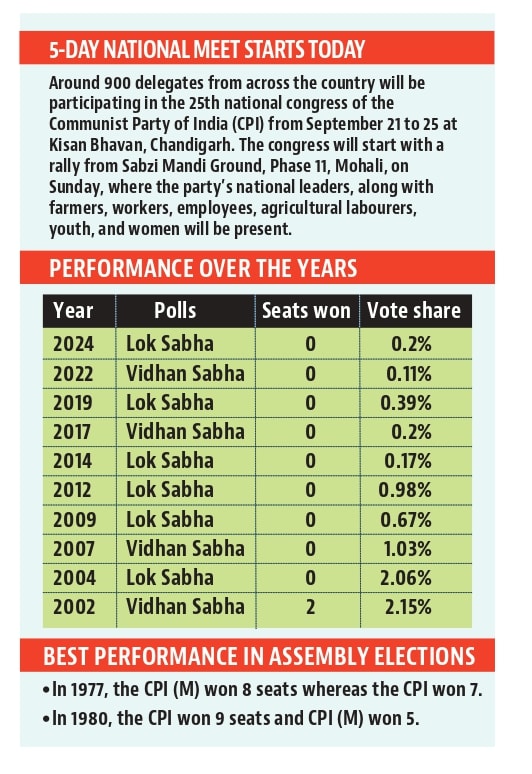
It has been over 23 years since any Left party last won an assembly seat in Punjab. In 2002, CPI had managed to secure two reserved seats — Malout, represented by Nathu Ram, and Pakka Kalan (now Bathinda rural), represented by Gurjant Singh Kuttiwal when the party had forged an alliance with the Congress.

 Prefer HTon Google


When the Communist Party of India (CPI) gathers in Punjab for its national congress starting Sunday, the irony will be hard to miss — the Left, once a force to reckon with in the state politics has today been reduced to a near non-existent presence.
Both CPI and CPI (Marxist) have seen their support base shrink in a state once regarded as a nursery of comrades. This even as the state saw the emergence of big names such as Comrade Harkishan Singh Surjit Singh and Satpal Dang in the past few decades.
It has been over 23 years since any Left party last won an assembly seat in Punjab. In 2002, CPI had managed to secure two reserved seats — Malout, represented by Nathu Ram, and Pakka Kalan (now Bathinda rural), represented by Gurjant Singh Kuttiwal when the party had forged an alliance with the Congress.
The last time that the Left found electoral success in parliamentary politics in the state was in 1999 when Bhan Singh Bhaura won the Bathinda Lok Sabha seat, again as a Congress ally.
All three victories had come from constituencies reserved for Scheduled Castes, indicating the limited appeal of the communist movement even then.
In 2012, Left parties made desperate attempts to revive its fortunes by forging an alliance with former finance minister Manpreet Badal’s People’s Party of Punjab (PPP) but failed to make a mark as not only did the alliance lose all seats, the communist parties also lost their deposits from everywhere, barring the Budhlada seat.
Political thinkers believe the Left was eclipsed by the rise of regional forces such as the Shiromani Akali Dal (SAD) and the Aam Aadmi Party (AAP), as well as the continued presence of the Congress. Many leaders in the present-day Congress and AAP are those who were active supporters of the communist party in their youth.
China war, militancy, emergence of regional parties bled it out
The decline stands in sharp contrast to the Left’s past relevance in Punjab. From the 1950s through the 1980s, communist parties played a central role in mobilising farmers, agricultural labourers, and industrial workers across the state.
Communist leaders were deeply involved in peasant struggles and trade unions, with Left-affiliated kisan sabhas and labour unions often setting the agenda for rural as well as industrial agitation.
The student and youth movements in Punjab’s universities and colleges too had a strong Left imprint, producing generations of leaders who carried forward the ideological banner.
“The biggest loss the left saw was during the militancy era, post 1984, when most of its leaders were killed by militants,” said senior journalist Bakhtaur Dhillon, who had been associated with the CPI during his student years in Bathinda.
Comrade Hardev Arshi, a two-time CPI MLA, said a few tactical mistakes made by the communist parties have contributed to its erosion from the political landscape of Punjab.
“The slide began in the sixties after the Left did not react to the emerging situations (in the aftermath of the 1962 China war) on the socio-economic front. The policies of capitalism and communalism, apart from the emergence of regional parties and rise of the BJP on communal lines, proved disastrous for the Left movement across the country,” said Arshi.
Veteran journalist Jatinder Pannu said left parties are themselves responsible for the decline of the Communist ideology in Punjab. “This ideology was so strong in 1957 that the Akalis and Congress had to join hands to fight against the parties. By 1967, however, both CPI and CPM started fighting against each other and there were instances when both the parties fielded leaders to defeat veterans like Comrade Harkishan Singh Surjit and Teja Singh Sutantar.” said Pannu.