
 E-Paper



Pak using drones to drop explosives, Indian drones meant to serve humanity: Union minister Jitendra Singh
The indigenously built medium-class multicopter unmanned aerial vehicle (UAV) took off from the CSIR-Indian Institute of Integrative Medicine Complex here and successfully delivered 50 vials of Covid-19 vaccines along with syringes to a public health centre in Jammu’s Marh area near the India-Pakistan border


Unlike Pakistan which uses drones to drop weapons and further terrorism in Indian territory, India uses its drones to serve humanity, Union Minister Jitendra Singh said on Saturday at the launch of operations of an unmanned aerial vehicle to deliver Covid-19 vaccines to areas along the international border in Jammu and Kashmir.
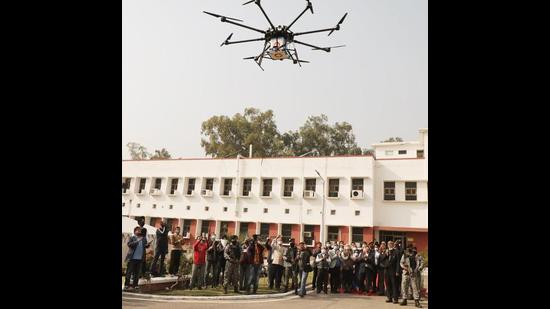
The indigenously built medium-class multicopter unmanned aerial vehicle (UAV) took off from the CSIR-Indian Institute of Integrative Medicine Complex here and successfully delivered 50 vials of Covid-19 vaccines along with syringes to a public health centre in Jammu’s Marh area near the India-Pakistan border.
“Pakistan is using drones to drop explosives to cause harm to human life and further terrorism, but our drone will act as a carrier of ‘Sanjeevani Boti’ for the betterment of humanity and is going with a message of peace,” Singh said.
He said health workers engaged in Covid-19 vaccination are facing problems in reaching families in remote and mountainous regions, and difficult terrains of Jammu and Kashmir, Uttarakhand, Himachal Pradesh, Arunachal Pradesh and elsewhere. The use of this type of drones will be of great help and also aid in fulfilling the government’s resolve of 100% vaccination, Singh said.
The GPS-guided beyond visual line of sight (BVLOS) Octacopter UAV has been developed by the National Aerospace Laboratories (NAL), a constituent of the Council of Scientific and Industrial Research (CSIR), and has a range of 55 kilometres, an official said, adding that it can carry a payload of 20 kilograms.
The UAV is integrated with a powerful on board embedded computer and latest generation sensors for versatile applications like agricultural pesticide spraying, crop monitoring, mining survey and magnetic geo-survey mapping, he said. On restrictions on use of drones in Jammu and Kashmir, the minister said there is no need to be concerned as all necessary security measures have been taken and permissions sought from authorities concerned. The civil aviation ministry had granted conditional permission to CSIR-NAL for conducting BVLOS flight trials on September 13.
Jammu and Kashmir witnessed a spurt in drone activities from Pakistan over the past one year with terrorists using the technology to drop bombs at an Indian Air Force (IAF) station in Jammu in June. Following the bombing, authorities ordered ban on storage, sale or possession, use and transport of the flying machines in various districts.


