
 E-Paper



People hit streets in Srinagar to protest ‘worst-ever’ power crisis
Locals and mainstream politicians blame the J&K government for not doing enough to resolve the power crisis


Jammu and Kashmir is currently reeling under what is claimed to be ‘worst-ever’ power crisis, which forced residents to take to streets on Wednesday.
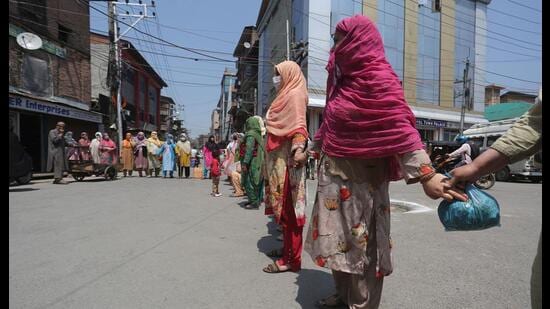
Locals and mainstream politicians blame the J&K government for not doing enough to resolve the power crisis. In many towns and villages, people claim they don’t get electricity for three to four hours in 24 hours.
“This is first time we are witnessing such a scenario in Kashmir,” said Tariq Mughloo, vice-president, Kashmir Economic Alliance. “They (government) say that the situation is due to shortage of coal and less supply. Why don’t they operate gas turbines. The power cuts have impacted the businessmen and industrial unit holders. This crisis has now entered in its third week.”
“Even during winters, when the power demand is high, people never faced such a situation,” said Rizwan Ahmad, a local. “Earlier, we used to convey our problems to mainstream politicians and they would take complaints seriously. Now, bureaucrats are at the helm of affairs who aren’t bothered about the problems of locals,” he added.
At several places, power crisis has even affected the potable water supply. “We don’t receive drinking water due to power cuts. This is happening when Kashmir isn’t witnessing peak demand due to rising temperatures,” said Sadiq Ahmad, a resident of Lolab Kupwara.
“Our district generates more than 1,000 MW of power, but we still face power cuts,” said Yasir Ahmad, a resident of Uri, where three hydel power houses are located and two projects are under NHPC.
The Kashmir Power Distribution Corporation Limited (KPDCL) in a statement said that load served during April has been around 900 to 1,100 MW against the demand of 1,600 MW, thereby creating a deficit.
“This deficit has forced corporation to go for unscheduled cuts. The early arrival of summer in rest of the country led to highest-ever power demand and reduced thermal power generation coupled with suboptimal generation of hydro power due to reduced discharge because of less rains has resulted in deficient power availability leading to unscheduled and prolonged power cuts,” the statement said.
While sharing details about current capacity, it said that hydro generation currently is around 50% of the installed capacity and load supplied by KPDCL is in the range of 900-1,100 MWs against the peak demand of 1,600MW.
A senior official of KPDCL said that hydro generation is expected to improve once discharge increases to optimal level in coming weeks subject to sufficient rainfall.
“The reduced thermal generation has affected J&K’s power allocation and imports,” the officer, said adding that situation is going to be as such in coming days till availability improves nationally and hydroelectric generation picks up.
Congress lashes out at LG admn
Jammu and Kashmir Pradesh Congress Committee on Wednesday came down heavily on the LG’s administration for the ‘worst power crisis’ and warned it to take immediate steps to improve the situation before it further worsens.
Addressing mediapersons here, JKPCC working president Raman Bhalla and chief spokesperson Ravinder Sharma strongly castigated the LG’s administration for its ‘failure’ to cope with the situation of power crisis for the past several days in entire J&K, especially in the hot and arid Jammu region.
Sharma said this kind of situation is unprecedented and was never witnessed in the past.
He drew the attention of the government to prolonged power cuts up to 14 hours in urban areas of Jammu and said that situation was ‘pathetic’ in rural areas.
Both the Congress leaders also slammed the decision to impose water tax in rural areas where there was no regular and proper supply.
(With inputs from Jammu)


