
 E-Paper



Peppers for profit: Mansa farmers turning to capsicum cultivation
Bhainibagha village, which produces maximum capsicum in Malwa region, has estimated 600 acres under green bell pepper cultivation


BATHINDA: A group of enterprising young farmers of Bhainibagha village in Mansa district is paving the way to boost their agricultural income by gradually adopting crop diversification.
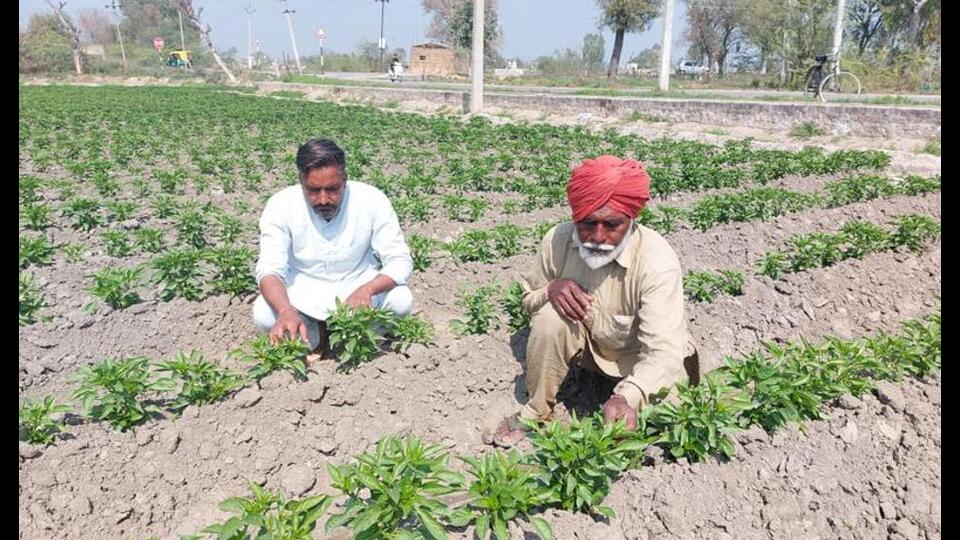
Part of the semi-arid region of Punjab, the village has carved a niche for itself by switching over to capsicum cultivation as a rabi crop by replacing the traditional winter crop of wheat.
According to horticulture department officials, Bhainibagha is credited with producing maximum capsicum in the Malwa region. Located on the Bathinda-Mansa road, the village has an estimated 600 acres, an increase of about 200 acres this season, under capsicum cultivation.
As the harvesting of capsicum begins from March 15, growers estimate to produce more than one lakh quintals of green bell peppers. Every household has a minimum of one acre under cultivation of this vegetable, say the growers.
Farmers say the crop is labour-intensive but highly remunerative. Low-cost, low tunnel structures are used for growing the crop that has a demand in several states. A 35-year-old second-generation horticulturist Hardeep Singh says capsicum cultivation costs about ₹80-85,000 per acre, including tunnel, seeds, recommended farm chemicals and labour.
“Best farm practices ensure 230-300 quintal of harvest from an acre and net saving of a farmer may be up to ₹2 lakh per acre in the six-month crop. It is ideal for water conservation and putting less stress on the soil,” said Singh, who has been growing capsicum for over 15 years. His father Kaur Singh was among the first to grow capsicum on the joint family’s 6.5 acres in 2002.
“My father and uncle got an inspiration from Beas-based Radha Soami Satsang for cultivating capsicum. After initial challenges, they made more efforts and the rest is history. After 2002, other farmers of the village started moving towards horticulture to improve their financial status,” he added.
Farmers have overcome marketing pangs as the quality and quantity at a single-location site invites bulk buyers from across the states.
Mansa district horticulture officer Parmesh Kumar said Jhanda Kalan village and suburban town of Sardulgarh were also producing capsicum on 100 and 70 acres, respectively.
“But Bhainibagha is a unique village where farmers have set an example in the field diversification. It is the quality of their produce that wholesale buyers from Delhi, Rajasthan and several districts of Punjab rush to the village for farm gate purchase,” said Kumar.
This season, Chamkaur Singh, 30, diversified 1.5 acres of his family’s 20-acre land under capsicum. “It is a maiden firsthand experience and I have planned to double the area for horticulture in the next season. It ensures much higher returns than wheat as a winter crop,” he said.
Another grower, Sukhwinder Singh, has four acres under capsicum and he says the last two seasons of the lockdown induced by pandemic outbreak hurt the earnings. “Now, I am expecting a good season with a wholesale rate of ₹20/kg. It will compensate for previous losses,” he added.


