E-Paper



PU student politics’ sharp turn to the mainstream
After dominating campus politics for years, home-bred outfits SOPU and PUSU ceded space to students wing of mainstream political parties in the last seven PU student council elections

 Prefer HTon Google


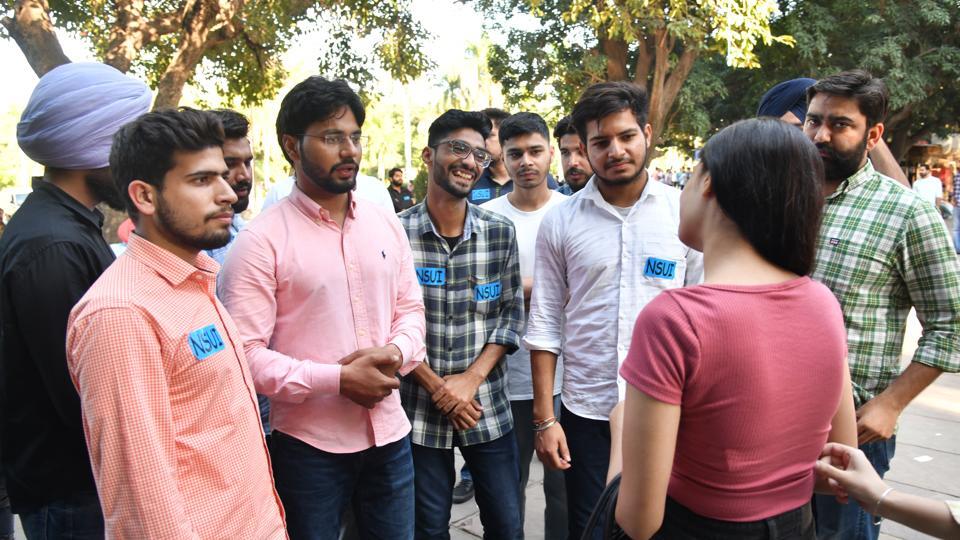
The Panjab University Campus Students Council (PUCSC) elections were first held in 1977, but it wasn’t until 2013 that a candidate from a student wing affiliated with a mainstream political party – National Students’ Union of India (NSUI) – was elected as the president of the body.
Prior to that, student politics at the varsity had been dominated by Panjab University Students’ Union (PUSU) and Students’ Organisation of Panjab University (SOPU). Both outfits take pride in their roots, having stemmed from the varsity itself.
With the rise of student bodies affiliated with mainstream political parties at PU over the last decade, however, there has been a definitive shift in student politics on campus. The competition itself has grown as the number of student bodies has hit the dozen mark now.
A year before NSUI’s win in 2013, a SOPU alliance had swept the polls. A drastic fall, however, saw the political outfit not clinch any major victory since.
The watershed moment
NSUI’s Chandan Rana was at the centre of the watershed moment as he defeated PUSU and SOPU presidential candidates, setting the stage for entry of other mainstream parties into PU politics.
Rana, who has since formed an association with Himachal Youth Congress, said the culture of PU’s student politics has made a “positive” shift since 2013 and ideas of discussion, debate and decision-making have take centre stage in the last ten years.
“In 2013, issues not confined to campus gates evoked a positive response from students. The voting percentage was 68% in 2013, around 9% more than the year before and highest up to that point,” he said, adding that students seeking a career in politics now have a platform for entry.
NSUI’s 2013 win was followed by the entry of other political parties onto campus. In the first big setback to older student parties, 14 leaders from PUSU and SOPU joined the Akali Dal-backed Students Organisation of India (SOI) in 2014. SOI went on record a major victory in the 2015 pools, sweeping the PUCSC elections.
Acknowledging a shift, PUSU president Ravinder said, “The trend has impacted the student activism on campus. We, however, have kept our ideology intact by having no political affiliations. Students have realised that they need a non-political outfit where deserving candidates are given fair chances.”
PUSU has fared slightly better than its contemporary in the last decade, having registered a presidential post win in 2016 with Nishant Kaushal. The influence that the party once held has definitely waned, but in a positive sign, they have decided to field candidates for all four posts after a near- two-decade gap.
Students For Society, another outfit to have emerged from the university, did buck the trend by beating mainstream parties in 2018. The victory, however, is often seen more as an anomaly.
Heading into this year’s elections, political science professor and former PUTA president Professor Ronki Ram noted a heightened election awareness among students on campus.
Wind in AAP’s sails
The Aam Aadmi Party (AAP) has become the latest entrant into PU politics after jumping in the 2022 race with a new student outfit — the Chhatra Yuva Sangharsh Samiti (CYSS).
Staying true to the trend, the CYSS has drawn a number of prominent faces from other student outfits. Fittingly enough, Kaushal, the star of the home-bred PUSU’s last win, was a part of the continued exodus.