
 E-Paper



Punjab bandh throws life out of gear as highways blocked, shops shut
Seeking release of Sikh prisoners, Qaumi Insaaf Morcha activists block roads, bus stands from 7 am to 2 pm, leaving commuters stranded

 Prefer HTon Google


Normal life was disrupted across Punjab on Friday as markets remained closed and traffic movement was hit at several places amid the seven-hour “Punjab Bandh” called by the Qaumi Insaaf Morcha to press for the release of Sikh prisoners.
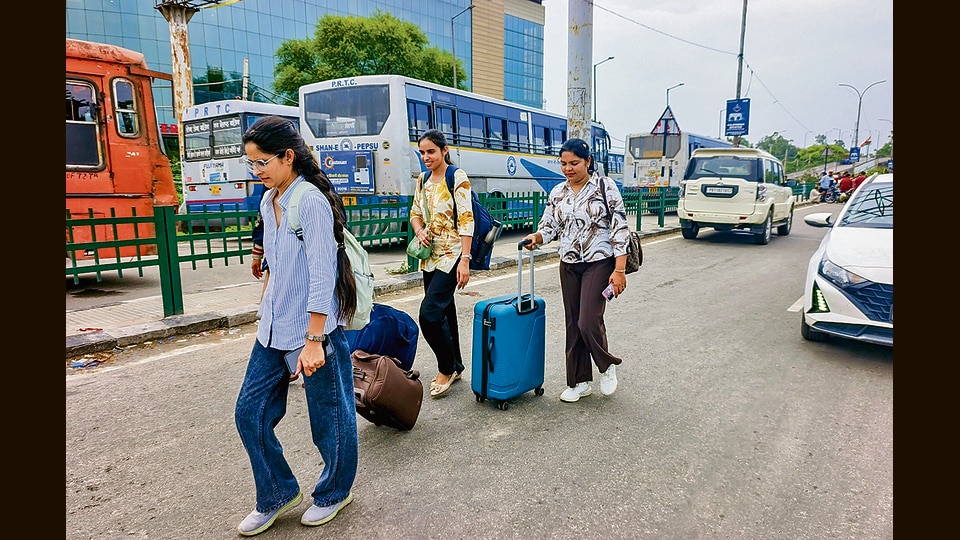
The bandh, observed from 7 am to 2 pm, evoked a near-total response in several parts of the Majha and Doaba regions, while its impact was mixed in parts of Malwa.
Heavy police deployment was made at several sensitive locations across the state to maintain law and order as supporters of the morcha and various farmers’ organisations blocked roads and highways, and marched through markets asking traders to bring their shutters down.
Commuters, especially office-goers and travellers, bore the brunt of the shutdown, with agitators blocking roads with tractor-trolleys and other vehicles, leading to serpentine queues of vehicles.
Commuters at some places were seen requesting the protesters to allow them to proceed towards their destinations. Police diverted traffic to alternative routes wherever possible.
Morcha activists and supporters also blocked the movement of private and public buses at various bus stands, causing hardship to long-distance passengers.
Essential services such as medical emergencies, travel to airports, exams and wedding ceremonies were allowed, the morcha leaders said.
Doaba hit hard
In the Doaba region, a complete bandh was observed across Jalandhar, Hoshiarpur, Shaheed Bhagat Singh Nagar and Kapurthala districts, with protesters blocking several national and state highways.
The Amritsar-New Delhi highway was blocked near Paragpur village in Jalandhar, while roads were also blockaded at several points in Hoshiarpur. The Jalandhar-Chandigarh national highway was obstructed near Nawanshahr, leaving scores of commuters stranded till the blockades were lifted.
All private schools and colleges in the four districts observed closures, while government schools reported thin attendance. Commercial establishments also downed shutters, with protesters moving through markets appealing to shopkeepers to support the bandh.
The bandh also caused inconvenience to pilgrims travelling to and returning from the Chintpurni temple in neighbouring Himachal Pradesh, as no buses were operating from the Hoshiarpur bus stand.
Near-total shutdown in Majha
In the Majha region, a near-total shutdown was observed in Amritsar, Gurdaspur, Tarn Taran and Pathankot districts as shops, offices, bank branches, malls and educational institutions remained closed.
While health services were unaffected, public transport came to a complete halt across the four districts, affecting passengers’ travel plans.
Protesters staged demonstrations and blocked roads at several places in Amritsar, including Hall Bazaar, the Bhandari railway overbridge and the Golden Gate.
Eight Sikh Youth Federation Bhindranwale leaders were taken into preventive custody after they blocked a road near the Golden Temple entrance. They were released after the bandh ended.
The shutdown also affected the movement of devotees at the Golden Temple, with footfall significantly lower than usual. The Shiromani Gurdwara Parbandhak Committee (SGPC) closed its offices in support of the bandh.
Activists also moved through city markets urging owners of partially open shops to shut their establishments and later took out a procession in Amritsar. As a result, city’s bustling markets wore a deserted look.
Pathankot reported a mixed response, with many shops remaining open despite the suspension of bus services.
Sikh and farmer organisations, however, blocked the Pathankot-Amritsar National Highway at a toll plaza on the outskirts of the town, impacting traffic movement.
Mixed response in Malwa
In Malwa, the response varied from district to district. In Bathinda, shops in several parts of the city stayed open, while most markets in the old locality were shut.
Public and private sector buses could not ply after morcha supporters assembled outside the bus stand and blocked its main gate.
Government offices and banks were open and trains ran as scheduled, while traffic on the Bathinda-Patiala, Bathinda-Sriganganagar and Bathinda-Amritsar highways remained smooth.
The bandh evoked a stronger response in Sangrur, Barnala, Ferozepur, Fazilka, Mansa and Moga districts, where most commercial areas observed shutdown.
In Sangrur and Barnala, markets, shops and even online delivery platforms remained closed. Protesters blocked Sangrur bus stand and also the Bathinda-Chandigarh National Highway near Mastuana village.
Emergency services, including hospitals and ambulances, were operational.
In Patiala, protesters parked vehicles outside the main bus stand, blocking traffic and stalling bus movement.
In Ferozepur, shops in key commercial areas of the city and cantonment remained shut. Some establishments, including banks, that opened in the morning were later closed after protesters reached there. The protesters also blocked Octroi Number 7, disrupting traffic towards Zira and Ludhiana.
The bandh was called by the Qaumi Insaaf Morcha, which has been spearheading an indefinite sit-in on the Mohali-Chandigarh border since January 7, 2023, for the release of Sikh prisoners.
Morcha leaders announced the bandh on August 15 after Chandigarh Police used tear gas shells and water cannons to disperse protesters who tried to breach barricades during a march towards the Punjab governor’s residence.
The shutdown received support from SGPC, Delhi Sikh Gurdwara Management Committee; farmers organisations, including Kisan Mazdoor Sangharsh Committee; employees unions; and political parties, including SAD (Punar Surjit), SAD (Amritsar) and Akali Dal Waris Punjab De.
(With agency inputs)


