Justice Ashwani Kumar Mishra was sworn in as the chief justice of the Punjab and Haryana High Court on Monday, even as Punjab chief minister Bhagwant Mann and his cabinet colleagues skipped the event over their opposition to the appointment.
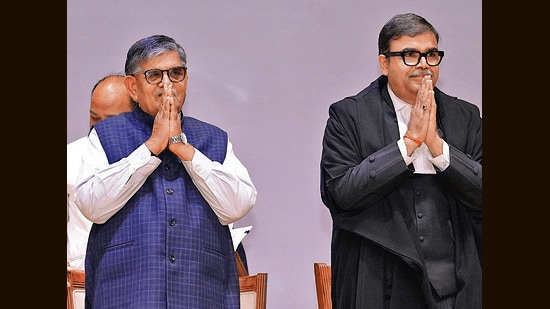
Conventionally, the CMs of both stakeholder states — Punjab and Haryana —attend the swearing-in ceremony of the high court chief justice.
The oath of office was administered by Punjab Governor Gulab Chand Kataria at Punjab Lok Bhawan. The ceremony was attended by Haryana governor Ashim Kumar Ghosh, chief minister Nayab Singh Saini, sitting judges of the high court, and senior officials from both states.
Also read: Justice Mishra sworn in as Punjab and Haryana HC chief justice; Mann skips ceremony
Punjab objects to appointment over procedure
Mann, whose administration strongly objected to the Centre notifying the appointment without awaiting state’s feedback, left for New Delhi on Sunday, following an emergency cabinet meeting where it opposed the appointment, alleging it violated Para 6 of the Memorandum of Procedure. The clause requires the state government’s views to be obtained post-Supreme Court Collegium recommendation and prior to sending the proposal to the Prime Minister for executive decision.
{{/usCountry}}Mann, whose administration strongly objected to the Centre notifying the appointment without awaiting state’s feedback, left for New Delhi on Sunday, following an emergency cabinet meeting where it opposed the appointment, alleging it violated Para 6 of the Memorandum of Procedure. The clause requires the state government’s views to be obtained post-Supreme Court Collegium recommendation and prior to sending the proposal to the Prime Minister for executive decision.
{{/usCountry}}Demanding the swearing-in be paused, the state said it received a letter from Union minister of state for law Arjun Ram Meghwal on August 12 seeking consent. The collegium had recommended justice Mishra’s name on August 6, but the notification was issued without waiting for Punjab’s input.
Also read: Mann accuses Centre of muzzling Punjab’s federal rights by elevating HC chief justice
Centre defends appointment, rejects state’s objections
Countering these claims, additional solicitor general Satya Pal Jain termed the state’s stance “unfortunate and uncalled for,” emphasising that the President made the appointment under Article 217(1) of the Constitution. Jain said the procedure was strictly followed, adding that state views are non-binding and do not grant “veto” power over judicial appointments.
Justice Mishra, 57, had been serving as acting chief justice since June 2. Appointed as an additional judge of the Allahabad HC in February 2014, he served there until his transfer to the Punjab and Haryana high court in July 2025.
Kejriwal had questioned Collegium recommendation
AAP national convener Arvind Kejriwal had previously alleged on August 9 that the Collegium overlooked seniority in recommending Justice Mishra.
Punjab’s opposition comes in the backdrop of an August 3 order passed by a bench led by Justice Mishra. The court directed the cash-strapped Punjab government to clear pending dearness allowance (DA) to employees within a fortnight while barring “unproductive expenditures”, including major advertising campaigns, until dues were cleared. The state has challenged the ruling, which imposes an estimated ₹14,100 crore burden, in the Supreme Court. The appeal is yet to be listed for hearing.
Also read: Consultation or consent? The legal faultline in Punjab’s chief justice row
‘Won’t be browbeaten’: Mishra warns against tactics
Hours after his swearing- in, justice Mishra told lawyers that the court won’t be “browbeaten by any tactics” and will defend “oath of the Constitution”.
The remarks came during hearing of two applications filed by Punjab government employees and pensioners alleging that the high court order of August 3 that mandated release of up-to-date dearness allowance (DA) by the state government within 14 days, has not been complied with. Objecting to the statements of counsels of employees and pensioners, the state’s counsel started addressing the court in a loud pitch.
Also read: Won’t be browbeaten, says new Punjab and Haryana high court chief justice on Day 1
“This court would be governed by the rule of law and this institution will not be browbeaten by any kind of tactics. So, we will go strictly as per the law. We have taken the oath of the Constitution and we know how to preserve our oath and defend it,” the chief justice said.