
 E-Paper



Roundabout | Filmmaker of the soil ever in search of characters
Rajeev Kumar’s journey as a filmmaker has been closely entwined to the Punjabi soil and the turbulent times that nurtured him


When renowned Punjabi filmmaker Rajeev Kumar, an alum of the department of Indian Theatre at Panjab University, was asked to create the set of a famous play for his final assignment, he chose Italian dramatist Luigi Pirandello’s Sei personaggi in cerca d’autore (Six Characters in Search of an Author). Since then, he has been disinterring characters from the Punjabi soil and bringing them to life under his transformative lens to tell stories of struggle and resistance that must be told.
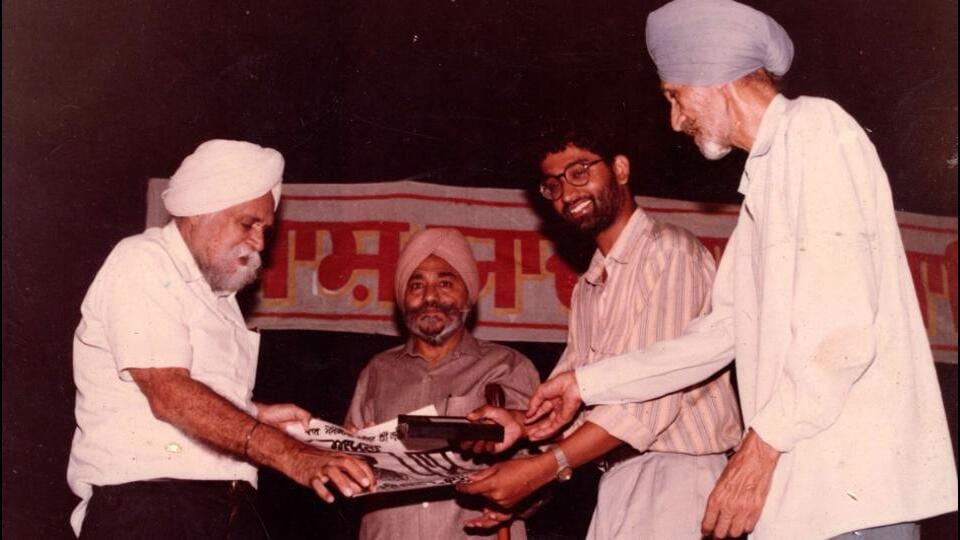
Born in 1969, the son of a police constable, the filmmaker grew up on the embers of the ultra-left Naxalite Movement, which saw a fleeting season in Punjab but left a lasting impact on its literature. To borrow the words of short fiction writer Prem Prakash: “It (the Naxalite Movement) changed the complete ethos, and way of seeing things.”
While his father was posted in Mullanpur Dakhan village, Kumar grew up in Jagraon surrounded by older cousins. “I could well be called a precocious child for I was greatly influenced by what my cousins were reading and watching, which in those days were plays of Gursharan Singh, Ajmer Singh Aulakh, and reading the novels of Jaswant Singh Kanwal,” he says.
After graduating from Science College, Jagraon, he moved to Chandigarh to study theatre. Looking back, he says: “My generation saw many movements and streams --- the dreams of the Left, the militant movement for Khalistan, the 1984 Sikh Riots, and then the western model of liberalisation. We saw it all.” However, his choice as a filmmaker was to shed light on the stories and struggles of the oppressed.
Street theatre in turbulent times
In the early years, Kumar worked with great commitment in the street theatre of the iconic Gursharan Singh, which had politics, social issues, and fair society as its concerns.
I was introduced to Kumar and his friend Jatinder Jeetu in the 90s. Jeetu, whose family had moved from New Delhi to Mohali after the 1984 violence that followed Prime Minister Indira Gandhi’s assassination, was pursuing law at Panjab University. Those were turbulent times, but then when has Punjab been without turbulence. Jeetu was active in Gurcharan Channi’s street theatre and one of the projects they starred in together was the 1994 film Apna Pash, which marked the beginning of Kumar’s journey as a filmmaker.
From theatre to cinema
How did the shift from stage to the camera happen? Kumar says, “It was not just my passion, but also that of other friends and comrades to take the story of Pash (the left-wing poet who was killed during militancy) to a larger audience. We were trying to cope with the loss of the much-loved poet.”
He adds that the love of the camera came perhaps from his father who took a course in photography and also worked as a photographer for the police force. The film, Apna Pash, remains a favourite with Rajeev for the spirit of the venture. “It was truly a collective venture. We put whatever money we had into the project. Someone would lend a camera for a few days and the dream was realised,” he says.
Another photographic memory of those days for this writer was attending the wedding of Kumar and Jeetu in a simple and warm ceremony at the Sector 38 gurdwara. Two friends had come together and Jeetu, who is head of operation at a leading television house in Mumbai, says: “Friends we still remain, sharing togetherness and even differences of opinion!”
It has been a journey down a long road with minor bumps but many moments of joy and satisfaction. The couple left Chandigarh for Mumbai after Kumar got an interesting job as the in-house director for the much-talked-about television show, Surbhi. But the call of cinema was too strong and Kumar next experimented with a short story, Atu Khoji, that set the ball rolling. It was Nabar: A Rebel With A Cause that got him the National Award for Punjabi.
A feminist foray
His other films include Chamm, Siri, Saavi and now it is onto Rakaans, which he terms his first feminist film with stories of women of substance gleaned from the Punjab countryside. He says, “ It has taken me long to see things from a woman’s perspective and the journey with Jeetu has made a difference!”
One wishes Rajeev and Jeetu, greater creative heights on the path they chose to tread!
nirudutt@gmail.com


