
 E-Paper



Roundabout | Padma, I will meet you yet again…
Padma Sachdev brought alive in literature the life and folk rhythms of the Jammu hills; her friends, family and fans will always remember her poems, the ring of her tinkling laughter and her enduring strength


None other than India’s nightingale Lata Mangeshkar in her tribute to Dogri poet Padma Sachdev, who passed from life to legend last week, said, “I am at a loss of words on hearing of the passing away of my dear friend, the famous Dogri poet and composer. Ours was a long and old friendship. She anchored my music concert in the US and I sang her Dogri song. It is a sad day for me.”
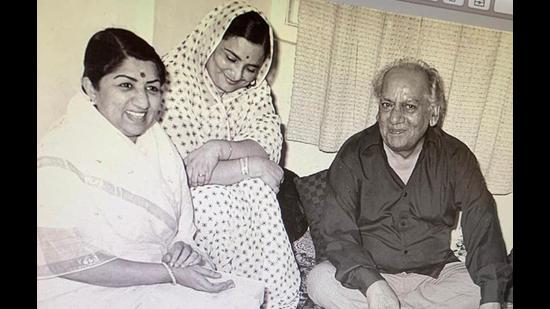
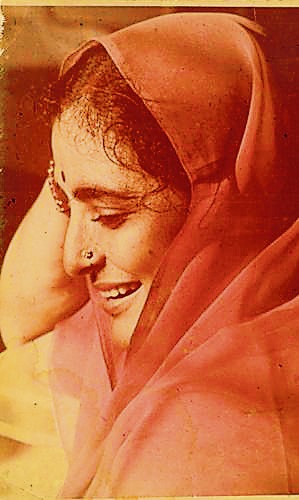
Such was the charisma of the fair-faced girl, born in 1940 at Purmandal village of the Jammu hills, who went onto be hailed as the first modern poet of the Dogri language.
I first caught a glimpse of Padma at an all-woman poetry symposium, which had been organised by Punjabi poet and television producer SS Misha in honour of Amrita Pritam winning the prestigious Jnanpith Award in 1981. My first introduction to her was her tinkling laughter and the jokes she was cracking as we sat in the bus that was to take us from the hotel to the auditorium.
At the symposium, Padma was the lone Dogri star who charmed the audience with a recitation of her two famous poems – Deshnikala, in which she described exile as the lot of a young girl after marriage, and ‘Raaje Dian Mandian’, another classic poem on class difference.
A home away from home
Too shy to ask her for an interview, I just wrote a piece on her poetry and the songs she had written for films. I was to meet her five years later on stage at yet another symposium, at the end of which she stopped me and said, laughing: “Hain te tu kallo par terian nazman barhi gorian ne. My aithe nerhe is Bengali Market rehandi haan, ghar aa ja kisse din!” (Though, you are dark, but your poems are fair enough. Why don’t you come and meet me at my house, which is close by in Bengali Market?)
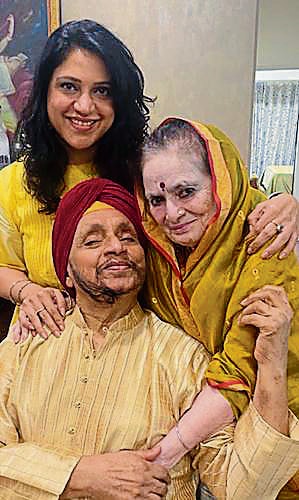
I was staying in Delhi those days and went to meet her. The warmth of Padma and her husband, Surinder Singh, the famous classical singer who made the duo with his elder brother Tejpal Singh, would make it my home away from home. The room of their daughter, Manjit Sachdev (Meeta), then but a child, was always at my disposal whenever I stayed the night. Meeta would bunk with one of her parents for the night and Padma would treat me to home-cooked food.
Looking back at this rare couple who were the celebrities of the 80s, I wonder at their warmth and generosity in making a small-town Chandigarh girl part of their family in the cold and harsh capital city.
The couple had just moved to Delhi from Mumbai as Meeta had developed allergies due to the damp weather. Their friends would keep dropping in from Mumbai and I got to meet the who’s who of writers and musicians in their Toder Mal Lane home. The most cherished part was the long time I got to spend with Ismat Chughtai of Lihaaf fame.
Sitting on Meeta’s bed she would tell me one rare story after another of the Mumbai film world. Alzheimer’s disease had just about started setting in at the time, but Ismat was still alert and witty.
Those were busy days for Padma. In the morning, she would go to her cabin in the library of the India International Centre to work on her book Sabad Milava, in which she was writing a prose piece accompanying her selected poems.
She would leave Ismat Appa and I (the bad girls as she described us) stocked with cigarettes and beer in the fridge and return in the afternoon when it was time for Meeta to return from school. Oh! What days and what precious conversations.
A friend for all times
Distance or long gaps of not being able to meet never weakened the tie of love and friendship with Padma and Surinderji as I moved back to Chandigarh. She was the happiest when I adopted a daughter. When I took her to meet Padma, what a celebration there was! Padma literally gave the child a silver spoon and Meeta’s best Russian doll.
After a meningitis attack in 1988, many thought that Padma, who had braved and fought tuberculosis of the bones at age 16 at a Srinagar sanatorium, would succumb. However, there she was again winning more awards and accolades despite frail health.
With my mother paralysed for long years and a daughter growing up, the meetings became fewer.
The summer of 2019 was the last time I was to meet her. Surinderji was resting after a long stay in the hospital. Padma, too, was not well but had changed into a special suit to meet me. I saw something black on her upper lip and almost pulled it out when she stopped me because it was the oxygen line. It was then that I noticed the cylinder. “Don’t worry Padma, you will be fine!” I told her. “That I will be!” she replied confidently.
Meeta who works for OTT platforms in Mumbai moved with them well before the Covid pandemic hit to be able to look after them. Meeta says her “ma” had been in the hospital for just two days when she insisted on returning home where she was actively planning what she would do in the future. “She called up just about everyone from Lata Mangeshkar to her dentist!”
And then she went slowly into the good night. It is a line from Amrita’s poem to Imroz that comes to the mind: “Padma, I will meet you yet again…”


