
 E-Paper



RTI reveals alarming shortage of teachers in Chandigarh’s peripheral schools
GMSSS-Behlana, has a PTR of 92:1, while GMSSS 37-B and GMSSS-Dhanas have 71:1 and 68:1, respectively; out of the 42 UT schools, 11 institutions have one teacher for more than 50 students


While Chandigarh boasts a reputation for quality education, a closer look at the data retrieved from the district education office, through an RTI, reveals a troubling trend in some UT schools - a significant imbalance between the number of students and teachers. This raises questions about the impact on student learning and the overall quality of education.
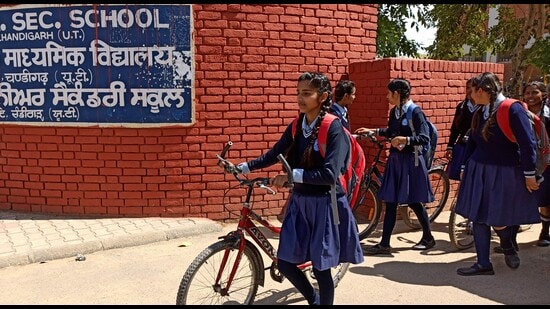
As per the Central Board of Secondary Education (CBSE) norms, pupil-to-teacher ratio (PTR) should not exceed 30:1 in schools. PTR is the number of students who attend a school, divided by the number of teachers in the institution. For example, a PTR of 10:1 indicates that there are 10 students for every one teacher. Higher the PTR, more the number of students per teacher.
1 PGT for 179 students at GMSSS-Kaimbwala
As per the data, it was found that out of 42 government model senior secondary schools in the city, distribution of teachers in them is disproportionate. Mostly, the schools from the city’s peripheral areas have a poor PTR (less number of teachers). Among these, GMSSS-Behlana, has a PTR of 92:1, while GMSSS 37-B and GMSSS-Dhanas have 71:1 and 68:1, respectively. Out of the 42 UT schools, 11 institutions have one teacher for more than 50 students.
At the Government Model Senior Secondary School (GMSSS), Kaimbwala, there is only one postgraduate teacher (PGT) for 179 students of Classes 11 and 12. Comparatively, every 17 students at GMSSS, Sector 56, have one PGT. Both the schools have only humanities stream.
Hiring to be over by Jan 30: Director school education
A teacher, on the condition of anonymity, said in GMSSS-Kaimbwala only Hindi is taught by a PGT. All other subjects, like English, history, political science and physical education are taught by trained graduate teachers (TGTs) to Classes 11 and 12. The teacher added that the situation has remained the same since 2022.
The principal of GMSSS-Behlana said every month the list of required teaching posts is sent to the department, which has assured them of getting them filled. Till then we are managing with what we have, the principal added. Unlike the periphery-area schools, the situation for other city schools is quite different. For instance, at the Government Girls Model Senior Secondary School (GGMSSS), Sector 18, there is one teacher for every 27 students, in GMSSS, Sector 33-D, the PTR is 25:1, with the Sector 27-D GMSSS standing at 26:1.
In 42 government senior secondary schools, the total strength of students studying in Classes 11 and 12 is 22,693, whereas the total number of teachers for them is only 570. Director school education Harsuhinder Pal Singh Brar said, “The recruitment is being completed by January 30 and we should be able to achieve our targets.” On being questioned about the disparity of teachers’ distribution in schools, Pal said it depends on the subject and can’t be measured on an overall basis.
President of UT Cadre Educational Employees Union, Swarn Singh Kamboj, said the disparity between distribution of teachers shows that the department is not paying attention towards the issue. Teachers should be transferred regularly but this is not being done, so mostly, teachers prefer city schools over periphery, he added. Chairman of Joint Action Committee of Teachers, Shivmurat Singh, said over the years many high schools have been converted to senior secondary schools but teaching posts have not been increased accordingly. Even after the current recruitment of 98 PGT posts, it is not going to fill in the vacuum. Arvind Rana, legal adviser of Joint Teachers Association, said teachers should be transferred as per schools’ requirements.
NEP, CBSE, recommend 30:1 PTR
As mentioned in the 2023-24 UDISE Plus report, both RTE and National Education Policy (NEP) 2020 envisage the right mix of teacher and students. The NEP recommends a 30:1 PTR ratio at all levels of the school education system, to have a reasonable level of interactive learning and achieve desired level of outcomes. Clause 5.4 of the CBSE Affiliation Bylaws 2018 also says the ratio should not exceed 30:1. As per rules, there must also be 1.5 teachers per section, excluding principal, physical education teacher and counsellor, to teach various subjects.


