
 E-Paper



Salim Ali census: 14% more waterfowl flocked to Sukhna for their winter sojourn this year
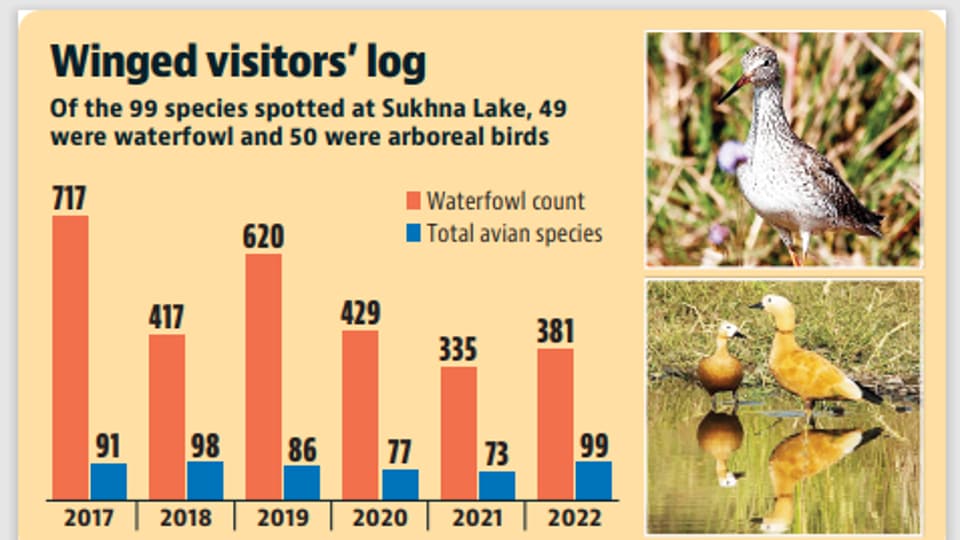
As many as 381 waterfowl were spotted on Sunday during the Chandigarh Bird Club’s annual avian census, against last year’s tally of 335, which was the lowest since 2017


Sukhna Lake saw a 14% increase in migratory waterfowl this year, the annual Salim Ali Bird Species Count and Waterfowl Census revealed on Monday.
As many as 381 waterfowl were spotted on Sunday during the Chandigarh Bird Club’s annual avian census, against last year’s tally of 335, which was the lowest since 2017. The census was also conducted at Ghaggar Dam, Siswan Dam, Jayanti Dam, Kaushalya Dam, Mirzapur Dam and Motemajra. However, this year, the census was not carried out at Dhanas Lake, which had also hosted 335 waterfowl last year.
As many as 99 avian species were spotted across the Inter State Chandigarh Region (ISCR), the highest since 2017. Of the total species spotted, 49 were waterfowl, while 50 species were arboreal birds.
The total waterfowl count in ISCR was 1,200. At 381, the highest number of waterfowl were spotted at Sukhna Lake, followed by 318 at Mirzapur Dam, 230 at Motemajra, 110 at Jayanti Dam, 82 at Siswan Dam, 53 at Ghaggar Dam, while only 26 birds were spotted at Kaushalya Dam.
Though more winged visitors flocked to Sukhna Lake as compared to last year, the count remained low. In 2017, the first year of the census, 717 water fowl had visited the lake, the number had dropped to 417 in 2018. A jump was again witnessed in 2019 with 620 migratory birds visiting the lake, but the figure again dropped to 429 in the subsequent year.
Asked about the fluctuating bird count, Chandigarh Bird Club president Mitenderpal Singh Sekhon said, “The number of birds arriving at the lakes and dams keeps on fluctuating on a daily basis. More migratory birds were spotted five days ago as compared to the day of the census.”
The survey, which is carried out in memory of Dr Salim Ali, the Birdman of India, is carried out on the Sunday closest to his birth anniversary, which falls on November 12.
On the decline in bird count over the years, Sekhon said, “The count is low as compared to previous years because winters have been starting early. The mountains just received fresh snowfall a few days back and most of the birds are in the process of migrating towards their winter destinations. More birds will arrive at the lakes and dams in February, 2023.”
Asserting that the population of migratory birds will continue to improve till December-end, UT chief conservator of forests Debendra Dalai said, “Winters have just started and more birds will be visiting the city over the coming days.”
The bird club also conducts a census in February to determine how many migratory birds visited the city over the whole season.
Of the 99 bird species spotted this year, the Ruddy Shelduck (Brahminy Duck) was the most common with 295 birds spotted across the ISCR. The club members also spotted 117 Indian Spot-Billed Ducks, and 102 Eurasian Moorhens.
In the rare category, only one bird each of the Great Egret, White-tailed Lapwing, Black-headed Gull, Eurasian Coot and Little Grebe were spotted.


