
 E-Paper



Sanawar school: Upholding a legacy of 175 years
The Lawrence School, Sanawar, which counts world leaders, top businessmen, distinguished army officers and renowned artistes among its alumni, celebrates its dodransbicentennial this year


Ensconced in the salubrious ambience of the Shimla hills, The Lawrence School, Sanawar, has the distinction of being the oldest co-educational residential school in India. It is indeed a showpiece of fine stone and wood period architecture, spread across 139 acres set in a sylvan environ.
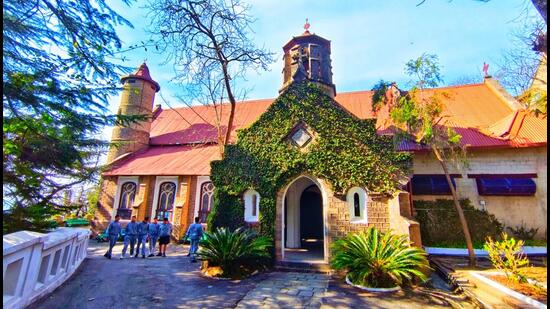
Founded in 1847, Sanawar which is nestled atop a hilltop thickly forested with oak, pine and cedar, has now become a historical landmark in its own right. With its characteristic red roofs, visible on the horizon for miles in all directions, the estate is a veritable wonderland of rambling paths, trees and trails all teeming with birdlife. A perfect haven for generations of students to thrive in its idyllic environment.
Sanawar, which is the proud alma mater of many eminent men and women who have made their mark across the world, prides itself on imparting an education second to none that is built upon a foundation of service to society and the trust of generations. It is pertinent to know the story of this noble institution as we celebrate its dodransbicentennial (175 years) this year.
A walk down memory lane
Its inception took place on April 15, 1847, when a group of 14 boys and girls camped at the top of this ridge in the foothills of the Himalayas. Thus, the institution, known as Sanawar today, came into being as The Lawrence Asylum. The genesis of Sanawar is a combination of charity, benevolence, philanthropy and selfless service.
Sanawar owes its very existence to the generosity of its founder Sir Henry Lawrence. It is said that Sir Lawrence always gave away one-third of his income. The school from its foundation till the independence of India in 1947 was primarily meant for wards and orphans of European soldiers. Post-independence, it opened its doors for admission to Indians.
Students at Sanawar led a Spartan life as it is the high character and the exemplary life of the founder that embodies the spirit of Sanawar. Instead of living in a European station, Sir Lawrence pitched his tents among the people, under their trees, and their streams, for eight months a year. A shift from the military to the civil took place when he was appointed assistant revenue surveyor in the north-west provinces. In these endeavors
, his innate personality traits found expression, that would endear him to the local people.
Tumult in Punjab
The events taking place in the Punjab were to have a lasting effect not only on the life of Sir Lawrence, but would also irrevocably impact the region. After the death of Maharaja Ranjit Singh in 1839, the whole of Punjab descended into chaos and disorder. The Battle of Sobraon on February 10, 1846, was a turning point in the fortunes of the British as well as the Sikhs. The First Anglo Sikh War (1845-1846) resulted in a Sikh Council of Regency in the name of the infant, Duleep Singh. Lieutenant Colonel Henry Lawrence was appointed as the British resident. This had a huge impact not only on the fortunes of the British Empire but also on the trajectory of the life of Sir Lawrence. This meant that in the aftermath of the tumult not only did he administer the whole of Punjab but the Frontier as well.
The wars resulted in many casualties and the orphans led a miserable existence in the heat and dust of the plains. The barracks were no place for children to grow up. They endured many a hardship in the crowded and unsuitable environment that they were in until they were given Asylum in the institution founded by Sir Lawrence. From its foundation, the financial burden of the School was borne by Sir Lawrence until his death in 1857.
Military tradition
The institution has always displayed a humane but martial spirit. In 1853, Sanawar was presented with the King’s Colours – one of only six schools and colleges ever to be hounored in the entire British Empire. Sanawar has the distinction of having held its colours for the longest unbroken period. The tradition of military training at The Lawrence School, Sanawar, had always been strong and was of such a high standard that several contingents of boys enlisted from the school to the battle fields of the first World War. In appreciation of this, the school was redesignated in 1920 from Lawrence Military Asylum to the Lawrence Royal Military School and in 1922, the Prince of Wales personally presented the school with new colours. It is a ‘never-give-in’ spirit coupled with the highest integrity that marks and sets apart a Sanawarian from the rest of the crowd. Old Sanawarians continued to serve the country during all major wars from 1947 onwards. Second Lieutenant Arun Khetarpal, who was awarded the nation’s highest gallantry award, the Param Vir Chakra, was an alum of the school.
The school seeks to turn-out young men and women with a well-developed personality prepared to engage with and contribute to the community at a regional, national and global level.
himmatdhillon@yahoo.com
(The writer is headmaster, The Lawrence School, Sanawar. Views expressed are personal.)


